



Investigation of an isolated case of human Crimean–Congo hemorrhagic fever in Central Uganda, 2015☆
Supporting Files

-
3 2018 ; 3-2018
-
Available in CDC Stacks on 2018-04-10T00:00:00Z
File Language:
English
Details
-
Alternative Title:Int J Infect Dis
-
Personal Author:Balinandi, Stephen ; Patel, Ketan ; Ojwang, Joseph ; Kyondo, Jackson ; Mulei, Sophia ; Tumusiime, Alex ; Lubwama, Bernard ; Nyakarahuka, Luke ; Klena, John D. ; Lutwama, Julius ; Ströher, Ute ; Nichol, Stuart T. ; Shoemaker, Trevor R.
-
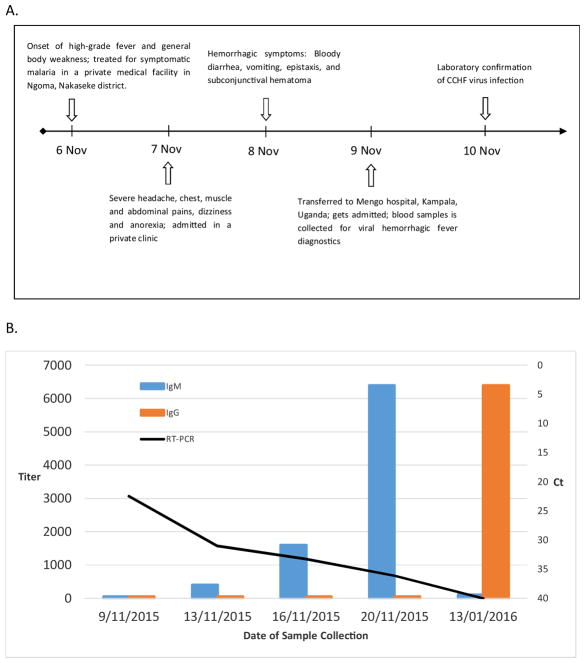
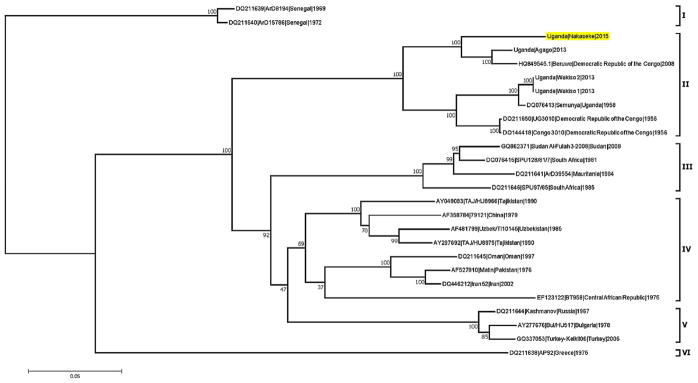
Description:Background ; Crimean–Congo hemorrhagic fever (CCHF) is the most geographically widespread tick-borne viral infection. Outbreaks of CCHF in sub-Saharan Africa are largely undetected and thus under-reported. On November 9, 2015, the National Viral Hemorrhagic Fever Laboratory at the Uganda Virus Research Institute received an alert for a suspect VHF case in a 33-year-old male who presented with VHF compatible signs and symptoms at Mengo Hospital in Kampala. ; Methods ; A blood sample from the suspect patient was tested by RT-PCR for CCHF and found positive. Serological testing on sequential blood specimens collected from this patient showed increasing anti-CCHFV IgM antibody titers, confirming recent infection. Repeat sampling of the confirmed case post recovery showed high titers for anti-CCHFV-specific IgG. An epidemiological outbreak investigation was initiated following the initial RT-PCR positive detection to identify any additional suspect cases. ; Results ; Only a single acute case of CCHF was detected from this outbreak. No additional acute CCHF cases were identified following field investigations. Environmental investigations collected 53 tick samples, with only 1, a Boophilus decoloratus, having detectable CCHFV RNA by RT-PCR. Full-length genomic sequencing on a viral isolate from the index human case showed the virus to be related to the DRC (Africa 2) lineage. ; Conclusions ; This is the fourth confirmed CCHF outbreak in Uganda within 2 years after more than 50 years of no reported human CCHF cases in this country. Our investigations reaffirm the endemicity of CCHFV in Uganda, and show that exposure to ticks poses a significant risk for human infection. These findings also reflect the importance of having an established national VHF surveillance system and diagnostic capacity in a developing country like Uganda, in order to identify the first cases of VHF outbreaks and rapidly respond to reduce secondary cases. Additional efforts should focus on implementing effective tick control methods and investigating the circulation of CCHFV throughout the country.
-
Subjects:
- Article
- Crimean–Congo hemorrhagic fever
- Uganda
- Outbreak
- CCHF
- Adult
- Animals
- Antibodies, Anti-Idiotypic
- Antibodies, Viral
- Chlorocebus aethiops
- DNA Copy Number Variations
- Disease Outbreaks
- Hemorrhagic Fever Virus, Crimean-Congo
- Hemorrhagic Fever, Crimean
- Humans
- Male
- Phylogeny
- RNA, Viral
- Sequence Analysis, RNA
- Ticks
- Vero Cells
-
Source:Int J Infect Dis. 68:88-93
-
Pubmed ID:29382607
-
Pubmed Central ID:PMC5893389
-
Document Type:
-
Funding:
-
Volume:68
-
Download URL:
-
File Type:
 [PDF - 791.27 KB]
 -
Collection(s):
-
Main Document Checksum:urn:sha256:2a823d403346542ae6060ff35ef565168a9b5e20f30a604ba807a894edec0cc2
Supporting Files


File Language:
English
 Was this page helpful?
 Found an issue?


CDC STACKS serves as an archival repository of CDC-published products including
scientific findings, journal articles, guidelines, recommendations, or other public health information authored or
co-authored by CDC or funded partners.
As a repository, CDC STACKS retains documents in their original published format to ensure public access to scientific information.
As a repository, CDC STACKS retains documents in their original published format to ensure public access to scientific information.
You May Also Like
COLLECTION
CDC Public Access