


Nitrogen Dioxide Exposure in School Classrooms of Inner-City Children with Asthma
Supporting Files

-
October 05 2017
-
File Language:
English
Details
-
Alternative Title:J Allergy Clin Immunol
-
Personal Author:
-
Description:Background
Ambient and home exposure to nitrogen dioxide (NO2) causes asthma symptoms and decreased lung function in children with asthma. Little is known about the health effects of school classroom pollution exposure.
Objective
We aimed to determine the effect of indoor classroom NO2 on lung function and symptoms of inner-city schoolchildren with asthma.
Methods
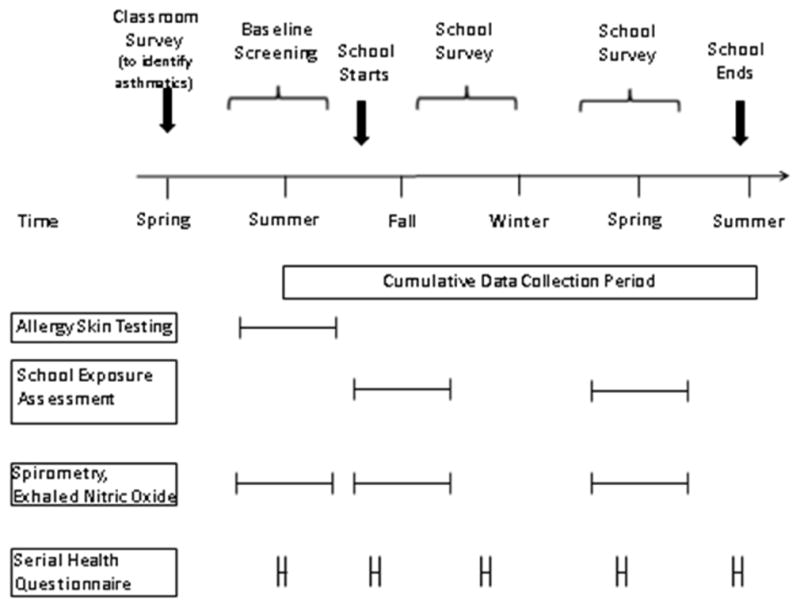
Children enrolled in the School Inner City Asthma Study were followed for one academic year. Subjects performed spirometry and fractional exhaled nitric oxide (FeNO) twice during the school year, at school. Classroom NO2 was collected by passive sampling for 1 week periods, twice per year coinciding with lung function testing. Generalized estimating equation models assessed lung function and symptom relationships with the temporally nearest classroom NO2 level.
Results
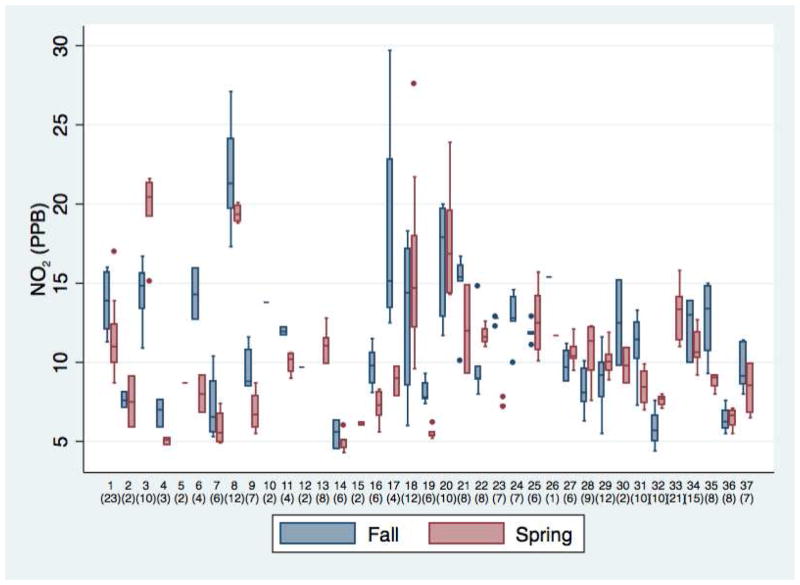
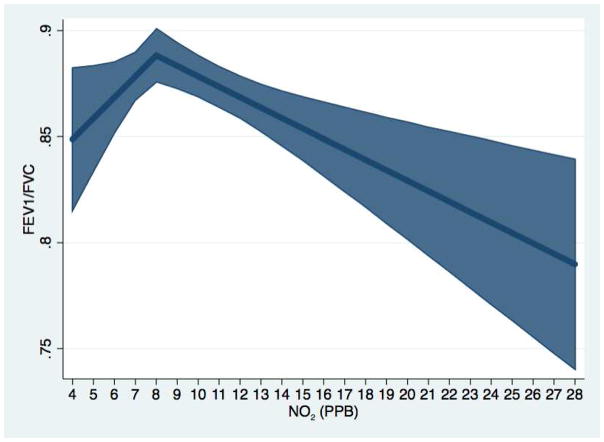
NO2 mean values were 11.1ppb (range 4.3 – 29.7ppb). In total, exposure data was available for 296 subjects; 188 with complete spirometry data. Above a threshold of 8ppb NO2, and after adjusting for race and season (spirometry standardized by age, height, and gender), NO2 was highly associated with airflow obstruction such that each 10ppb rise in NO2 was associated with a 5% decline in FEV1/FVC (β: −0.05, 95% confidence interval (CI) [−0.08, −0.02], p=0.01). FEF25-75% predicted was also inversely associated with higher NO2 exposure (β: −22.8, 95%CI [−36.0, −9.7], p=0.01). There was no significant association of NO2 with FEV1% predicted, FeNO or asthma symptoms. Additionally, there was no effect modification of atopy on lung function or symptom outcomes.
Conclusion
In children with asthma, indoor classroom NO2 may be associated with increased airflow obstruction.
-
Subjects:
-
Source:J Allergy Clin Immunol. 141(6):2249-2255.e2
-
Pubmed ID:28988796
-
Pubmed Central ID:PMC5886827
-
Document Type:
-
Funding:U01 AI110397/AI/NIAID NIH HHS/United States ; R01 AI073964/AI/NIAID NIH HHS/United States ; P01 ES009825/ES/NIEHS NIH HHS/United States ; R01 HL137192/HL/NHLBI NIH HHS/United States ; K23 AI104780/AI/NIAID NIH HHS/United States ; P30 ES000002/ES/NIEHS NIH HHS/United States ; U61 TS000237/TS/ATSDR CDC HHS/United States ; K23 AI106945/AI/NIAID NIH HHS/United States ; L40 AI107923/AI/NIAID NIH HHS/United States ; U10 HL098102/HL/NHLBI NIH HHS/United States ; U01 AI126614/AI/NIAID NIH HHS/United States ; UL1 TR001102/TR/NCATS NIH HHS/United States ; K23 ES023700/ES/NIEHS NIH HHS/United States ; K24 AI106822/AI/NIAID NIH HHS/United States
-
Volume:141
-
Issue:6
-
Collection(s):
-
Main Document Checksum:urn:sha256:ea1f9745e28b1de9e722f12c46fb064a1fc731e468d7649827398d92ffb77f26
-
Download URL:
-
File Type:
 [PDF
- 651.57 KB
]
[PDF
- 651.57 KB
]
Supporting Files


File Language:
English
ON THIS PAGE

CDC STACKS serves as an archival repository of CDC-published products including
scientific findings,
journal articles, guidelines, recommendations, or other public health information authored or
co-authored by CDC or funded partners.
As a repository, CDC STACKS retains documents in their original published format to ensure public access to scientific information.
As a repository, CDC STACKS retains documents in their original published format to ensure public access to scientific information.
You May Also Like
COLLECTION
CDC Public Access