


Community-based mass treatment with azithromycin for the elimination of yaws in Ghana—Results of a pilot study
Supporting Files
Public Domain

-
Mar 22 2018
-
File Language:
English
Details
-
Alternative Title:PLoS Negl Trop Dis
-
Personal Author:Abdulai, Abdul Aziz ; Agana-Nsiire, Patrick ; Biney, Frank ; Kwakye-Maclean, Cynthia ; Kyei-Faried, Sardick ; Amponsa-Achiano, Kwame ; Simpson, Shirley Victoria ; Bonsu, George ; Ohene, Sally-Ann ; Ampofo, William Kwabena ; Adu-Sarkodie, Yaw ; Addo, Kennedy Kwasi ; Chi, Kai-Hua ; Danavall, Damien ; Chen, Cheng Y. ; Pillay, Allan ; Sanz, Sergi ; Tun, Ye ; Mitjà, Oriol ; Asiedu, Kingsley Bampoe ; Ballard, Ronald C.
-
Description:Introduction
The WHO yaws eradication strategy consists of one round of total community treatment (TCT) of single-dose azithromycin with coverage of > 90%.The efficacy of the strategy to reduce the levels on infection has been demonstrated previously in isolated island communities in the Pacific region. We aimed to determine the efficacy of a single round of TCT with azithromycin to achieve a decrease in yaws prevalence in communities that are endemic for yaws and surrounded by other yaws-endemic areas.
Methods
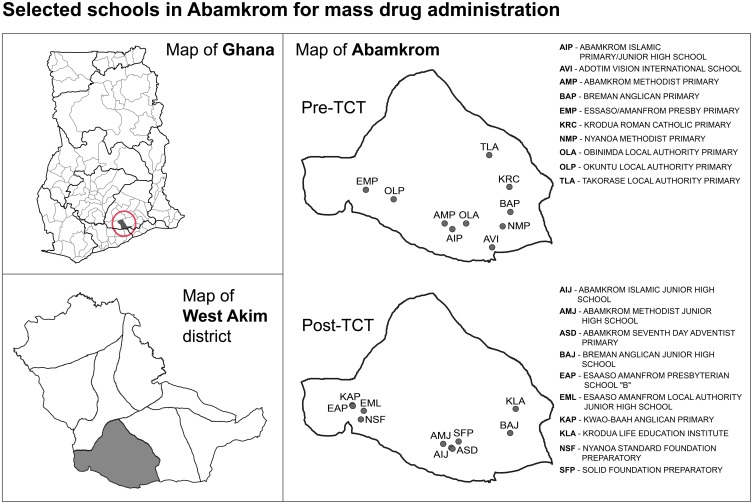
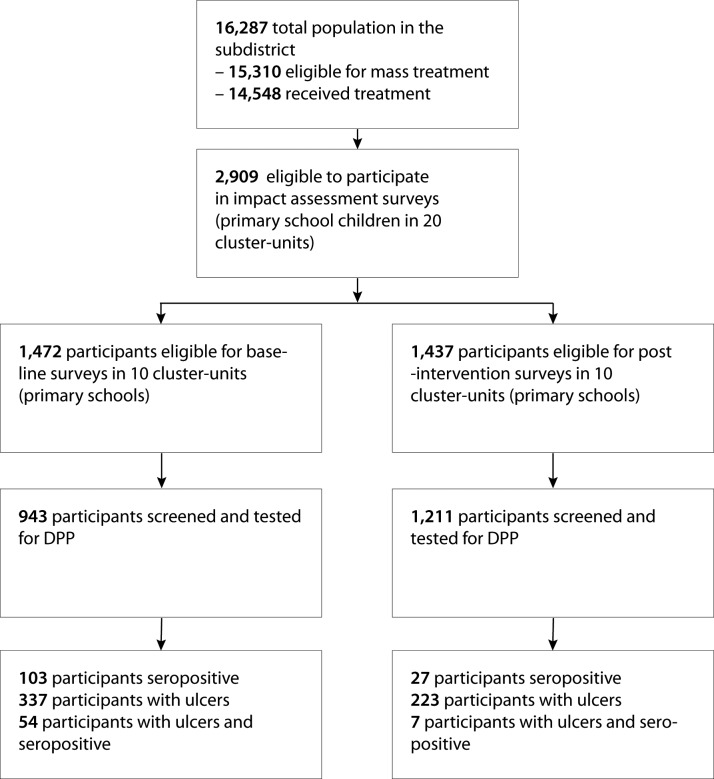
Surveys for yaws seroprevalence and prevalence of skin lesions were conducted among schoolchildren aged 5–15 years before and one year after the TCT intervention in the Abamkrom sub-district of Ghana. We used a cluster design with the schools as the primary sampling unit. Among 20 eligible primary schools in the sub district, 10 were assigned to the baseline survey and 10 to the post-TCT survey. The field teams conducted a physical examination for skin lesions and a dual point-of-care immunoassay for non-treponemal and treponemal antibodies of all children present at the time of the visit. We also undertook surveys with non-probabilistic sampling to collect lesion swabs for etiology and macrolide resistance assessment.
Results
At baseline 14,548 (89%) of 16,287 population in the sub-district received treatment during TCT. Following one round of TCT, the prevalence of dual seropositivity among all children decreased from 10.9% (103/943) pre-TCT to 2.2% (27/1211) post-TCT (OR 0.19; 95%CI 0.09–0.37). The prevalence of serologically confirmed skin lesions consistent with active yaws was reduced from 5.7% (54/943) pre-TCT to 0.6% (7/1211) post-TCT (OR 0.10; 95% CI 0.25–0.35). No evidence of resistance to macrolides against Treponema pallidum subsp. pertenue was seen.
Discussion
A single round of high coverage TCT with azithromycin in a yaws affected sub-district adjoining other endemic areas is effective in reducing the prevalence of seropositive children and the prevalence of early skin lesions consistent with yaws one year following the intervention. These results suggest that national yaws eradication programmes may plan the gradual expansion of mass treatment interventions without high short-term risk of reintroduction of infection from contiguous untreated endemic areas.
-
Subjects:
-
Source:PLoS Negl Trop Dis. 12(3).
-
Pubmed ID:29566044
-
Pubmed Central ID:PMC5863939
-
Document Type:
-
Name as Subject:
-
Place as Subject:
-
Volume:12
-
Issue:3
-
Collection(s):
-
Main Document Checksum:urn:sha256:a0b860cbfbc152377a05876f8217da0d870e5901d8d3e9a4c13d8a209cb9e06e
-
Download URL:
-
File Type:
 [PDF
- 2.40 MB
]
[PDF
- 2.40 MB
]
Supporting Files


File Language:
English
ON THIS PAGE




CDC STACKS serves as an archival repository of CDC-published products including
scientific findings,
journal articles, guidelines, recommendations, or other public health information authored or
co-authored by CDC or funded partners.
As a repository, CDC STACKS retains documents in their original published format to ensure public access to scientific information.
As a repository, CDC STACKS retains documents in their original published format to ensure public access to scientific information.
You May Also Like
COLLECTION
CDC Public Access