



Trends in Mortality Among Females in the United States, 1900–2010: Progress and Challenges
Supporting Files

-
Mar 08 2018
File Language:
English
Details
-
Journal Article:Preventing Chronic Disease (PCD)
-
Personal Author:
-
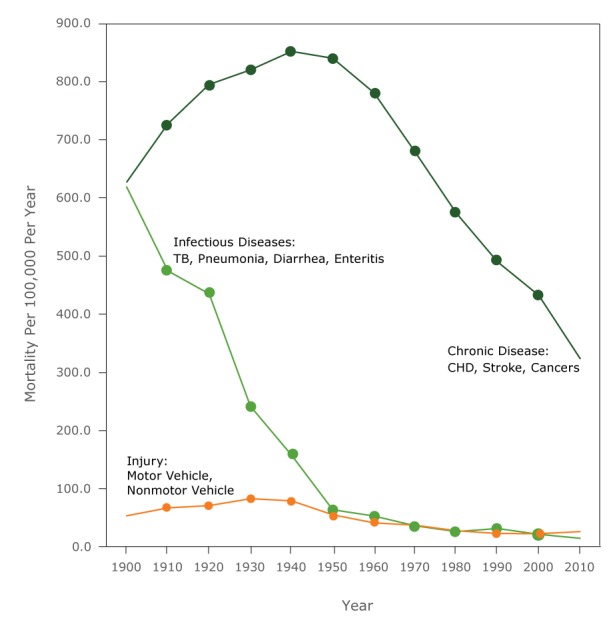
Description:Introduction ; We analyzed trends in US female mortality rates by decade from 1900 through 2010, assessed age and racial differences, and proposed explanations and considered implications. ; Methods ; We conducted a descriptive study of trends in mortality rates from major causes of death for females in the United States from 1900 through 2010. We analyzed all-cause unadjusted death rates (UDRs) for males and females and for white and nonwhite males and females from 1900 through 2010. Data for blacks, distinct from other nonwhites, were available beginning in 1970 and are reported for this and following decades. We also computed age-adjusted all-cause death rates (AADRs) by the direct method using age-specific death rates and the 2000 US standard population. Data for the analysis of decadal trends in mortality rates were obtained from yearly tabulations of causes of death from published compilations and from public use computer data files. ; Results ; In 1900, UDRs and AADRs were higher for nonwhites than whites and decreased more rapidly for nonwhite females than for white females. Reductions were highest among younger females and lowest among older females. Rates for infectious diseases decreased the most. AADRs for heart disease increased 96.5% in the first 5 decades, then declined by 70.6%. AADRs for cancer rose, then decreased. Stroke decreased steadily. Unintentional motor vehicle injury AADRs increased, leveled off, then decreased. Differences between white and nonwhite female all-cause AADRs almost disappeared during the study period (5.4 per 100,000); differences in white and black AADRs remained high (121.7 per 100,000). ; Conclusion ; Improvements in social and environmental determinants of health probably account for decreased mortality rates among females in the early 20th century, partially offset by increased smoking. In the second half of the century, other public health and clinical measures contributed to reductions. The persistent prevalence of risk behaviors and underuse of preventive and medical services indicate opportunities for increased female longevity, particularly in racial minority populations.
-
Subjects:
-
Source:Prev Chronic Dis. 15.
-
DOI:
-
ISSN:1545-1151
-
Pubmed ID:29522701
-
Pubmed Central ID:PMC5858181
-
Document Type:
-
Funding:
-
Place as Subject:
-
Location:
-
Volume:15
-
Download URL:
-
File Type:
 [PDF - 781.95 KB]
 -
Collection(s):
-
Main Document Checksum:urn:sha-512:d2e6f1334b25167be5d3f3d222404f4b3e7410c31c8ba237d518de959eb7da41242af96bd551d5b86a3111edc2e1b99926f2df3003687849b495e3665ad11d7a
Supporting Files

Related Documents


File Language:
English
 Was this page helpful?
 Found an issue?


CDC STACKS serves as an archival repository of CDC-published products including
scientific findings, journal articles, guidelines, recommendations, or other public health information authored or
co-authored by CDC or funded partners.
As a repository, CDC STACKS retains documents in their original published format to ensure public access to scientific information.
As a repository, CDC STACKS retains documents in their original published format to ensure public access to scientific information.
You May Also Like
COLLECTION
Preventing Chronic Disease