


Breast Cancer Screening Among Women with Medicaid, 2006–2008: a Multilevel Analysis
Supporting Files

-
Jun 10 2016
-
File Language:
English
Details
-
Alternative Title:J Racial Ethn Health Disparities
-
Personal Author:
-
Description:Introduction
Nationally, about one third of women with breast cancer (BC) are diagnosed at late stage, which might be reduced with greater utilization of BC screening. The purpose of this paper is to examine the predictors of BC mammography use among women with Medicaid, and differences among Medicaid beneficiaries in their propensity to use mammography.
Methods
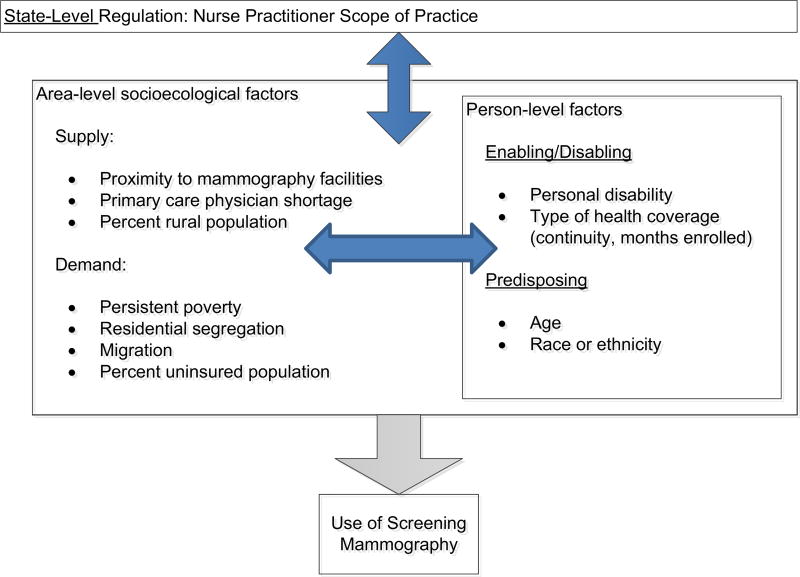
The sample included 2,450,527 women drawn from both fee-for-service and managed care Medicaid claims from 25 states, during 2006–2008. The authors used multilevel modeling of predictors at person, county, and state levels of influence and examined traditional factors affecting access and the expanded scope of practice allowed for the nurse practitioner (NP) in some states to provide primary care independent of physician oversight.
Results
Black [OR = 0.87; 95 % CI (0.87–0.88)] and American Indian women [OR = 0.74; 95 % CI (0.71–0.76)] had lower odds ratio of mammography use than white women, while Hispanic [OR = 1.06; 95 % CI (1.05–1.07)] had higher odds ratio of mammography use than white women. Living in counties with higher Hispanic residential segregation [OR = 1.16; 95 % CI (1.10–1.23)] was associated with a higher odds ratio of mammography use compared to areas with low Hispanic residential segregation, whereas living among more segregated black [OR = 0.78; 95 % CI (0.75–0.81)] or Asian [OR = 0.19; 95 % CI (0.17–0.21)] communities had lower odds ratio compared to areas with low segregation. Holding constant statistically the perceived shortage of MDs, which was associated with significantly lower mammography use, the NP regulatory variable [OR = 1.03; 95 % CI (1.01–1.07)] enhanced the odds ratio of mammography use among women in the six states with expanded scope of practice, compared with women residing in 19 more restrictive states.
Conclusions
Racial and ethnic disparities exist in the use of mammography among Medicaid-insured women. More expansive NP practice privileges in states are associated with higher utilization, and may help reduce rural disparities.
-
Subjects:
-
Source:J Racial Ethn Health Disparities. 4(3):446-454.
-
Pubmed ID:27287274
-
Pubmed Central ID:PMC5863532
-
Document Type:
-
Funding:
-
Place as Subject:
-
Volume:4
-
Issue:3
-
Collection(s):
-
Main Document Checksum:urn:sha256:4e3741f156a2a0a38ea08544769397668382fb25f51de88f3f56164af4006e8d
-
Download URL:
-
File Type:
 [PDF
- 341.81 KB
]
[PDF
- 341.81 KB
]
Supporting Files


File Language:
English
ON THIS PAGE

CDC STACKS serves as an archival repository of CDC-published products including
scientific findings,
journal articles, guidelines, recommendations, or other public health information authored or
co-authored by CDC or funded partners.
As a repository, CDC STACKS retains documents in their original published format to ensure public access to scientific information.
As a repository, CDC STACKS retains documents in their original published format to ensure public access to scientific information.
You May Also Like
COLLECTION
CDC Public Access