


Outbreak of invasive infections from subtype emm26.3 group A Streptococcus among homeless adults—Anchorage, Alaska, 2016–2017
Supporting Files

-
Mar 19 2018
-
File Language:
English
Details
-
Alternative Title:Clin Infect Dis
-
Personal Author:
-
Description:Background
In 2016, we detected an outbreak of group A Streptococcus (GAS) invasive infections among the estimated 1000 persons experiencing homelessness (PEH) in Anchorage, Alaska. We characterized the outbreak and implemented a mass antibiotic intervention at homeless service facilities.
Methods
We identified cases through the Alaska GAS laboratory-based surveillance system. We conducted emm-typing, antimicrobial susceptibility testing, and whole genome sequencing (WGS) on all invasive isolates and compared medical record data of patients infected with emm26.3 and other emm types. In February 2017, we offered PEH at six facilities in Anchorage a single dose of 1 gram of azithromycin. We collected oropharyngeal and non-intact skin swabs on a subset of participants concurrent with the intervention and 4 weeks afterward.
Results
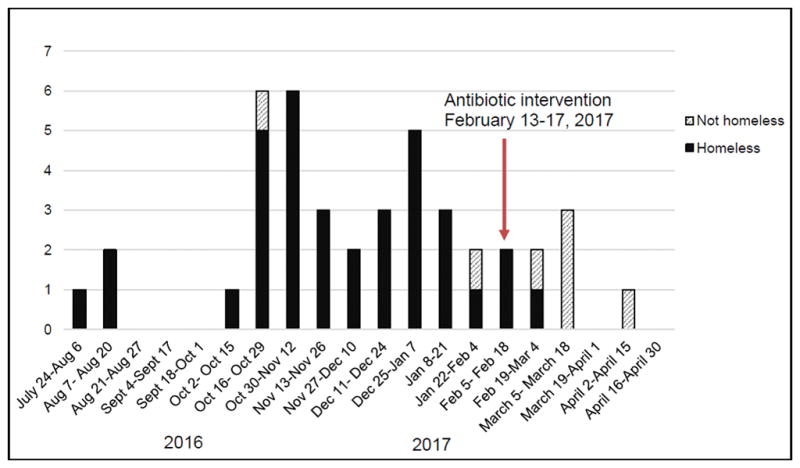
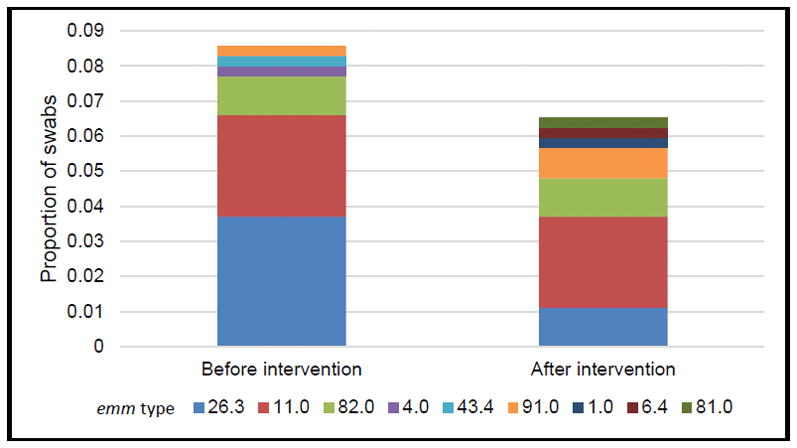
From July 2016–April 2017, we detected 42 invasive emm26.3 cases in Anchorage, 35 of which were in PEH. The emm26.3 isolates differed on average by only 2 single nucleotide polymorphisms. Compared to other emm types, infection with emm26.3 was associated with cellulitis (odds ratio [OR] 2.5, p=0.04) and necrotizing fasciitis (OR 4.4, p=0.02). We dispensed antibiotics to 391 PEH. Colonization with emm26.3 decreased from 4% of 277 at baseline to 1% of 287 at follow-up (p=0.05). Invasive GAS incidence decreased from 1.5 cases per 1000 PEH/week in the 6 weeks prior to the intervention to 0.2 cases per 1000 PEH/week in the 6 weeks after (p=0.01).
Conclusions
In an invasive GAS outbreak in PEH in Anchorage, mass antibiotic administration was temporally associated with reduced invasive disease cases and colonization prevalence.
-
Subjects:
-
Source:Clin Infect Dis. 66(7):1068-1074
-
Pubmed ID:29069346
-
Pubmed Central ID:PMC5862750
-
Document Type:
-
Funding:
-
Volume:66
-
Issue:7
-
Collection(s):
-
Main Document Checksum:urn:sha256:0adfe1d43c43db78b7aba12c42372ef0af8ea7e4f386ed3559a0617f944fdd2e
-
Download URL:
-
File Type:
 [PDF
- 548.39 KB
]
[PDF
- 548.39 KB
]
Supporting Files


File Language:
English
ON THIS PAGE



CDC STACKS serves as an archival repository of CDC-published products including
scientific findings,
journal articles, guidelines, recommendations, or other public health information authored or
co-authored by CDC or funded partners.
As a repository, CDC STACKS retains documents in their original published format to ensure public access to scientific information.
As a repository, CDC STACKS retains documents in their original published format to ensure public access to scientific information.
You May Also Like
COLLECTION
CDC Public Access