


Masculine Discrepancy Stress, Emotion-Regulation Difficulties, and Intimate Partner Violence
Supporting Files

-
May 24 2016
-
File Language:
English
Details
-
Alternative Title:J Interpers Violence
-
Personal Author:
-
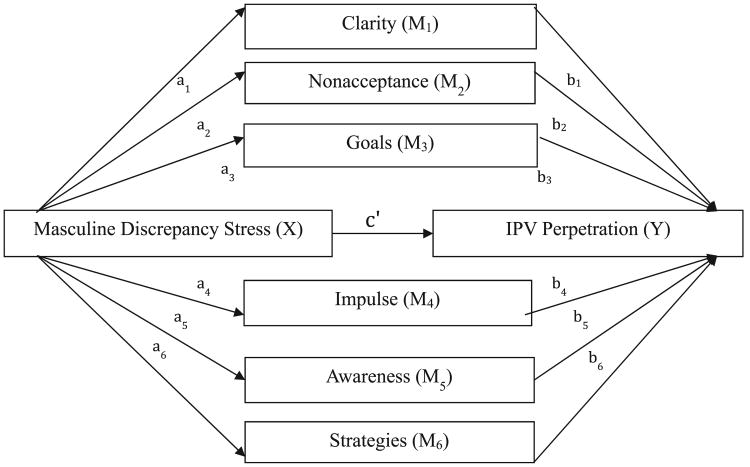
Description:Research suggests that masculine socialization processes contribute to the perpetration of intimate partner violence (IPV) by men. Although this research has traditionally focused on men who strongly adhere to traditional gender norms, men who negatively evaluate themselves as falling short of these norms (a construct termed masculine discrepancy stress) have proven to be at increased risk of IPV perpetration. Likewise, men experiencing problems with emotion regulation, a multidimensional construct reflecting difficulties in effectively experiencing and responding to emotional states, are also at risk of IPV perpetration. In the present research, we tested the hypothesis that the link between discrepancy stress and IPV perpetration is mediated via difficulties in emotion regulation. Three hundred fifty-seven men completed online surveys assessing their experience of discrepancy stress, emotion-regulation difficulties, and history of IPV perpetration. Results indicated that discrepancy-stressed men's use of physical IPV was fully mediated by emotion-regulation difficulties. In addition, emotion-regulation difficulties partially mediated the association between discrepancy stress and sexual IPV. Findings are discussed in terms of the potential utility of emotion-focused interventions for modifying men's experience and expression of discrepancy stress and reducing perpetration of IPV.
-
Subjects:
-
Source:J Interpers Violence.
-
Pubmed ID:27226013
-
Pubmed Central ID:PMC5861012
-
Document Type:
-
Funding:
-
Collection(s):
-
Main Document Checksum:urn:sha256:29e68af1433082cff508693410900a790b5a6865c4e8ac1777a8ea7191941ef9
-
Download URL:
-
File Type:
 [PDF
- 544.95 KB
]
[PDF
- 544.95 KB
]
Supporting Files


File Language:
English
ON THIS PAGE

CDC STACKS serves as an archival repository of CDC-published products including
scientific findings,
journal articles, guidelines, recommendations, or other public health information authored or
co-authored by CDC or funded partners.
As a repository, CDC STACKS retains documents in their original published format to ensure public access to scientific information.
As a repository, CDC STACKS retains documents in their original published format to ensure public access to scientific information.
You May Also Like
COLLECTION
CDC Public Access