


Behavioral and Mental Health Correlates of Youth Stalking Victimization
Supporting Files

-
12 2016
File Language:
English
Details
-
Alternative Title:Am J Prev Med
-
Personal Author:
-
Description:Introduction
Although recognized as a public health problem, little attention has been paid to the problem of stalking among youth. Latent profile analysis was used to identify latent groups of adolescent stalking victims and their behavioral and mental health correlates.
Methods
A cross-sectional sample of 1,236 youths were randomly selected from 13 schools stratified by community risk level (i.e., low, moderate, and high risk) and gender. Students completed surveys assessing behavioral indicators of stalking victimization, as well as substance use, sexual behavior, dating violence, and psychiatric symptoms. Data were collected in 2013 and data analyses were performed in 2015.
Results
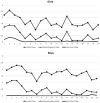
Analysis indicated the presence of a non-victim class, a minimal exposure class, and a victim class for boys and girls alike. Approximately 14% of girls and 13% of boys were in the stalking victim class. Adolescents in the victim class reported more symptoms of post-traumatic stress, mood disorder, and hopelessness, as well as more instances of alcohol use, binge drinking, and physical dating violence victimization. Girls in the victim class also reported engaging in sexting behaviors and oral sex with significantly more partners than their non-victim peers.
Conclusions
These findings provide valuable knowledge of the prevalence and pertinent health correlates of stalking victimization in adolescence. The data suggest a substantial proportion of adolescents are victims of stalking and are likewise at risk for a number of deleterious health outcomes. As such, this population merits further attention by prevention researchers and practitioners.
-
Subjects:
-
Source:Am J Prev Med. 51(6):1007-1014
-
Pubmed ID:27743623
-
Pubmed Central ID:PMC5860645
-
Document Type:
-
Funding:
-
Volume:51
-
Issue:6
-
Collection(s):
-
Main Document Checksum:urn:sha256:3f5d21fc2ef8faca306aed5769e665db0dcd1543fb5816064e34c850034080e5
-
Download URL:
-
File Type:
 [PDF
- 399.11 KB
]
[PDF
- 399.11 KB
]
Supporting Files


File Language:
English
ON THIS PAGE


CDC STACKS serves as an archival repository of CDC-published products including
scientific findings,
journal articles, guidelines, recommendations, or other public health information authored or
co-authored by CDC or funded partners.
As a repository, CDC STACKS retains documents in their original published format to ensure public access to scientific information.
As a repository, CDC STACKS retains documents in their original published format to ensure public access to scientific information.
You May Also Like
COLLECTION
CDC Public Access