


In Search of Teen Dating Violence Typologies
Supporting Files

-
Dec 09 2015
-
Details
-
Alternative Title:J Adolesc Health
-
Personal Author:
-
Description:Purpose
The goal of the present research was to identify distinct latent classes of adolescents that commit teen dating violence (TDV) and assess differences on demographic, behavioral, and attitudinal correlates.
Methods
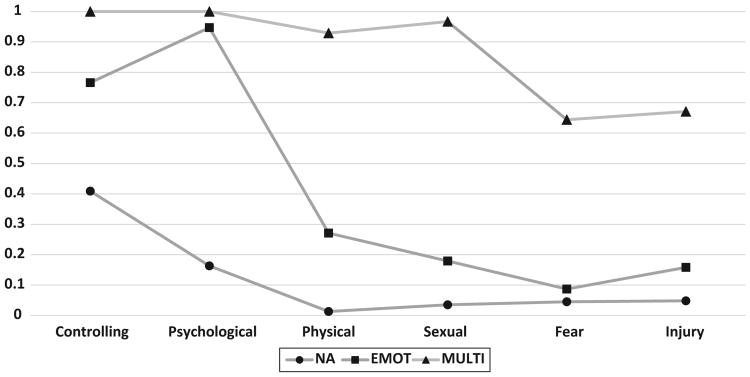
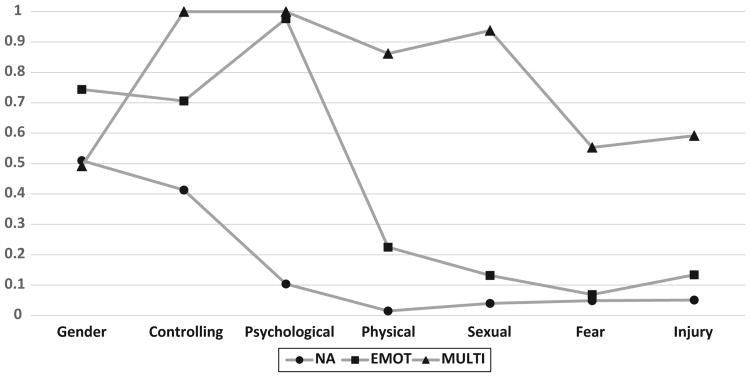
Boys and girls (N = 1,149; Mage = 14.3; Grades 6–12) with a history of violence exposure completed surveys assessing six indices of TDV in the preceding 3 months. Indices of TDV included controlling behaviors, psychological TDV, physical TDV, sexual TDV, fear/intimidation, and injury. In addition, adolescents provided demographic and dating history information and completed surveys assessing attitudes condoning violence, relationship skills and knowledge, and reactive/proactive aggression.
Results
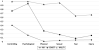
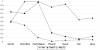
Latent class analysis indicated a three-class solution wherein the largest class of students was nonviolent on all indices (“nonaggressors”) and the smallest class of students demonstrated high probability of nearly all indices of TDV (“multiform aggressors”). In addition, a third class of “emotional aggressors” existed for which there was a high probability of controlling and psychological TDV but low likelihood of any other form of TDV. Multiform aggressors were differentiated from emotional and nonaggressors on the use of self-defense in dating relationships, attitudes condoning violence, and proactive aggression. Emotional aggressors were distinguished from nonaggressors on nearly all measured covariates.
Conclusions
Evidence indicates that different subgroups of adolescents engaging in TDV exist. In particular, a small group of youth engaging in multiple forms of TDV can be distinguished from a larger group of youth that commit acts of TDV restricted to emotional aggression (i.e., controlling and psychological) and most youth that do not engage in TDV.
-
Subjects:
-
Source:J Adolesc Health. 58(2):202-207.
-
Pubmed ID:26683984
-
Pubmed Central ID:PMC5860637
-
Document Type:
-
Funding:
-
Volume:58
-
Issue:2
-
Collection(s):
-
Main Document Checksum:urn:sha256:d392cae952d7341d5f4092e97a68cba56126e8c2faf53289b7bb74739e4d6ab2
-
Download URL:
-
File Type:
 [PDF
- 584.39 KB
]
[PDF
- 584.39 KB
]
Supporting Files


ON THIS PAGE

CDC STACKS serves as an archival repository of CDC-published products including
scientific findings,
journal articles, guidelines, recommendations, or other public health information authored or
co-authored by CDC or funded partners.
As a repository, CDC STACKS retains documents in their original published format to ensure public access to scientific information.
As a repository, CDC STACKS retains documents in their original published format to ensure public access to scientific information.
You May Also Like
COLLECTION
CDC Public Access