


Population-Based Cancer Survival in the United States: Data, Quality Control, and Statistical Methods
Supporting Files

-
Dec 15 2017
-
File Language:
English
Details
-
Alternative Title:Cancer
-
Personal Author:
-
Description:BACKGROUND
Robust comparisons of population-based cancer survival estimates require tight adherence to the study protocol, standardized quality control, appropriate life tables of background mortality, and centralized analysis. The CONCORD program established worldwide surveillance of population-based cancer survival in 2015, analyzing individual data on 26 million patients (including 10 million US patients) diagnosed between 1995 and 2009 with 1 of 10 common malignancies.
METHODS
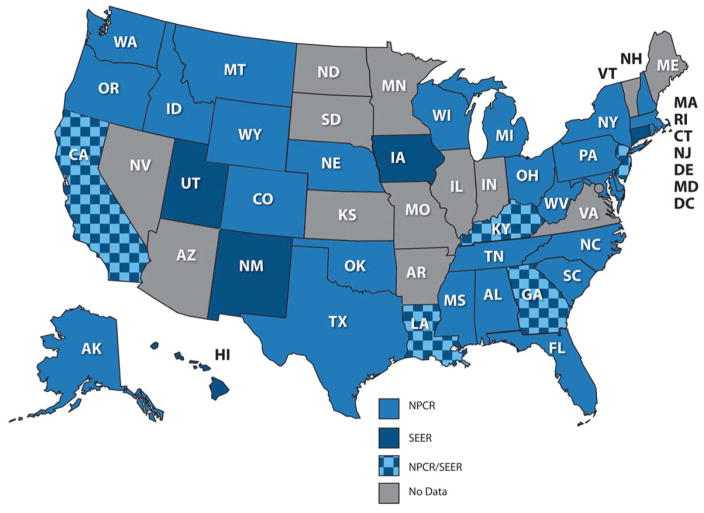
In this Cancer supplement, we analyzed data from 37 state cancer registries that participated in the second cycle of the CONCORD program (CONCORD-2), covering approximately 80% of the US population. Data quality checks were performed in 3 consecutive phases: protocol adherence, exclusions, and editorial checks. One-, 3-, and 5-year age-standardized net survival was estimated using the Pohar Perme estimator and state- and race-specific life tables of all-cause mortality for each year. The cohort approach was adopted for patients diagnosed between 2001 and 2003, and the complete approach for patients diagnosed between 2004 and 2009.
RESULTS
Articles in this supplement report population coverage, data quality indicators, and age-standardized 5-year net survival by state, race, and stage at diagnosis. Examples of tables, bar charts, and funnel plots are provided in this article.
CONCLUSIONS
Population-based cancer survival is a key measure of the overall effectiveness of services in providing equitable health care. The high quality of US cancer registry data, 80% population coverage, and use of an unbiased net survival estimator ensure that the survival trends reported in this supplement are robustly comparable by race and state. The results can be used by policymakers to identify and address inequities in cancer survival in each state and for the United States nationally.
-
Subjects:
-
Source:Cancer. 123(Suppl 24):4982-4993
-
Pubmed ID:29205302
-
Pubmed Central ID:PMC5851448
-
Document Type:
-
Funding:
-
Name as Subject:
-
Place as Subject:
-
Volume:123
-
Collection(s):
-
Main Document Checksum:urn:sha256:bc2edce919bd7787f5fe9d425208e278fe8037427cae48e0481734212d9cf03a
-
Download URL:
-
File Type:
 [PDF
- 641.48 KB
]
[PDF
- 641.48 KB
]
Supporting Files


File Language:
English
ON THIS PAGE



CDC STACKS serves as an archival repository of CDC-published products including
scientific findings,
journal articles, guidelines, recommendations, or other public health information authored or
co-authored by CDC or funded partners.
As a repository, CDC STACKS retains documents in their original published format to ensure public access to scientific information.
As a repository, CDC STACKS retains documents in their original published format to ensure public access to scientific information.
You May Also Like
COLLECTION
CDC Public Access