


Predicting Adolescent Dating Violence Perpetration
Supporting Files

-
Sep 2015
Details
-
Alternative Title:Am J Prev Med
-
Personal Author:
-
Description:Introduction
Exposure to adult intimate partner violence (IPV) places youth at risk for a range of outcomes, including perpetration of adolescent dating violence (ADV). However, there is variability in the effect of IPV exposure, as many youth who are exposed to IPV do not go on to exhibit problems. Thus, research is needed to examine contextual factors, such as parenting practices, to more fully explain heterogeneity in outcomes and better predict ADV perpetration. The current research draws from a multisite study to investigate the predictive power of IPV exposure and parenting practices on subsequent ADV perpetration.
Methods
Participants included 417 adolescents (48.7% female) drawn from middle schools in high-risk, urban communities. IPV exposure, two types of parenting practices (positive parenting/involvement and parental knowledge of their child’s dating), and five types of ADV perpetration (threatening behaviors, verbal/emotional abuse, relational abuse, physical abuse, and sexual abuse) were assessed at baseline (2012) and approximately 5 months later (2013) via adolescent report. Analyses (conducted in 2015) used a structural equation modeling approach.
Results
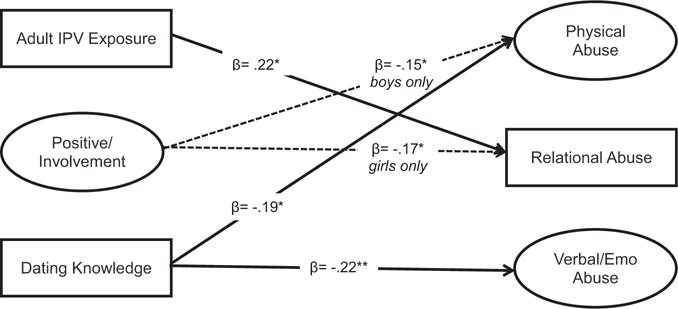
Structural models indicated that IPV exposure was positively related only to relational abuse at follow-up. Further, adolescents who reported parents having less knowledge of dating partners were more likely to report perpetrating two types of ADV (physical and verbal/emotional abuse) at follow-up. Analyses did not demonstrate any significant interaction effects.
Conclusions
Results fill a critical gap in understanding of important targets to prevent ADV in middle school and highlight the important role that parents may play in ADV prevention
-
Subjects:
-
Source:Am J Prev Med. 49(3):476-482.
-
Pubmed ID:26296446
-
Pubmed Central ID:PMC5839136
-
Document Type:
-
Funding:U88 CE002050/CE/NCIPC CDC HHS/United States ; CE002048/CE/NCIPC CDC HHS/United States ; CE002052/CE/NCIPC CDC HHS/United States ; U88 CE002054/CE/NCIPC CDC HHS/United States ; U88 CE002048/CE/NCIPC CDC HHS/United States ; U88 CE002052/CE/NCIPC CDC HHS/United States ; CE002054/CE/NCIPC CDC HHS/United States ; CC999999/Intramural CDC HHS/United States ; CE002050/CE/NCIPC CDC HHS/United States
-
Volume:49
-
Issue:3
-
Collection(s):
-
Main Document Checksum:urn:sha256:a2461933d07c3290555b7ba110d399991d9a80ebdb10844b8e1b942cef819362
-
Download URL:
-
File Type:
 [PDF
- 357.81 KB
]
[PDF
- 357.81 KB
]
Supporting Files


ON THIS PAGE

CDC STACKS serves as an archival repository of CDC-published products including
scientific findings,
journal articles, guidelines, recommendations, or other public health information authored or
co-authored by CDC or funded partners.
As a repository, CDC STACKS retains documents in their original published format to ensure public access to scientific information.
As a repository, CDC STACKS retains documents in their original published format to ensure public access to scientific information.
You May Also Like
COLLECTION
CDC Public Access