



IFCC Working Group Recommendations for Assessing Commutability Part 2: Using the Difference in Bias Between a Reference Material and Clinical Samples
Supporting Files

-
January 18 2018
-
Available in CDC Stacks on 2018-03-05T00:00:00Z
File Language:
English
Details
-
Alternative Title:Clin Chem
-
Personal Author:Nilsson, Göran ; Budd, Jeffrey R. ; Greenberg, Neil ; Delatour, Vincent ; Rej, Robert ; Panteghini, Mauro ; Ceriotti, Ferruccio ; Schimmel, Heinz ; Weykamp, Cas ; Keller, Thomas ; Camara, Johanna E. ; Burns, Chris ; Vesper, Hubert W. ; MacKenzie, Finlay ; Miller, W. Greg
-
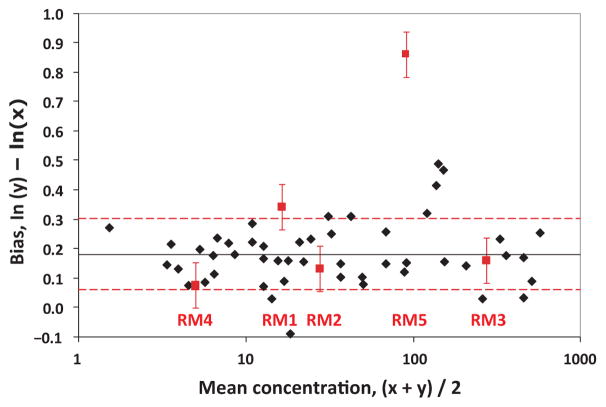
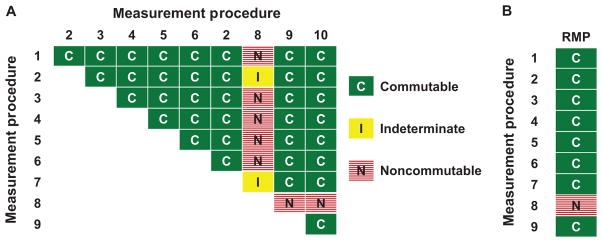
Description:A process is described to assess the commutability of a reference material (RM) intended for use as a calibrator, trueness control, or external quality assessment sample based on the difference in bias between an RM and clinical samples (CSs) measured using 2 different measurement procedures (MPs). This difference in bias is compared with a criterion based on a medically relevant difference between an RM and CS results to make a conclusion regarding commutability. When more than 2 MPs are included, the commutability is assessed pairwise for all combinations of 2 MPs. This approach allows the same criterion to be used for all combinations of MPs included in the assessment. The assessment is based on an error model that allows estimation of various random and systematic sources of error, including those from sample-specific effects of interfering substances. An advantage of this approach is that the difference in bias between an RM and the average bias of CSs at the concentration (i.e., amount of substance present or quantity value) of the RM is determined and its uncertainty estimated. An RM is considered fit for purpose for those MPs for which commutability is demonstrated.
-
Subjects:
-
Source:Clin Chem. 64(3):455-464
-
Pubmed ID:29348165
-
Pubmed Central ID:PMC5835923
-
Document Type:
-
Funding:
-
Volume:64
-
Issue:3
-
Download URL:
-
File Type:
 [PDF - 671.31 KB]
 -
Collection(s):
-
Main Document Checksum:urn:sha256:89f1a85585bbfa8ab5b7897a76071b9801ed2d4beb8e6a072a2481bb76458c25
Supporting Files


File Language:
English
 Was this page helpful?
 Found an issue?


CDC STACKS serves as an archival repository of CDC-published products including
scientific findings, journal articles, guidelines, recommendations, or other public health information authored or
co-authored by CDC or funded partners.
As a repository, CDC STACKS retains documents in their original published format to ensure public access to scientific information.
As a repository, CDC STACKS retains documents in their original published format to ensure public access to scientific information.
You May Also Like
COLLECTION
CDC Public Access