


Influenza viruses in Thailand: 7 years of sentinel surveillance data, 2004–2010
Supporting Files

-
Nov 10 2011
-
File Language:
English
Details
-
Alternative Title:Influenza Other Respir Viruses
-
Personal Author:
-
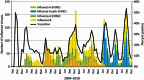
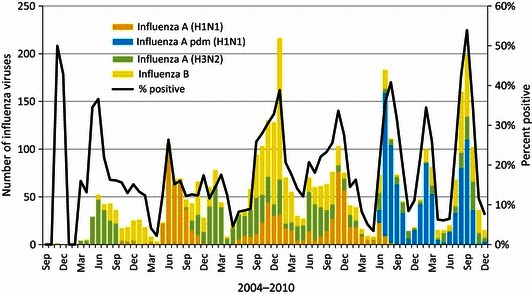
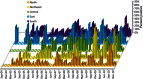
Description:The re-emergence of avian influenza A (H5N1) in 2004 and the pandemic of influenza A (H1N1) in 2009 highlight the need for routine surveillance systems to monitor influenza viruses, particularly in Southeast Asia where H5N1 is endemic in poultry. In 2004, the Thai National Institute of Health, in collaboration with the U.S. Centers for Disease Control and Prevention, established influenza sentinel surveillance throughout Thailand.|To review routine epidemiologic and virologic surveillance for influenza viruses for public health action.|Throat swabs from persons with influenza-like illness and severe acute respiratory illness were collected at 11 sentinel sites during 2004-2010. Influenza viruses were identified using the standard protocol for polymerase chain reaction. Viruses were cultured and identified by immunofluorescence assay; strains were identified by hemagglutination inhibition assay. Data were analyzed to describe frequency, seasonality, and distribution of circulating strains.|Of the 19,457 throat swabs, 3967 (20%) were positive for influenza viruses: 2663 (67%) were influenza A and able to be subtyped [21% H1N1, 25% H3N2, 21% pandemic (pdm) H1N1] and 1304 (33%) were influenza B. During 2009-2010, the surveillance system detected three waves of pdm H1N1. Influenza annually presents two peaks, a major peak during the rainy season (June-August) and a minor peak in winter (October-February).|These data suggest that March-April may be the most appropriate months for seasonal influenza vaccination in Thailand. This system provides a robust profile of the epidemiology of influenza viruses in Thailand and has proven useful for public health planning.
-
Subjects:
-
Source:Influenza Other Respir Viruses. 6(4):276-283.
-
Pubmed ID:22074057
-
Pubmed Central ID:PMC5779807
-
Document Type:
-
Funding:
-
Place as Subject:
-
Volume:6
-
Issue:4
-
Collection(s):
-
Main Document Checksum:urn:sha256:d827bfe3bc6b95f44820526e340fb17fbc0515f5bade7125b36ce676ba35c9f1
-
Download URL:
-
File Type:
 [PDF
- 1.28 MB
]
[PDF
- 1.28 MB
]
Supporting Files


File Language:
English
ON THIS PAGE



CDC STACKS serves as an archival repository of CDC-published products including
scientific findings,
journal articles, guidelines, recommendations, or other public health information authored or
co-authored by CDC or funded partners.
As a repository, CDC STACKS retains documents in their original published format to ensure public access to scientific information.
As a repository, CDC STACKS retains documents in their original published format to ensure public access to scientific information.
You May Also Like
COLLECTION
CDC Public Access