


Borrelia bissettiae sp. nov. and Borrelia californiensis sp. nov. prevail in diverse enzootic transmission cycles
Supporting Files

-
3 2016
-
File Language:
English
Details
-
Alternative Title:Int J Syst Evol Microbiol
-
Personal Author:
-
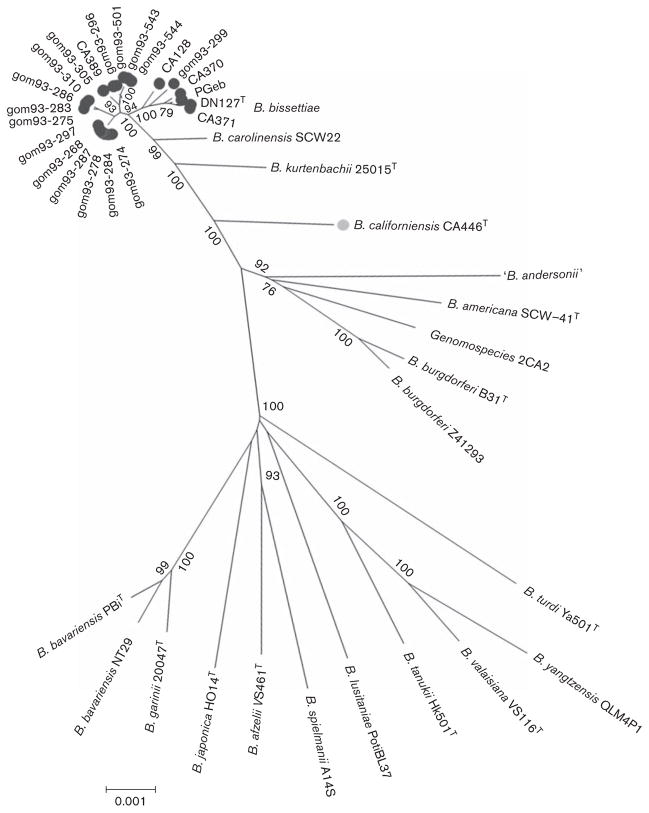
Description:Two species of the genus |, | sp. nov. and | sp. nov., were first described by Postic and co-workers on the basis of genetic analyses of several loci. Multilocus sequence analysis of eight housekeeping loci confirmed that these two | genomospecies are distinct members of the | complex. | sp. nov. was initially described in transmission cycles involving | wood rats and | ticks in California, and | and | in Colorado. The preferred host of | sp. nov. appears to be the California kangaroo rat, |; |, | and | ticks are naturally infected with it. Thus, the ecological associations of the two genomospecies and their genetic distance from all other known | genomospecies species justify their description as separate genomospecies: | sp. nov. (type strain DN127| = DSM 17990| = CIP 109136|) and | (type strain CA446| = DSM 17989| = ATCC BAA-2689|).
-
Subjects:
-
Source:Int J Syst Evol Microbiol. 66(3):1447-1452
-
Pubmed ID:26813420
-
Pubmed Central ID:PMC5801759
-
Document Type:
-
Funding:
-
Volume:66
-
Issue:3
-
Collection(s):
-
Main Document Checksum:urn:sha256:52a40cdef2dc9729b2bf3e195f27cc8e4efdac41edaee1d3e573723842b34b1c
-
Download URL:
-
File Type:
 [PDF
- 245.20 KB
]
[PDF
- 245.20 KB
]
Supporting Files


File Language:
English
ON THIS PAGE


CDC STACKS serves as an archival repository of CDC-published products including
scientific findings,
journal articles, guidelines, recommendations, or other public health information authored or
co-authored by CDC or funded partners.
As a repository, CDC STACKS retains documents in their original published format to ensure public access to scientific information.
As a repository, CDC STACKS retains documents in their original published format to ensure public access to scientific information.
You May Also Like
COLLECTION
CDC Public Access