


What factors influence women’s perceptions of their systemic recurrence risk after breast cancer treatment?
Supporting Files

-
Aug 17 2017
-
File Language:
English
Details
-
Alternative Title:Med Decis Making
-
Personal Author:
-
Description:Background
Breast cancer patients’ misunderstanding of their systemic cancer recurrence risk has consequences on decision-making and quality of life. Little is known about how women derive their risk estimates.
Methods
Using Los Angeles and Georgia’s SEER registries (2014–2015), a random sample of early-stage breast cancer patients was sent surveys about 2–3 months after surgery (N=3930, RR 68%). We conducted inductive thematic analysis of open-ended responses about why women chose their risk estimates in a uniquely large sub-sample (N=1754). Clinician estimates of systemic recurrence risk were provided for patient subgroups with DCIS and with low, intermediate, and high-risk invasive disease. Women’s perceived risk of systemic recurrence (0–100%) was categorized as overestimation, reasonably accurate estimation, or underestimation (0% for invasive disease) and was compared across identified factors and by clinical presentation.
Results
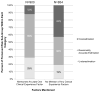
Women identified 9 main factors related to their clinical experience (e.g., diagnosis and testing; treatment) and non-clinical beliefs (e.g., uncertainty; spirituality). Women who mentioned at least one clinical experience factor were significantly less likely to overestimate their risk (12% vs. 43%, p<.001). Most women who were influenced by “communication with a clinician” had reasonably accurate recurrence estimates (68%). “Uncertainty” and “family and personal history” were associated with overestimation, particularly for women with DCIS (75%; 84%). “Spirituality, religion, and faith” was associated with underestimation of risk (63% vs. 20%, p<.001).
Limitations
The quantification of our qualitative results is subject to any biases that may have occurred during the coding process despite rigorous methodology.
Conclusions
Patient-clinician communication is important to breast cancer patients’ understanding of their numeric risk of systemic recurrence. Clinician discussions about recurrence risk should address uncertainty and relevance of family and personal history.
-
Subjects:
-
Source:Med Decis Making. 38(1):95-106
-
Pubmed ID:28814131
-
Pubmed Central ID:PMC5764769
-
Document Type:
-
Funding:HHSN261201000140C/CA/NCI NIH HHS/United States ; HHSN261201000035C/CA/NCI NIH HHS/United States ; P01 CA163233/CA/NCI NIH HHS/United States ; U58 DP003875/DP/NCCDPHP CDC HHS/United States ; HHSN261201300015C/RC/CCR NIH HHS/United States ; HHSN261201000035I/CA/NCI NIH HHS/United States ; HHSN261201000034C/CA/NCI NIH HHS/United States ; U58 DP003862/DP/NCCDPHP CDC HHS/United States
-
Volume:38
-
Issue:1
-
Collection(s):
-
Main Document Checksum:urn:sha256:2f4430cc012418a758ae40b76e416597c589ca562047f4bf6c9f0305f26983d7
-
Download URL:
-
File Type:
 [PDF
- 530.96 KB
]
[PDF
- 530.96 KB
]
Supporting Files


File Language:
English
ON THIS PAGE



CDC STACKS serves as an archival repository of CDC-published products including
scientific findings,
journal articles, guidelines, recommendations, or other public health information authored or
co-authored by CDC or funded partners.
As a repository, CDC STACKS retains documents in their original published format to ensure public access to scientific information.
As a repository, CDC STACKS retains documents in their original published format to ensure public access to scientific information.
You May Also Like
COLLECTION
CDC Public Access