



STrengthening the REporting of Genetic Association Studies (STREGA)— An Extension of the STROBE Statement
Current
Supporting Files

-
Feb 03 2009
-
Status Current
File Language:
English
Details
-
Alternative Title:PLoS Med
-
Personal Author:Little, Julian ; Higgins, Julian P.T ; Ioannidis, John P.A ; Moher, David ; Gagnon, France ; von Elm, Erik ; Khoury, Muin J ; Cohen, Barbara ; Davey-Smith, George ; Grimshaw, Jeremy ; Scheet, Paul ; Gwinn, Marta ; Williamson, Robin E ; Zou, Guang Yong ; Hutchings, Kim ; Johnson, Candice Y ; Tait, Valerie ; Wiens, Miriam ; Golding, Jean ; van Duijn, Cornelia ; McLaughlin, John ; Paterson, Andrew ; Wells, George ; Fortier, Isabel ; Freedman, Matthew ; Zecevic, Maja ; King, Richard ; Infante-Rivard, Claire ; Stewart, Alex ; Birkett, Nick
-
Corporate Authors:
-
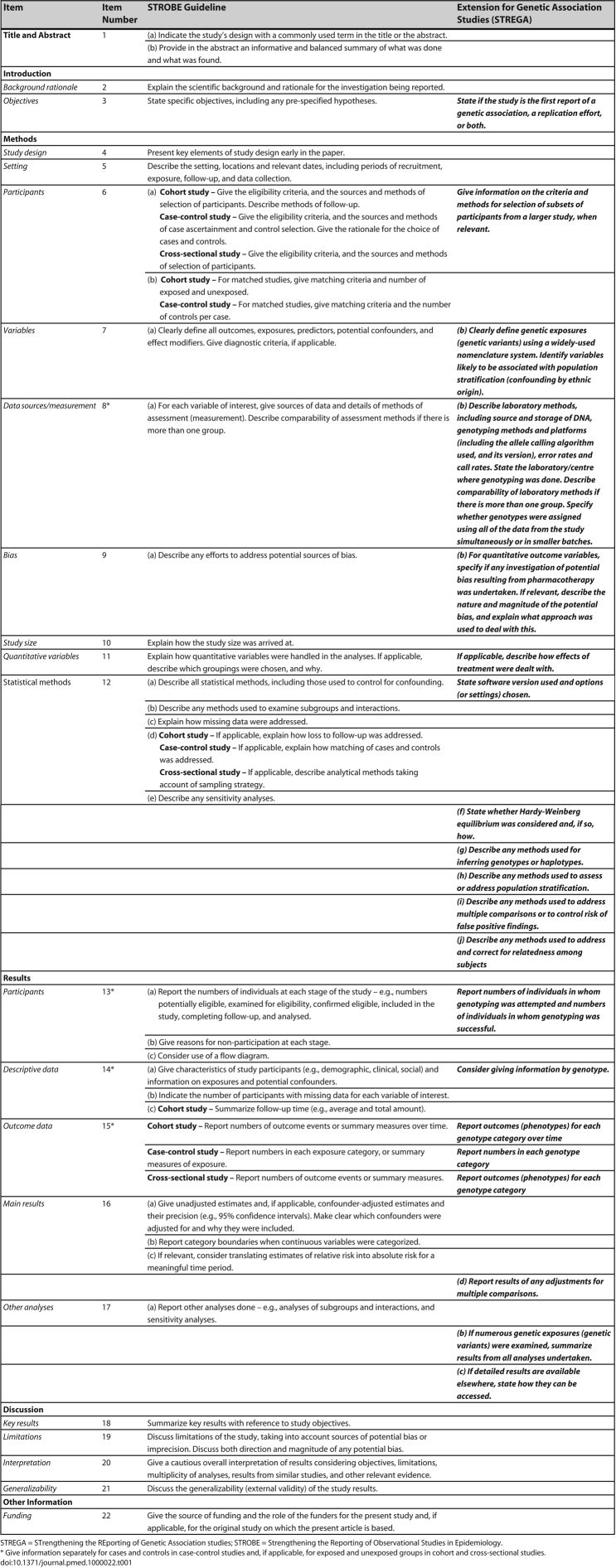
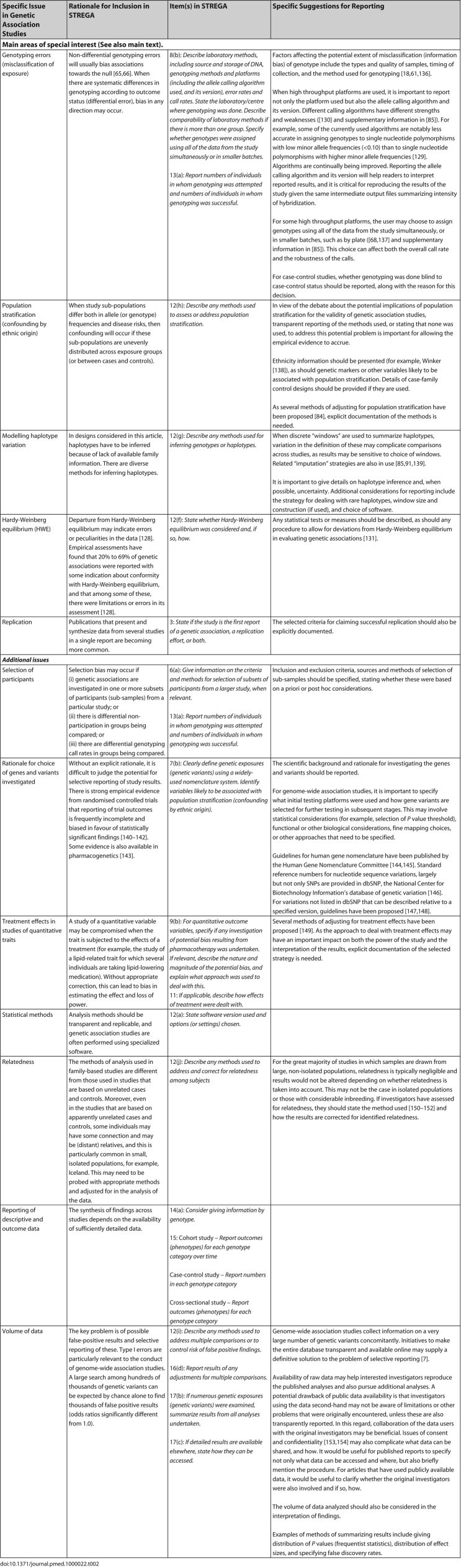
Description:Making sense of rapidly evolving evidence on genetic associations is crucial to making genuine advances in human genomics and the eventual integration of this information in the practice of medicine and public health. Assessment of the strengths and weaknesses of this evidence, and hence the ability to synthesize it, has been limited by inadequate reporting of results. The STrengthening the REporting of Genetic Association studies (STREGA) initiative builds on the Strengthening the Reporting of Observational Studies in Epidemiology (STROBE) Statement and provides additions to 12 of the 22 items on the STROBE checklist. The additions concern population stratification, genotyping errors, modelling haplotype variation, Hardy-Weinberg equilibrium, replication, selection of participants, rationale for choice of genes and variants, treatment effects in studying quantitative traits, statistical methods, relatedness, reporting of descriptive and outcome data, and the volume of data issues that are important to consider in genetic association studies. The STREGA recommendations do not prescribe or dictate how a genetic association study should be designed but seek to enhance the transparency of its reporting, regardless of choices made during design, conduct, or analysis.
-
Subjects:
-
Source:PLoS Med. 2009; 6(2).
-
DOI:
-
Pubmed ID:19192942
-
Pubmed Central ID:PMC2634792
-
Document Type:
-
Funding:
-
Volume:6
-
Issue:2
-
Download URL:
-
File Type:
 [PDF - 179.12 KB]
 -
Collection(s):
-
Main Document Checksum:urn:sha-512:63038e6092624847dba00d6e0d898df5e674ce385e6ce568c4485e5ab07fd3b0af615f8eeb825b58a4623da6caf2c3fbb3d3b2a95912e791d489ca153b327585
Supporting Files


File Language:
English
 Was this page helpful?
 Found an issue?


CDC STACKS serves as an archival repository of CDC-published products including
scientific findings, journal articles, guidelines, recommendations, or other public health information authored or
co-authored by CDC or funded partners.
As a repository, CDC STACKS retains documents in their original published format to ensure public access to scientific information.
As a repository, CDC STACKS retains documents in their original published format to ensure public access to scientific information.
You May Also Like