


Birthplace and esophageal cancer incidence patterns among Asian-Americans
Supporting Files

-
Dec 09 2014
-
File Language:
English
Details
-
Alternative Title:Dis Esophagus
-
Personal Author:
-
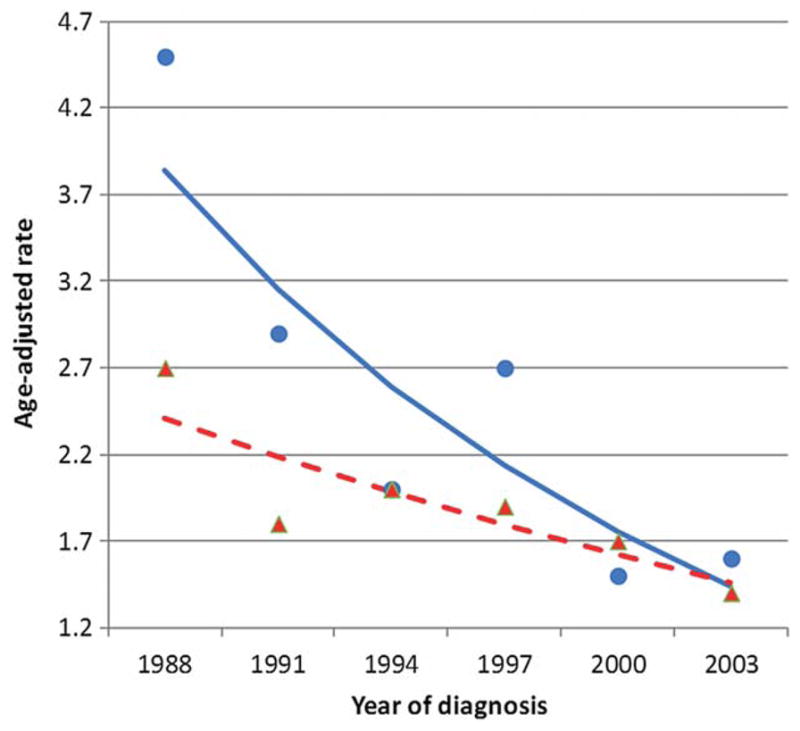
Description:The incidence of esophageal adenocarcinoma in the United States has risen rapidly over the last 30 years, whereas the incidence of esophageal squamous cell carcinoma has fallen dramatically. In contrast, parts of Asia have extremely high rates of squamous cell carcinoma, but virtually no adenocarcinoma. Within the United States, Asian-Americans as a whole, have low rates of esophageal adenocarcinoma and higher rates of squamous cell carcinoma. It is unclear what the patterns are for those Asians born in the United States. The relative influence of ethnicity and environment on the incidence of esophageal cancer in this population is unknown. We identified all cases of esophageal adenocarcinoma and squamous cell carcinoma from the California Cancer Registry 1988-2004, including 955 cases among 6 different Asian ethnicities. Time trends were examined using Joinpoint software to calculate the annual percentage changes in regression models. Rates of esophageal squamous cell carcinoma varied substantially among different Asian ethnic groups, but squamous cell carcinoma was much more common than adenocarcinoma in both foreign-born and US-born Asian-Americans. Rates of squamous cell carcinoma were slightly higher among US-born Asian men (4.0 per 100,000) compared with foreign-born Asian men (3.2 per 100,000) and White men (2.2 per 100,000), P = 0.03. Rates of adenocarcinoma were also slighter higher among US-born Asian men (1.2 per 100,000) compared with foreign-born Asian men (0.7 per 100,000), P = 0.01. Rates of squamous cell carcinoma decreased for both US-born and foreign-born Asians during this period, whereas adenocarcinoma remained low and stable. These results provide better insight into the genetic and environmental factors affecting the changing incidence of esophageal cancer histologies in the United States and Asia.
-
Subjects:
-
Source:Dis Esophagus. 29(1):99-104.
-
Pubmed ID:25487184
-
Pubmed Central ID:PMC5752430
-
Document Type:
-
Funding:HHSN261201000035C/PC,CA/None/None ; HHSN261201000140C/CA/NCI NIH HHS/United States ; U58 DP000807/DP/NCCDPHP CDC HHS/United States ; 1U58 DP000807-01/DP/NCCDPHP CDC HHS/United States ; HHSN261201000035I/CA/NCI NIH HHS/United States ; HHSN261201000034C/CA/NCI NIH HHS/United States ; N01 PC035137/PC/NCI NIH HHS/United States
-
Place as Subject:
-
Volume:29
-
Issue:1
-
Collection(s):
-
Main Document Checksum:urn:sha256:60ebbf31a1b8d028e5c7e7805c5d8fa04f7dae8f6ba94e97b902b35b32f5a545
-
Download URL:
-
File Type:
 [PDF
- 155.66 KB
]
[PDF
- 155.66 KB
]
Supporting Files


File Language:
English
ON THIS PAGE



CDC STACKS serves as an archival repository of CDC-published products including
scientific findings,
journal articles, guidelines, recommendations, or other public health information authored or
co-authored by CDC or funded partners.
As a repository, CDC STACKS retains documents in their original published format to ensure public access to scientific information.
As a repository, CDC STACKS retains documents in their original published format to ensure public access to scientific information.
You May Also Like
COLLECTION
CDC Public Access