


Civil rights as determinants of public health and racial and ethnic health equity: Health care, education, employment, and housing in the United States
Supporting Files

-
11 02 2017
-
File Language:
English
Details
-
Alternative Title:SSM Popul Health
-
Personal Author:
-
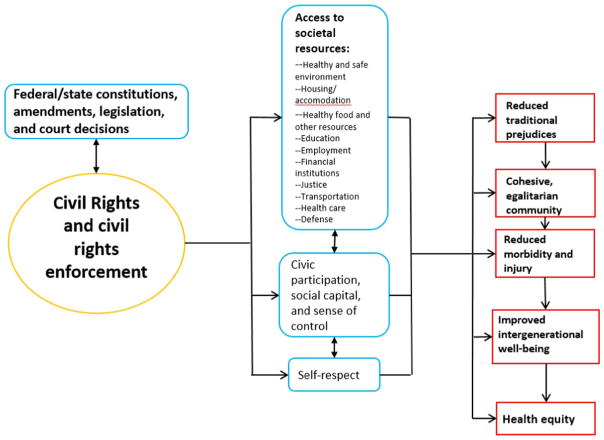
Description:This essay examines how civil rights and their implementation have affected and continue to affect the health of racial and ethnic minority populations in the United States. Civil rights are characterized as social determinants of health. A brief review of US history indicates that, particularly for Blacks, Hispanics, and American Indians, the longstanding lack of civil rights is linked with persistent health inequities. Civil rights history since 1950 is explored in four domains-health care, education, employment, and housing. The first three domains show substantial benefits when civil rights are enforced. Discrimination and segregation in housing persist because anti-discrimination civil rights laws have not been well enforced. Enforcement is an essential component for the success of civil rights law. Civil rights and their enforcement may be considered a powerful arena for public health theorizing, research, policy, and action.
-
Source:SSM Popul Health. 4:17-24
-
Pubmed ID:29250579
-
Pubmed Central ID:PMC5730086
-
Document Type:
-
Funding:
-
Volume:4
-
Collection(s):
-
Main Document Checksum:urn:sha-512:3305bc634316f091e33d0773613bbf69a65411f4e5ffa659e2b7f8df76a96ad434b0886d744049d6edb4bc403e4d0d4e96470d95034b22052868950cc1ca6185
-
Download URL:
-
File Type:
 [PDF
- 366.38 KB
]
[PDF
- 366.38 KB
]
Supporting Files


File Language:
English
ON THIS PAGE


CDC STACKS serves as an archival repository of CDC-published products including
scientific findings,
journal articles, guidelines, recommendations, or other public health information authored or
co-authored by CDC or funded partners.
As a repository, CDC STACKS retains documents in their original published format to ensure public access to scientific information.
As a repository, CDC STACKS retains documents in their original published format to ensure public access to scientific information.