



The Link between Musculoskeletal Pain, Lifestyle Behaviors, Exercise Self-Efficacy, and Quality of Life in Overweight and Obese Individuals
Supporting Files

-
2015
File Language:
English
Details
-
Alternative Title:Int J Phys Med Rehabil
-
Personal Author:
-
Description:Objective
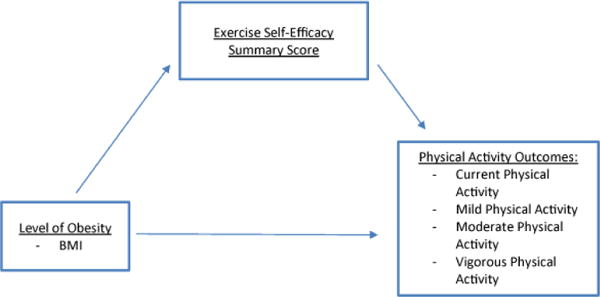
To determine the extent musculoskeletal (MS) pain in the low back and knee (weight-bearing (WB) joints), shoulder and wrist (non-weight bearing joints), and exercise self-efficacy mediates associations between overweight and obesity levels based on BMI (4 levels: overweight, obese class I, II, or III), physical function, emotional role, social interference, and physical activity (PA) levels.
Design
Cross-sectional study.
Setting
Four long-term nursing home facilities in the Northeast U.S.
Participants
99 overweight or obese (BMI > 25) nursing home employees.
Interventions
Self-reported survey administered to employees who met inclusion and exclusion criteria.
Main Outcome Measure(s)
General health status, physical function, emotional role, Exercise Self-Efficacy Scale (ESE), physical activity (PA), and frequency of pain at each joint.
Results
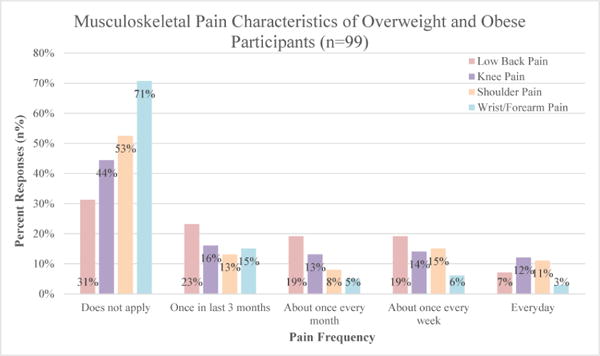
Reported pain frequency were 66.3%, 54.4%, 42.2%, and 24.1% for lower back, knee, shoulder, and wrist, respectively. Higher obesity levels were associated with lower physical function (r=−0.109, p=0.284). PA decreased with higher obesity levels (r=−0.248, p<0.05), particularly in moderate PA (r=−0.293, p<0.05). Obesity was associated with a lower ESE (r=−0.239, p<0.05). Wrist pain significantly mediated the effect of obesity on moderate physical function, emotional role, and ESE. ESE was a significant mediator between obesity and moderate and vigorous PA.
Conclusions
Overweight and obese nursing home employees are at higher risk for developing musculoskeletal disorders due to high demand, low control jobs, and the associated biomedical compromises while working. To increase the effectiveness of weight loss interventions for this population, the mediating effects of MS pain with higher levels of obesity should be considered.
-
Keywords:
-
Source:Int J Phys Med Rehabil. 3
-
Pubmed ID:29250572
-
Pubmed Central ID:PMC5730077
-
Document Type:
-
Funding:
-
Volume:3
-
Collection(s):
-
Main Document Checksum:urn:sha256:f7f47249e3dd55d28ce735297586bca1708ce1f14348fa474197442105e349a9
-
Download URL:
-
File Type:
 [PDF
- 453.39 KB
]
[PDF
- 453.39 KB
]
Supporting Files


File Language:
English
 Was this page helpful?
 Found an issue?



CDC STACKS serves as an archival repository of CDC-published products including
scientific findings,
journal articles, guidelines, recommendations, or other public health information authored or
co-authored by CDC or funded partners.
As a repository, CDC STACKS retains documents in their original published format to ensure public access to scientific information.
As a repository, CDC STACKS retains documents in their original published format to ensure public access to scientific information.
You May Also Like
COLLECTION
CDC Public Access