



The Impact of Michigan’s Partial Repeal of the Universal Motorcycle Helmet Law on Helmet Use, Fatalities, and Head Injuries
Supporting Files

-
1 2017 ; 1-2017
-
Available in CDC Stacks on January 01, 2018, 12:00 AM
File Language:
English
Details
-
Alternative Title:Am J Public Health
-
Personal Author:
-
Description:Objectives
To evaluate the impact of the partial repeal of Michigan’s universal motorcycle helmet law on helmet use, fatalities, and head injuries.
Methods
We compared helmet use rates and motorcycle crash fatality risk for the 12 months before and after the April 13, 2012, repeal with a statewide police-reported crash data set. We linked police-reported crashes to injured riders in a statewide trauma registry. We compared head injury before and after the repeal. Regression examined the effect of helmet use on fatality and head injury risk.
Results
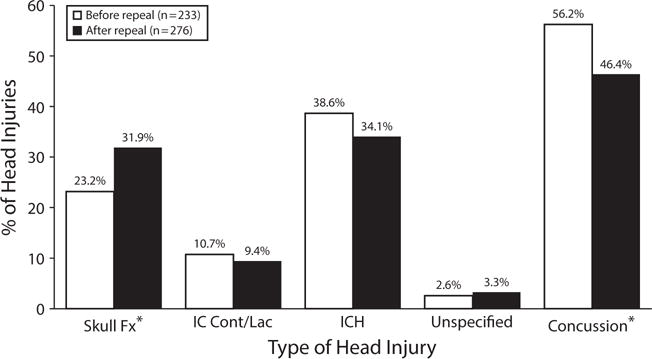
Helmet use decreased in crash (93.2% vs 70.8%; P < .001) and trauma data (91.1% vs 66.2%; P < .001) after the repeal. Although fatalities did not change overall (3.3% vs 3.2%; P = .87), head injuries (43.4% vs 49.6%; P < .05) and neurosurgical intervention increased (3.7% vs 6.5%; P < .05). Male gender (adjusted odds ratio AOR = 1.65), helmet nonuse (AOR = 1.84), alcohol intoxication (AOR = 11.31), intersection crashes (AOR = 1.62), and crashes at higher speed limits (AOR = 1.04) increased fatality risk. Helmet nonuse (AOR = 2.31) and alcohol intoxication (AOR = 2.81) increased odds of head injury.
Conclusions
Michigan’s helmet law repeal resulted in a 24% to 27% helmet use decline among riders in crashes and a 14% increase in head injury. -
Subjects:
-
Source:Am J Public Health. 107(1):166-172
-
Pubmed ID:27854530
-
Pubmed Central ID:PMC5308169
-
Document Type:
-
Funding:
-
Volume:107
-
Issue:1
-
Download URL:
-
File Type:
 [PDF - 366.71 KB]
 -
Collection(s):
-
Main Document Checksum:urn:sha256:4bfcbaae8d471e0a6c1c21303de8674227a9c56c314f18b93bf9a6f20836fbfc
Supporting Files


File Language:
English
 Was this page helpful?
 Found an issue?

CDC STACKS serves as an archival repository of CDC-published products including
scientific findings, journal articles, guidelines, recommendations, or other public health information authored or
co-authored by CDC or funded partners.
As a repository, CDC STACKS retains documents in their original published format to ensure public access to scientific information.
As a repository, CDC STACKS retains documents in their original published format to ensure public access to scientific information.
You May Also Like
COLLECTION
CDC Public Access