


Use of and Mortality After Bilateral Mastectomy Compared With Other Surgical Treatments for Breast Cancer in California, 1998–2011
Supporting Files

-
Sep 03 2014
File Language:
English
Details
-
Alternative Title:JAMA
-
Personal Author:
-
Description:IMPORTANCE
Bilateral mastectomy is increasingly used to treat unilateral breast cancer. Because it may have medical and psychosocial complications, a better understanding of its use and outcomes is essential to optimizing cancer care.
OBJECTIVE
To compare use of and mortality after bilateral mastectomy, breast-conserving therapy with radiation, and unilateral mastectomy.
DESIGN, SETTING, AND PARTICIPANTS
Observational cohort study within the population-based California Cancer Registry; participants were women diagnosed with stages 0–III unilateral breast cancer in California from 1998 through 2011, with median follow-up of 89.1 months.
MAIN OUTCOMES AND MEASURES
Factors associated with surgery use (from polytomous logistic regression); overall and breast cancer–specific mortality (from propensity score weighting and Cox proportional hazards analysis).
RESULTS
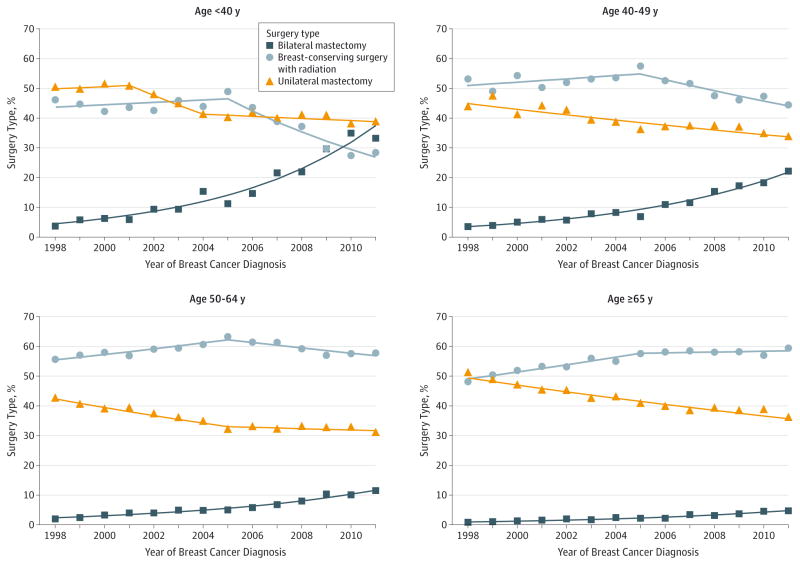
Among 189 734 patients, the rate of bilateral mastectomy increased from 2.0% (95% CI, 1.7%–2.2%) in 1998 to 12.3% (95% CI, 11.8%–12.9%) in 2011, an annual increase of 14.3% (95% CI, 13.1%–15.5%); among women younger than 40 years, the rate increased from 3.6% (95% CI, 2.3%–5.0%) in 1998 to 33% (95% CI, 29.8%–36.5%) in 2011. Bilateral mastectomy was more often used by non-Hispanic white women, those with private insurance, and those who received care at a National Cancer Institute (NCI)–designated cancer center (8.6% [95% CI, 8.1%–9.2%] among NCI cancer center patients vs 6.0% [95% CI, 5.9%–6.1%] among non-NCI cancer center patients; odds ratio [OR], 1.13 [95% CI, 1.04–1.22]); in contrast, unilateral mastectomy was more often used by racial/ethnic minorities (Filipina, 52.8% [95% CI, 51.6%–54.0%]; OR, 2.00 [95% CI, 1.90–2.11] and Hispanic, 45.6% [95% CI, 45.0%–46.2%]; OR, 1.16 [95% CI, 1.13–1.20] vs non-Hispanic white, 35.2% [95% CI, 34.9%–35.5%]) and those with public/Medicaid insurance (48.4% [95% CI, 47.8%–48.9%]; OR, 1.08 [95% CI, 1.05–1.11] vs private insurance, 36.6% [95% CI, 36.3%–36.8%]). Compared with breast-conserving surgery with radiation (10-year mortality, 16.8% [95% CI, 16.6%–17.1%]), unilateral mastectomy was associated with higher all-cause mortality (hazard ratio [HR], 1.35 [95% CI, 1.32–1.39]; 10-year mortality, 20.1% [95% CI, 19.9%–20.4%]). There was no significant mortality difference compared with bilateral mastectomy (HR, 1.02 [95% CI, 0.94–1.11]; 10-year mortality, 18.8% [95% CI, 18.6%–19.0%]). Propensity analysis showed similar results.
CONCLUSIONS AND RELEVANCE
Use of bilateral mastectomy increased significantly throughout California from 1998 through 2011 and was not associated with lower mortality than that achieved with breast-conserving surgery plus radiation. Unilateral mastectomy was associated with higher mortality than were the other 2 surgical options.
-
Subjects:
-
Source:JAMA. 312(9):902-914.
-
Pubmed ID:25182099
-
Pubmed Central ID:PMC5747359
-
Document Type:
-
Funding:HHSN261201000034C/PHS HHS/United States ; HHSN261201000035C/PC,CA/None/None ; HHSN261201000140C/CA/NCI NIH HHS/United States ; HHSN261201000035C/PHS HHS/United States ; U58 DP000807/DP/NCCDPHP CDC HHS/United States ; 1U58 DP000807-01/DP/NCCDPHP CDC HHS/United States ; HHSN261201000035I/CA/NCI NIH HHS/United States ; HHSN261201000034C/CA/NCI NIH HHS/United States ; HHSN261201000140C/PHS HHS/United States ; P30 CA124435/CA/NCI NIH HHS/United States ; N01 PC035137/PC/NCI NIH HHS/United States
-
Name as Subject:
-
Place as Subject:
-
Volume:312
-
Issue:9
-
Collection(s):
-
Main Document Checksum:urn:sha256:dd4580447be31155cd682de2c0083b623700ef3e2250ab4c4036129f14d1f621
-
Download URL:
-
File Type:
 [PDF
- 438.09 KB
]
[PDF
- 438.09 KB
]
Supporting Files


File Language:
English
ON THIS PAGE



CDC STACKS serves as an archival repository of CDC-published products including
scientific findings,
journal articles, guidelines, recommendations, or other public health information authored or
co-authored by CDC or funded partners.
As a repository, CDC STACKS retains documents in their original published format to ensure public access to scientific information.
As a repository, CDC STACKS retains documents in their original published format to ensure public access to scientific information.
You May Also Like
COLLECTION
CDC Public Access