


Incidence of symptomatic A(H1N1)pdm09 influenza during the pandemic and post-pandemic periods in a rural Indian community
Supporting Files

-
12 2013
-
File Language:
English
Details
-
Alternative Title:Int J Infect Dis
-
Personal Author:
-
Description:Background
Data on influenza illness rates with population denominators are needed to quantify overall morbidity and to prioritize public health intervention strategies.
Methods
The rates of influenza A(H1N1)pdm09 infection during pandemic phases were determined in a longitudinal community cohort study as part of an influenza vaccine study in a rural community of North India.
Results
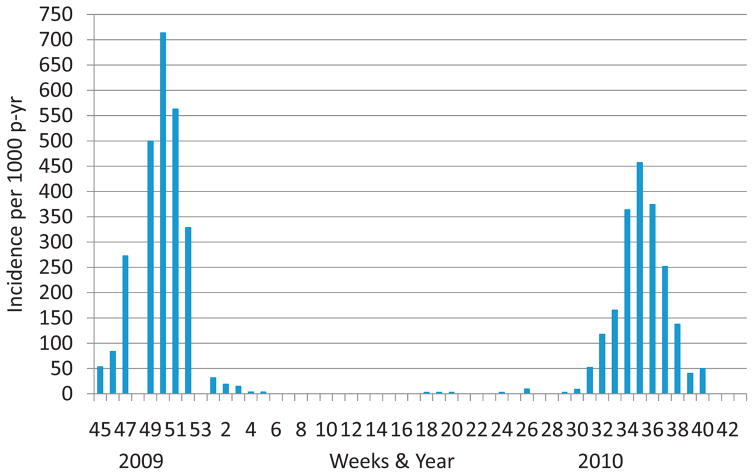
During the 711 731 person-weeks of surveillance, a total of 1410/7571 (19%) febrile acute respiratory illness cases were positive for influenza. Of these, 749 (53%) were influenza A(H1N1)pdm09, 643 (46%) influenza B, and 18 (1%) influenza A (H3N2). The overall incidence rate of influenza-associated febrile acute respiratory illness was 128/1000 person-years. The incidence rates of influenza A(H1N1)pdm09 were high during both the pandemic phase (179/1000 person-years; November 2009 to January 2010) and post-pandemic phase (156/1000 person-years; August to October 2010), with children <18 years of age being at the greatest risk of influenza infection in the community.
Conclusions
These findings provide important information for planning clinical and public health intervention strategies to mitigate the impact of influenza epidemics.
-
Subjects:
-
Source:Int J Infect Dis. 17(12):e1182-e1185
-
Pubmed ID:24103331
-
Pubmed Central ID:PMC5733120
-
Document Type:
-
Funding:
-
Volume:17
-
Issue:12
-
Collection(s):
-
Main Document Checksum:urn:sha256:70aa6704e695566b9fc5e5c622b3d67023ca6f689c99952aefa75dcc148239a2
-
Download URL:
-
File Type:
 [PDF
- 444.81 KB
]
[PDF
- 444.81 KB
]
Supporting Files


File Language:
English
ON THIS PAGE


CDC STACKS serves as an archival repository of CDC-published products including
scientific findings,
journal articles, guidelines, recommendations, or other public health information authored or
co-authored by CDC or funded partners.
As a repository, CDC STACKS retains documents in their original published format to ensure public access to scientific information.
As a repository, CDC STACKS retains documents in their original published format to ensure public access to scientific information.
You May Also Like
COLLECTION
CDC Public Access