



Influenza Vaccine Effectiveness in the United States during the 2015–2016 Season
Supporting Files

-
Aug 10 2017
-
Available in CDC Stacks on 2018-02-10T00:00:00Z
File Language:
English
Details
-
Alternative Title:N Engl J Med
-
Personal Author:Jackson, Michael L. ; Chung, Jessie R. ; Jackson, Lisa A. ; Phillips, C. Hallie ; Benoit, Joyce ; Monto, Arnold S. ; Martin, Emily T. ; Belongia, Edward A. ; McLean, Huong Q. ; Gaglani, Manjusha ; Murthy, Kempapura ; Zimmerman, Richard ; Nowalk, Mary P. ; Fry, Alicia M. ; Flannery, Brendan
-
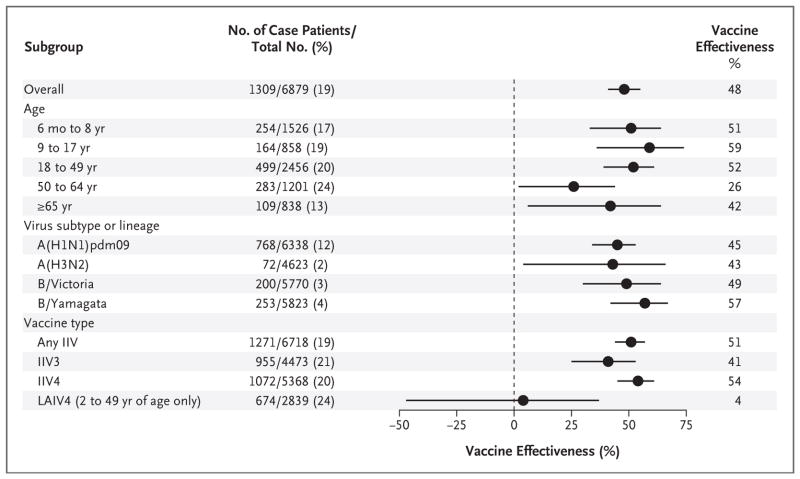
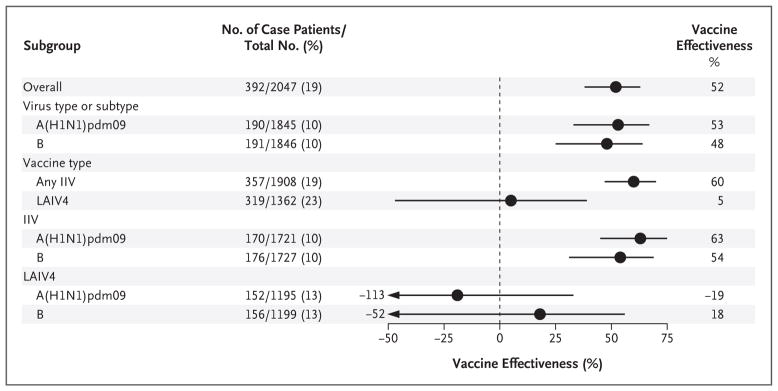
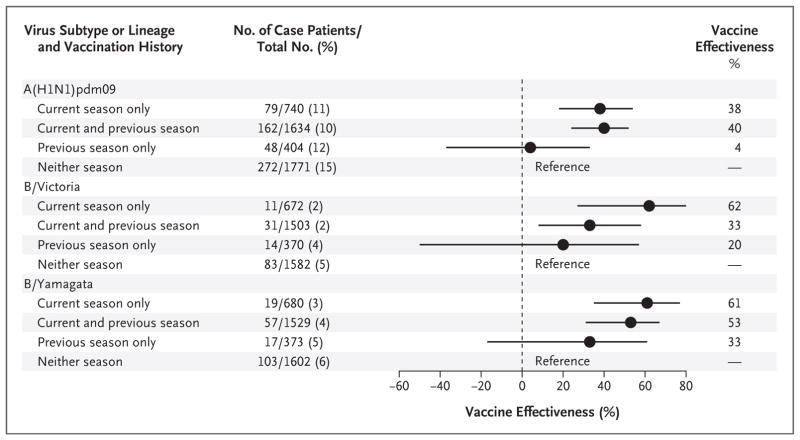
Description:BACKGROUND ; The A(H1N1)pdm09 virus strain used in the live attenuated influenza vaccine was changed for the 2015–2016 influenza season because of its lack of effectiveness in young children in 2013–2014. The Influenza Vaccine Effectiveness Network evaluated the effect of this change as part of its estimates of influenza vaccine effectiveness in 2015–2016. ; METHODS ; We enrolled patients 6 months of age or older who presented with acute respiratory illness at ambulatory care clinics in geographically diverse U.S. sites. Using a test-negative design, we estimated vaccine effectiveness as (1 – OR) × 100, in which OR is the odds ratio for testing positive for influenza virus among vaccinated versus unvaccinated participants. Separate estimates were calculated for the inactivated vaccines and the live attenuated vaccine. ; RESULTS ; Among 6879 eligible participants, 1309 (19%) tested positive for influenza virus, predominantly for A(H1N1)pdm09 (11%) and influenza B (7%). The effectiveness of the influenza vaccine against any influenza illness was 48% (95% confidence interval CI, 41 to 55; P<0.001). Among children 2 to 17 years of age, the inactivated influenza vaccine was 60% effective (95% CI, 47 to 70; P<0.001), and the live attenuated vaccine was not observed to be effective (vaccine effectiveness, 5%; 95% CI, −47 to 39; P = 0.80). Vaccine effectiveness against A(H1N1)pdm09 among children was 63% (95% CI, 45 to 75; P<0.001) for the inactivated vaccine, as compared with −19% (95% CI, −113 to 33; P = 0.55) for the live attenuated vaccine. ; CONCLUSIONS ; Influenza vaccines reduced the risk of influenza illness in 2015–2016. However, the live attenuated vaccine was found to be ineffective among children in a year with substantial inactivated vaccine effectiveness. Because the 2016–2017 A(H1N1)pdm09 strain used in the live attenuated vaccine was unchanged from 2015–2016, the Advisory Committee on Immunization Practices made an interim recommendation not to use the live attenuated influenza vaccine for the 2016–2017 influenza season. (Funded by the Centers for Disease Control and Prevention and the National Institutes of Health.)
-
Subjects:
-
Source:N Engl J Med. 377(6):534-543.
-
Pubmed ID:28792867
-
Pubmed Central ID:PMC5727917
-
Document Type:
-
Funding:UL1 TR000005/TR/NCATS NIH HHS/United States ; UL1 RR024153/RR/NCRR NIH HHS/United States ; U01 IP000473/IP/NCIRD CDC HHS/United States ; U01 IP000466/IP/NCIRD CDC HHS/United States ; U01 IP000471/IP/NCIRD CDC HHS/United States ; U01 IP000474/IP/NCIRD CDC HHS/United States ; U01 IP000467/IP/NCIRD CDC HHS/United States
-
Place as Subject:
-
Volume:377
-
Issue:6
-
Download URL:
-
File Type:
 [PDF - 553.16 KB]
 -
Collection(s):
-
Main Document Checksum:urn:sha256:1716e7c95a638bce454e5881cfd704d5d6c27fe0c45f41bfe4a7c0ce958195fe
Supporting Files


File Language:
English
 Was this page helpful?
 Found an issue?



CDC STACKS serves as an archival repository of CDC-published products including
scientific findings, journal articles, guidelines, recommendations, or other public health information authored or
co-authored by CDC or funded partners.
As a repository, CDC STACKS retains documents in their original published format to ensure public access to scientific information.
As a repository, CDC STACKS retains documents in their original published format to ensure public access to scientific information.
You May Also Like
COLLECTION
CDC Public Access