



Plasma trans-fatty acid concentrations in fasting adults declined from NHANES 1999–2000 to 2009–20101–3
Supporting Files

-
5 2017 ; 5-2017
-
Available in CDC Stacks on 2017-11-30T00:00:00Z
File Language:
English
Details
-
Alternative Title:Am J Clin Nutr
-
Personal Author:
-
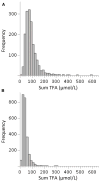
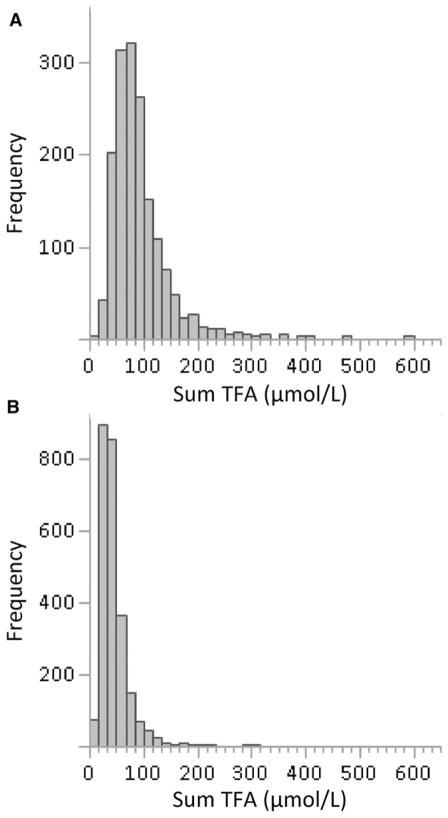
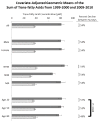
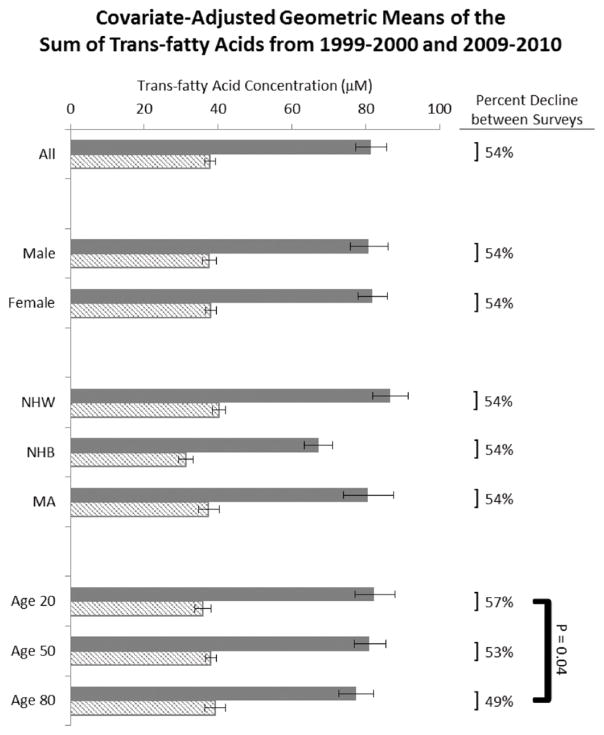
Description:Background ; The consumption of trans fatty acids (TFAs) is associated with an increased risk of cardiovascular disease, and reducing their consumption is a major public health objective. Food intake studies have provided estimates for TFA concentrations in the US population; however, there is a need for data on TFA blood concentrations in the population. ; Objective ; The objective of this study was to determine plasma TFA concentrations in a nationally representative group of fasted adults in the US population in NHANES samples from 1999–2000 and 2009–2010. ; Design ; Four major TFAs palmitelaidic acid (C16:1n–7t), trans vaccenic acid (C18:1n–7t), elaidic acid (C18:1n–9t), and linoelaidic acid (C18:2n–6t,9t) were measured in plasma in 1613 subjects from NHANES 1999–2000 and 2462 subjects from NHANES 2009–2010 by gas chromatography–mass spectrometry. Geometric means and distribution percentiles were calculated for each TFA and their sum by age, sex, and race/ethnicity (non-Hispanic white, non-Hispanic black, Mexican American), and covariate-adjusted geometric means were computed by using a model that included these demographic and other dietary factors, as well as survey year and any significant interaction terms. ; Results ; These nationally representative data for the adult US population show that TFA concentrations were 54% lower in NHANES 2009–2010 than in NHANES 1999–2000. Covariate-adjusted geometric means for the sum of the 4 TFAs were 81.4 μmol/L (95% CI: 77.3, 85.6 μmol/L) and 37.8 μmol/L (95% CI: 36.4, 39.4 μmol/L) in NHANES 1999–2000 and 2009–2010, respectively. Even with the large decline in TFA concentrations, differences between demographic subgroups were comparable in the 2 surveys. ; Conclusion ; The results indicate an overall reduction in TFA concentrations in the US population and provide a valuable baseline to evaluate the impact of the recent regulation categorizing TFAs as food additives.
-
Subjects:
-
Keywords:
-
Source:Am J Clin Nutr. 105(5):1063-1069
-
Pubmed ID:28381474
-
Pubmed Central ID:PMC5708855
-
Document Type:
-
Funding:
-
Volume:105
-
Issue:5
-
Download URL:
-
File Type:
 [PDF - 574.00 KB]
 -
Collection(s):
-
Main Document Checksum:urn:sha256:a7fa0e11cb12c0db05d96fc9678f8f56525875d7254a5125e7b2ac0ce4a3f5da
Supporting Files


File Language:
English
 Was this page helpful?
 Found an issue?

CDC STACKS serves as an archival repository of CDC-published products including
scientific findings, journal articles, guidelines, recommendations, or other public health information authored or
co-authored by CDC or funded partners.
As a repository, CDC STACKS retains documents in their original published format to ensure public access to scientific information.
As a repository, CDC STACKS retains documents in their original published format to ensure public access to scientific information.
You May Also Like
COLLECTION
CDC Public Access