


Neighbourhood economic deprivation explains racial/ethnic disparities in overweight and obesity among children and adolescents in the USA
Supporting Files

-
Sep 26 2013
File Language:
English
Details
-
Alternative Title:J Epidemiol Community Health
-
Personal Author:
-
Description:Background
Low-income and some racial and ethnic subpopulations are more likely to suffer from obesity. Inequities in the physical and social environment may contribute to disparities in paediatric obesity, but there is little empirical evidence to date. This study explored whether neighbourhood-level socioeconomic factors attenuate racial and ethnic disparities in obesity among youth in the USA and whether individual-level socioeconomic status (SES) interacts with neighbourhood deprivation.
Methods
This analysis used data from 17 100 youth ages 2–18 years participating in the 2001–2010 National Health and Nutrition Examination Survey linked to census tract-level socioeconomic characteristics. Multilevel logistic regression models were used to examine neighbourhood deprivation in association with odds of obesity (age-specific and sex-specific body mass index percentile ≥95).
Results
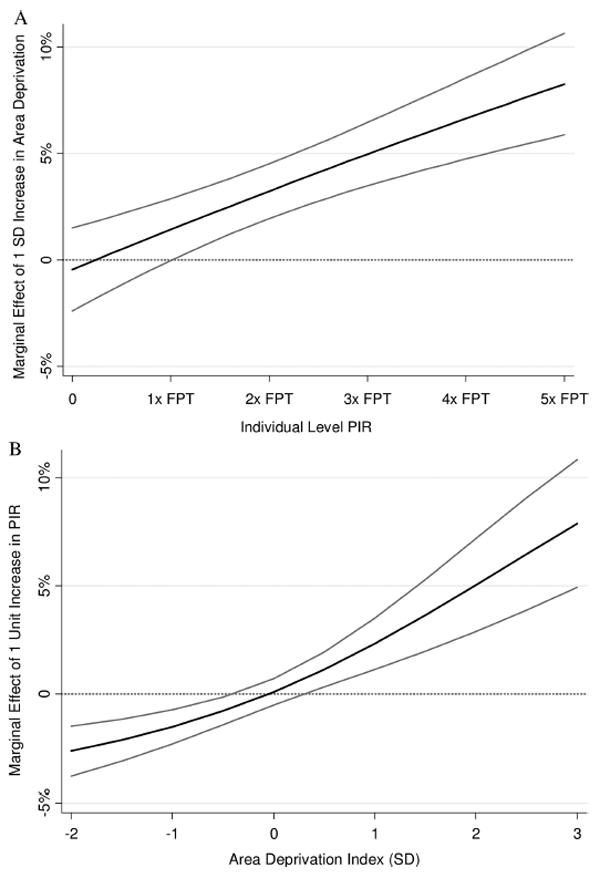
The unadjusted prevalence of obesity was 15% among non-Hispanic white children and 21% among non-Hispanic black and Mexican-American children. Adjustment for individual-level SES neighbourhood deprivation and the interaction between these two factors resulted in a 74% attenuation of the disparity in obesity between non-Hispanic black and non-Hispanic white children and a 49% attenuation of the disparity between Mexican-American and non-Hispanic white children. There was a significant interaction between individual-level SES and neighbourhood deprivation where higher individual-level income was protective for children living in low-deprivation neighbourhoods, but not for children who lived in high-deprivation areas. Conversely, area deprivation was associated with higher odds of obesity, but only among children who were above the poverty threshold.
Conclusions
Future research on disparities in obesity and other health outcomes should examine broader contextual factors and social determinants of inequities.
-
Subjects:
-
Source:J Epidemiol Community Health. 68(2):123-129.
-
Pubmed ID:24072744
-
Pubmed Central ID:PMC5705001
-
Document Type:
-
Funding:
-
Place as Subject:
-
Volume:68
-
Issue:2
-
Collection(s):
-
Main Document Checksum:urn:sha256:dcd2dd1673f12921019f0917c7def5feb79ce82df8e3ccdd77e730ef1bfd8358
-
Download URL:
-
File Type:
 [PDF
- 375.82 KB
]
[PDF
- 375.82 KB
]
Supporting Files


File Language:
English
ON THIS PAGE


CDC STACKS serves as an archival repository of CDC-published products including
scientific findings,
journal articles, guidelines, recommendations, or other public health information authored or
co-authored by CDC or funded partners.
As a repository, CDC STACKS retains documents in their original published format to ensure public access to scientific information.
As a repository, CDC STACKS retains documents in their original published format to ensure public access to scientific information.
You May Also Like
COLLECTION
CDC Public Access