


Data to Action: Using Environmental Public Health Tracking to Inform Decision Making
Supporting Files

-
2015
File Language:
English
Details
-
Alternative Title:J Public Health Manag Pract
-
Personal Author:
-
Description:Context
Public health surveillance includes dissemination of data and information to those who need it to take action to prevent or control disease. The concept of data to action is explicit in the mission of the Centers for Disease Control and Prevention’s (CDC) National Environmental Public Health Tracking Program (Tracking Program). CDC has built a National Environmental Public Health Tracking Network (Tracking Network) to integrate health and environmental data to drive public health action (PHA) to improve communities’ health.
Objective
To assess the utility of the Tracking Program and its Network in environmental public health practice and policy-making.
Design
We analyzed information on how Tracking has been used to drive PHAs within funded states and cities (grantees). Two case studies illustrate such use.
Setting
Analyses included all grantees funded between 2005 and 2013.
Participants
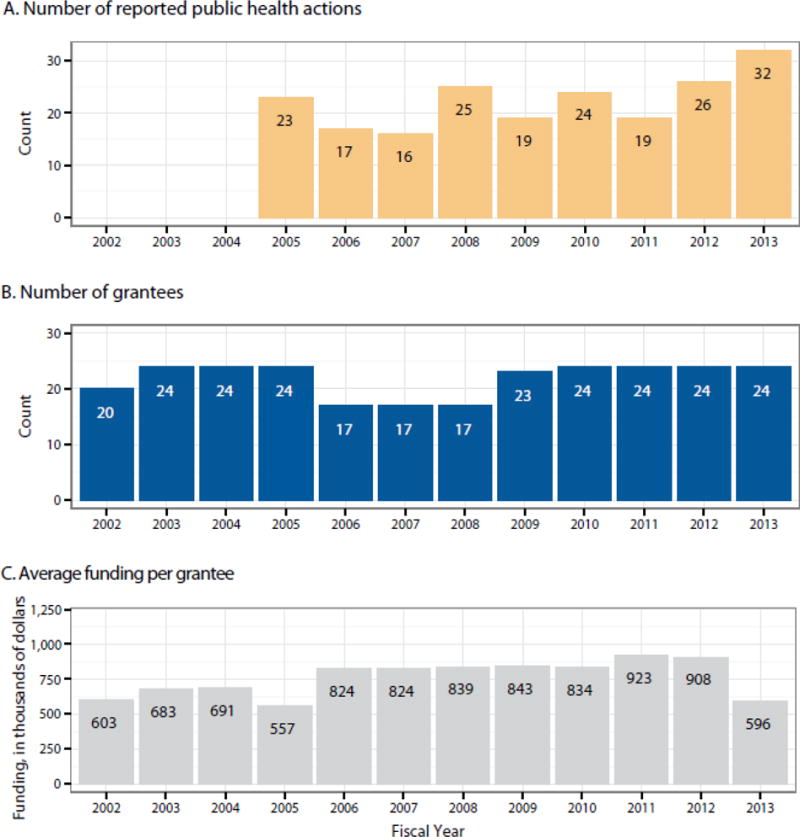
The number of grantees varied from 17 for 2006–2008 to 24 for 2010–2013.
Main Outcome Measures
We categorized each PHA reported to determine how grantees became involved, their role, the problems addressed, and the overall action.
Results
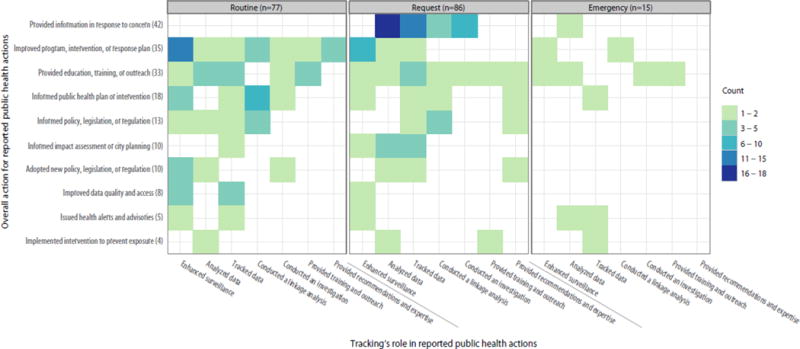
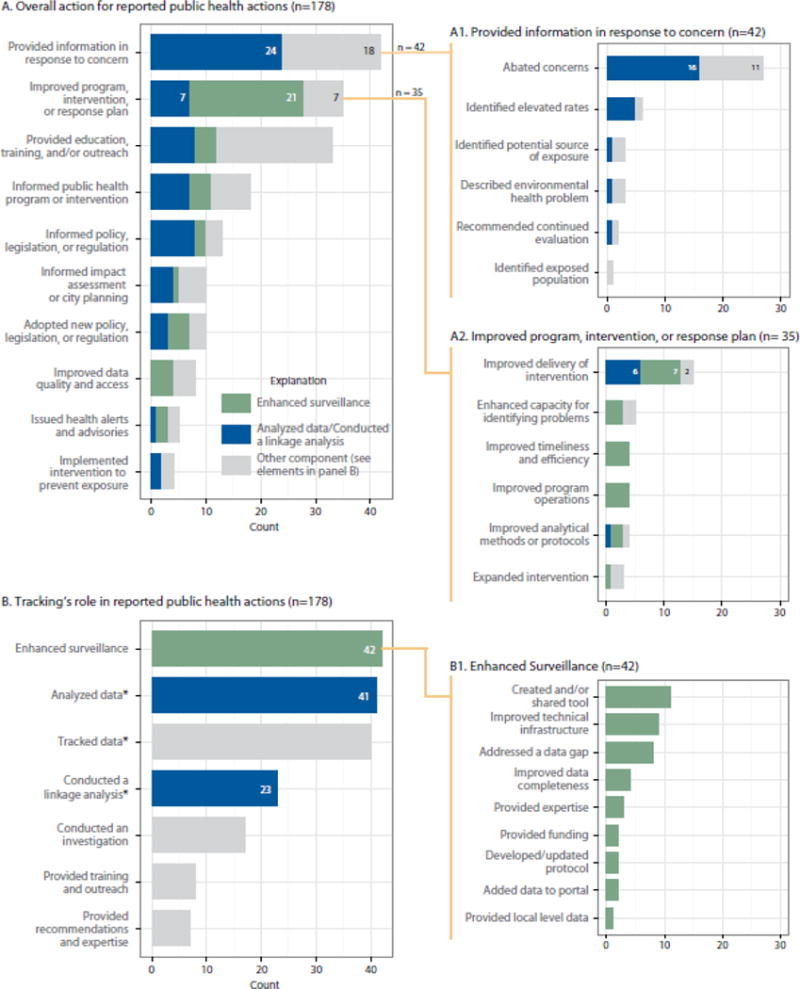
Tracking grantees reported 178 PHAs from 2006–2013. The most common overall action was “provided information in response to concern” (n=42) followed by “improved a public health program, intervention, or response plan” (n=35). Tracking’s role was most often to enhance surveillance (24%) or to analyze data (23%). In 47% of PHAs, the underlying problem was a concern about possible elevated rates of a health outcome, a potential exposure, or a potential association between a hazard and health. PHAs were started by a request for assistance (48%), in response to an emergency (8%), and though routine work by Tracking programs (43%).
Conclusion
Our review shows that the data, expertise, technical infrastructure, and other resources of the Tracking Program and its Network are driving state and local PHAs.
-
Subjects:
-
Keywords:
-
Source:J Public Health Manag Pract. 21(Suppl 2):S12-S22
-
Pubmed ID:25621441
-
Pubmed Central ID:PMC5703058
-
Document Type:
-
Funding:
-
Volume:21
-
Collection(s):
-
Main Document Checksum:urn:sha256:4de88eeee64830da708c39079811c513a76cd69fedde3fd8ff1ab1b60acced33
-
Download URL:
-
File Type:
 [PDF
- 603.83 KB
]
[PDF
- 603.83 KB
]
Supporting Files


File Language:
English
ON THIS PAGE





CDC STACKS serves as an archival repository of CDC-published products including
scientific findings,
journal articles, guidelines, recommendations, or other public health information authored or
co-authored by CDC or funded partners.
As a repository, CDC STACKS retains documents in their original published format to ensure public access to scientific information.
As a repository, CDC STACKS retains documents in their original published format to ensure public access to scientific information.
You May Also Like
COLLECTION
CDC Public Access