



Do Cancer-Related Fatigue and Physical Activity Vary by Age for Black Women With a History of Breast Cancer?
Supporting Files

-
Nov 30 2017
File Language:
English
Details
-
Journal Article:Preventing Chronic Disease (PCD)
-
Personal Author:
-
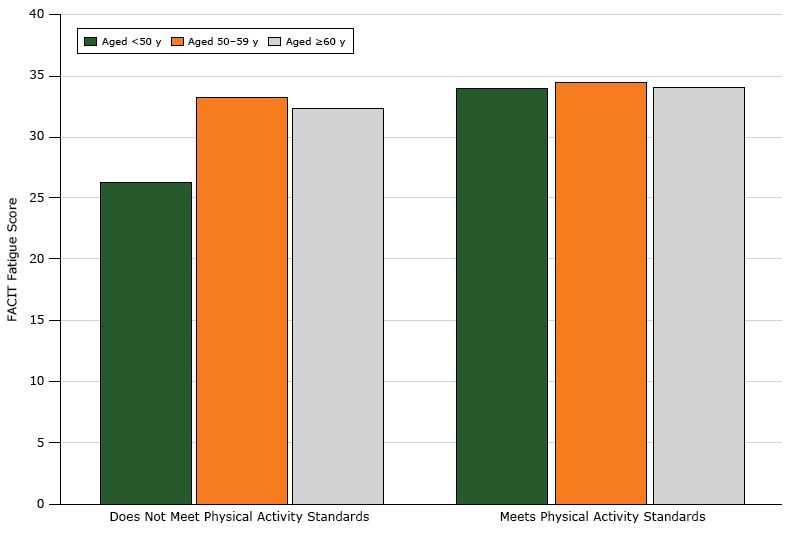
Description:Introduction ; Cancer-related fatigue (CRF) is the most uncomfortable symptom among women with a history of breast cancer. Black women are more likely than women of other racial/ethnic groups to have CRF risk factors, such as physical inactivity and obesity, yet CRF studies have not focused on black women. We conducted a cross-sectional analysis to assess CRF and physical activity among black women survivors of breast cancer. ; Method ; In May and July of 2012, 267 members (mean age, 54 y) of the Sisters Network, Inc, completed an online survey of sociodemographic characteristics, medical characteristics, and physical activity, and a fatigue instrument (the Functional Assessment of Chronic Illness Therapy FACIT). Multiple linear regression assessed fatigue and physical activity compliance (ie, 150 minutes of moderate to vigorous physical activity per week). ; Results ; Participants had an average FACIT score of 32.3, Fatigue was greater (P < .001) among the 56% of women not meeting physical activity guidelines. In multivariable analysis, correlates of fatigue showed that physical activity compliance (β = 3.20, P < .001) and older age group (50–59 y: β = 3.98, P = .001; ≥60 y,: β = 3.76, P = .003) were associated with less fatigue. The interaction between age and fatigue was also significant: mean differences in fatigue by physical activity level were obvious only among women younger than 50 years. (P < .001). ; Conclusion ; Physical activity compliance was associated with a lower level of fatigue. However, the effect of physical activity on fatigue may differ by age. Interventions aimed at curbing CRF in black women should consider age-appropriate strategies that can be integrated into existing lifestyles.
-
Subjects:
-
Source:Prev Chronic Dis. 14.
-
DOI:
-
ISSN:1545-1151
-
Pubmed ID:29191261
-
Pubmed Central ID:PMC5716813
-
Document Type:
-
Funding:K01 CA158000/CA/NCI NIH HHS/United States ; P30 AI094189/AI/NIAID NIH HHS/United States ; R25 MH083620/MH/NIMH NIH HHS/United States ; P30 CA006973/CA/NCI NIH HHS/United States ; R01 CA106851/CA/NCI NIH HHS/United States ; K01 CA184288/CA/NCI NIH HHS/United States ; U54 CA155850/CA/NCI NIH HHS/United States
-
Volume:14
-
Download URL:
-
File Type:
 [PDF - 327.24 KB]
 -
Collection(s):
-
Main Document Checksum:urn:sha-512:5cb0f88b2ec49d43837afd80bb663444a2c4315d685481c600c68bdd7e511d859d9f2e1ecea10dd10b094f5ef96cc6221708efcba2b7c9fad03264988615cae9
Supporting Files


File Language:
English
 Was this page helpful?
 Found an issue?

CDC STACKS serves as an archival repository of CDC-published products including
scientific findings, journal articles, guidelines, recommendations, or other public health information authored or
co-authored by CDC or funded partners.
As a repository, CDC STACKS retains documents in their original published format to ensure public access to scientific information.
As a repository, CDC STACKS retains documents in their original published format to ensure public access to scientific information.
You May Also Like
COLLECTION
Preventing Chronic Disease