



LDL cholesterol performance of beta quantification reference measurement procedure☆
Supporting Files

-
4 20 2014 ; 4-20-
-
Available in CDC Stacks on 2017-11-23T00:00:00Z
File Language:
English
Details
-
Alternative Title:Clin Chim Acta
-
Personal Author:Nakamura, Masakazu ; Kayamori, Yuzo ; Iso, Hiroyasu ; Kitamura, Akihiko ; Kiyama, Masahiko ; Koyama, Isao ; Nishimura, Kunihiro ; Nakai, Michikazu ; Noda, Hiroyuki ; Dasti, Mahnaz ; Vesper, Hubert W. ; Miyamoto, Yoshihiro
-
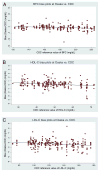
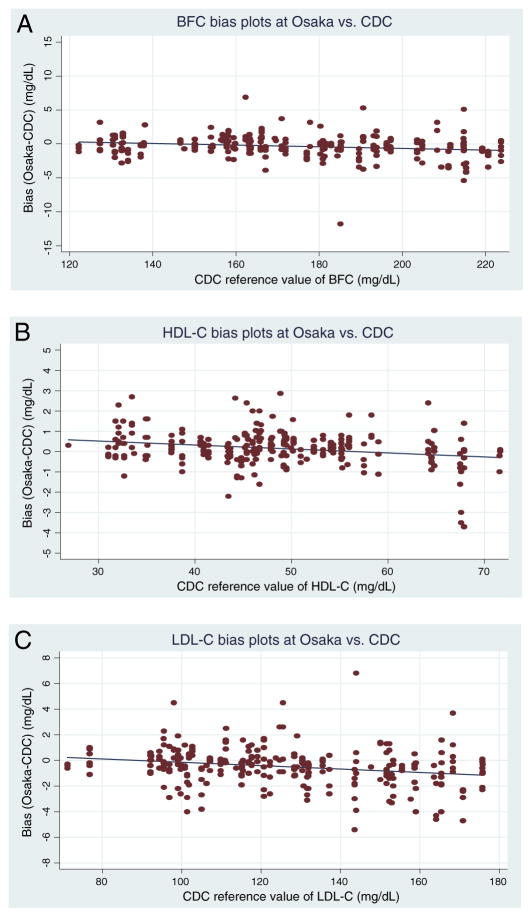
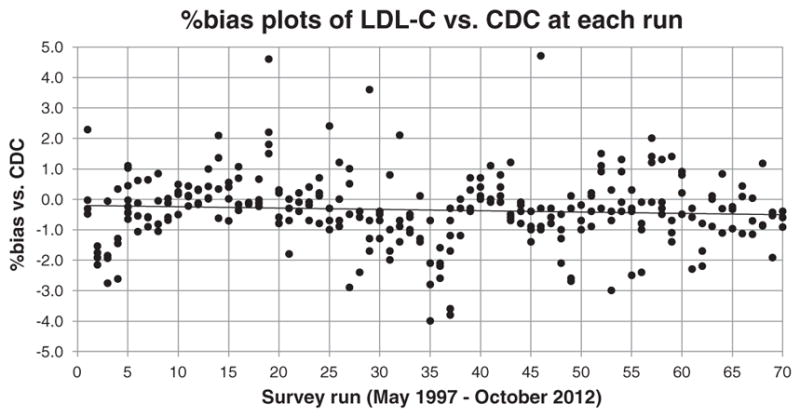
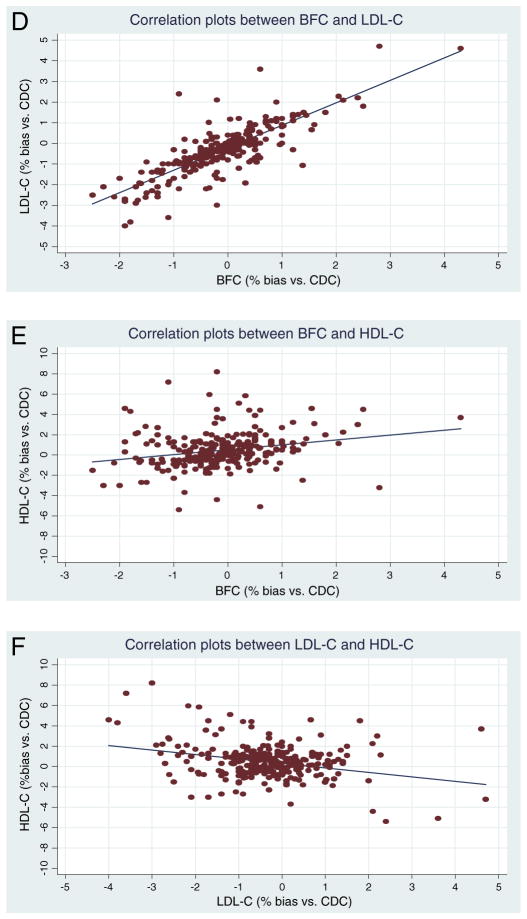
Description:Background ; Accurate measurement of blood lipids is crucial in cardiovascular disease risk management. The Centers for Disease Control and Prevention (CDC) Cholesterol Reference Method Laboratory Network (CRMLN) has assured the accuracy of these measurements forover 20 years using beta quantification (BQ) method as reference measurement procedure (RMP) for high- and low-density lipoprotein cholesterol (HDL-C, LDL-C). Only limited data exist about the performance of the BQ RMP. ; Methods ; Bottom fraction cholesterol (BFC), HDL-C, and LDL-C results after ultracentrifugation from the CDC lipid reference laboratory and the Japanese CRMLN laboratory were compared using 280 serum samples measured over the past 15 years. Data were compared statistically using method comparison and bias estimation analysis. ; Results ; Regression analysis between CDC (x) and Osaka (y) for BFC, HDL-C, and LDL-C were y = 0.988x + 1.794 (R2 = 0.997), y = 0.980x + 1.118 (R2 = 0.994), and y = 0.987x + 1.200 (R2 = 0.997), respectively. The Osaka laboratory met performance goals for 90% to 95% of the CDC reference values. ; Conclusions ; The BQ method by the Osaka CRMLN laboratory is highly accurate and has been stable for over 15 years. Accurate measurement of BFC is critical for the determination of LDL-C.
-
Subjects:
-
Keywords:
-
Source:Clin Chim Acta. 431:288-293
-
Pubmed ID:24589772
-
Pubmed Central ID:PMC5700747
-
Document Type:
-
Funding:
-
Volume:431
-
Download URL:
-
File Type:
 [PDF - 585.76 KB]
 -
Collection(s):
-
Main Document Checksum:urn:sha256:6d0b89cfbd4e8f6ee116602b1eafbec2a24ffb634b6e817f2bc313c9e55d8c5b
Supporting Files


File Language:
English
 Was this page helpful?
 Found an issue?


CDC STACKS serves as an archival repository of CDC-published products including
scientific findings, journal articles, guidelines, recommendations, or other public health information authored or
co-authored by CDC or funded partners.
As a repository, CDC STACKS retains documents in their original published format to ensure public access to scientific information.
As a repository, CDC STACKS retains documents in their original published format to ensure public access to scientific information.
You May Also Like
COLLECTION
CDC Public Access