


Evaluation of 24-locus MIRU-VNTR genotyping in Mycobacterium tuberculosis cluster investigations in four jurisdictions in the United States, 2006–2010
Supporting Files

-
May 25 2017
-
File Language:
English
Details
-
Alternative Title:Tuberculosis (Edinb)
-
Personal Author:
-
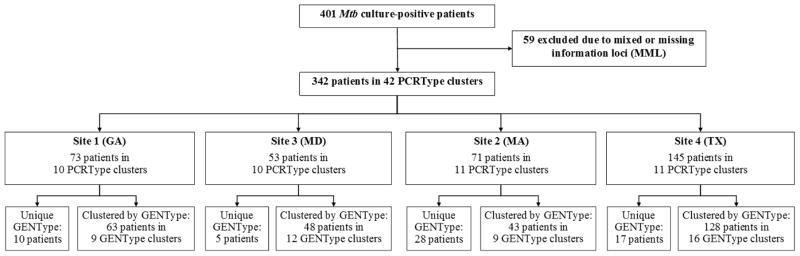
Description:The U.S. Centers for Disease Control and Prevention (CDC) uses a combination of spacer oligonucleotide typing (spoligotyping) and mycobacterial interspersed repetitive units-variable number of tandem repeats (MIRU-VNTR) analyses as part of the National TB Genotyping Service (NTGS). The NTGS expansion from 12-locus MIRU-VNTR (MIRU12) to 24-locus MIRU-VNTR (MIRU24) in 2009 enhanced the ability to discriminate Mycobacterium tuberculosis strains. In the current study, we investigated the MIRU24 concordance among epidemiologic-linked tuberculosis (TB) patients in four U.S. health jurisdictions. We also evaluated the programmatic benefits of combining MIRU24 and spoligotyping with epidemiologic evidence in identifying potential recent TB transmission. We examined 342 TB patients in 42 spoligotype/MIRU12 (PCRType) clusters (equivalent to 46 spoligotype/MIRU24 [GENType] clusters) to identify epidemiologic links among cases. GENType clusters, when compared to PCRType clusters, had 12 times higher odds of epidemiologic links being identified if patients were younger than 25 years and 3 times higher odds if patients resided in the same zip code, or had HIV infection. Sixty (18%) fewer PCRType-clustered patients would need investigations if clusters are defined using GENType instead of PCRType. An important advantage of defining clusters by MIRU24 is resource savings related to the reduced number of clustered cases needing investigation.
-
Subjects:
-
Source:Tuberculosis (Edinb). 106:9-15.
-
Pubmed ID:28802410
-
Pubmed Central ID:PMC5657443
-
Document Type:
-
Funding:
-
Place as Subject:
-
Volume:106
-
Collection(s):
-
Main Document Checksum:urn:sha256:8f72061221f60d61e99c69ddc6127876220555695a833700b5595604e933455b
-
Download URL:
-
File Type:
 [PDF
- 260.34 KB
]
[PDF
- 260.34 KB
]
Supporting Files


File Language:
English
ON THIS PAGE

CDC STACKS serves as an archival repository of CDC-published products including
scientific findings,
journal articles, guidelines, recommendations, or other public health information authored or
co-authored by CDC or funded partners.
As a repository, CDC STACKS retains documents in their original published format to ensure public access to scientific information.
As a repository, CDC STACKS retains documents in their original published format to ensure public access to scientific information.
You May Also Like
COLLECTION
CDC Public Access