



Relationships between infection with Plasmodium falciparum during pregnancy, measures of placental malaria, and adverse birth outcomes
Supporting Files
Public Domain

-
Oct 05 2017
-
Available in CDC Stacks on 2017-10-05T00:00:00Z
Details
-
Alternative Title:Malar J
-
Personal Author:Kapisi, James ; Kakuru, Abel ; Jagannathan, Prasanna ; Muhindo, Mary K. ; Natureeba, Paul ; Awori, Patricia ; Nakalembe, Miriam ; Ssekitoleko, Richard ; Olwoch, Peter ; Ategeka, John ; Nayebare, Patience ; Clark, Tamara D. ; Rizzuto, Gabrielle ; Muehlenbachs, Atis ; Havlir, Diane V. ; Kamya, Moses R. ; Dorsey, Grant ; Gaw, Stephanie L.
-
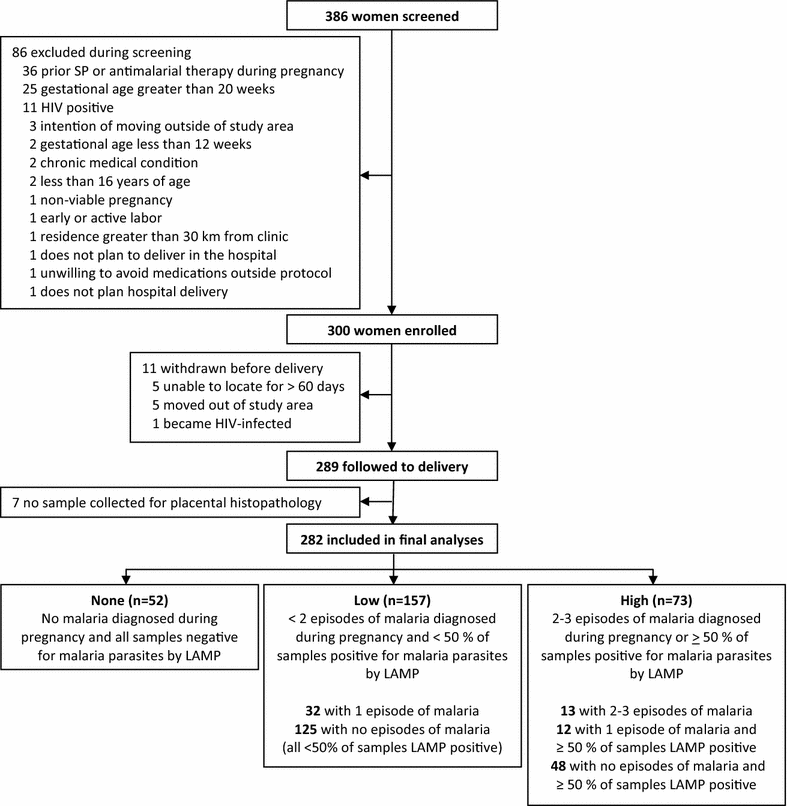
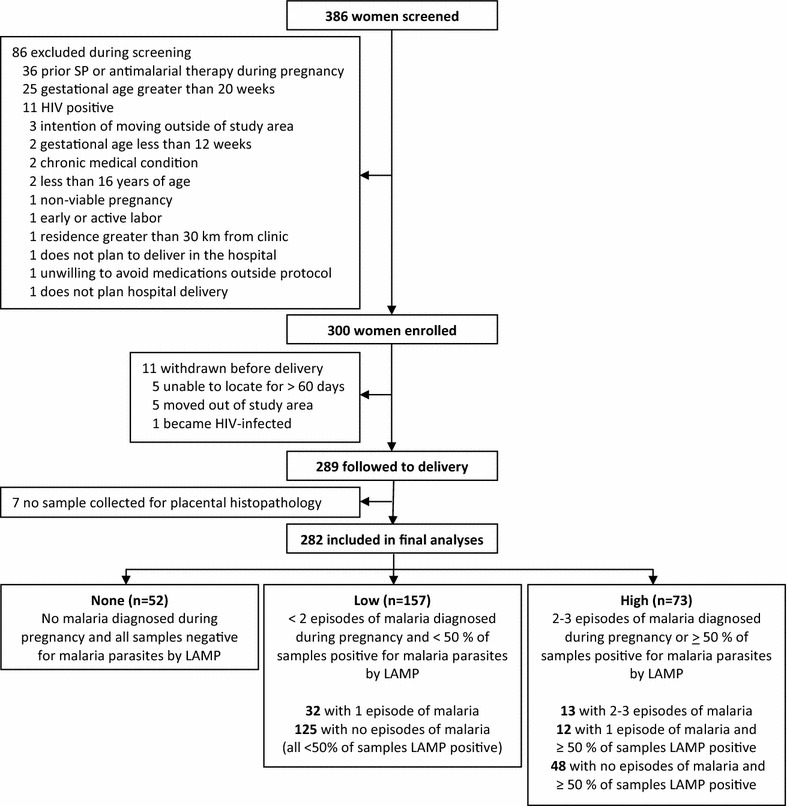
Description:Background ; Malaria in pregnancy has been associated with maternal morbidity, placental malaria, and adverse birth outcomes. However, data are limited on the relationships between longitudinal measures of malaria during pregnancy, measures of placental malaria, and birth outcomes. ; Methods ; This is a nested observational study of data from a randomized controlled trial of intermittent preventive therapy during pregnancy among 282 participants with assessment of placental malaria and delivery outcomes. HIV-uninfected pregnant women were enrolled at 12–20 weeks of gestation. Symptomatic malaria during pregnancy was measured using passive surveillance and monthly detection of asymptomatic parasitaemia using loop-mediated isothermal amplification (LAMP). Placental malaria was defined as either the presence of parasites in placental blood by microscopy, detection of parasites in placental blood by LAMP, or histopathologic evidence of parasites or pigment. Adverse birth outcomes assessed included low birth weight (LBW), preterm birth (PTB), and small for gestational age (SGA) infants. ; Results ; The 282 women were divided into three groups representing increasing malaria burden during pregnancy. Fifty-two (18.4%) had no episodes of symptomatic malaria or asymptomatic parasitaemia during the pregnancy, 157 (55.7%) had low malaria burden (0–1 episodes of symptomatic malaria and < 50% of samples LAMP+), and 73 (25.9%) had high malaria burden during pregnancy (≥ 2 episodes of symptomatic malaria or ≥ 50% of samples LAMP+). Women with high malaria burden had increased risks of placental malaria by blood microscopy and LAMP aRR 14.2 (1.80–111.6) and 4.06 (1.73–9.51), respectively, compared to the other two groups combined. Compared with women with no malaria exposure during pregnancy, the risk of placental malaria by histopathology was higher among low and high burden groups aRR = 3.27 (1.32–8.12) and aRR = 7.07 (2.84–17.6), respectively. Detection of placental parasites by any method was significantly associated with PTB aRR 5.64 (1.46–21.8), and with a trend towards increased risk for LBW and SGA irrespective of the level of malaria burden during pregnancy. ; Conclusion ; Higher malaria burden during pregnancy was associated with placental malaria and together with the detection of parasites in the placenta were associated with increased risk for adverse birth outcomes. ; Electronic supplementary material ; The online version of this article (doi:10.1186/s12936-017-2040-4) contains supplementary material, which is available to authorized users.
-
Subjects:
-
Source:Malar J. 16.
-
Pubmed ID:28982374
-
Pubmed Central ID:PMC5629777
-
Document Type:
-
Volume:16
-
Download URL:
-
File Type:
 [PDF - 1023.01 KB]
 -
Collection(s):
-
Main Document Checksum:urn:sha256:5d7ea5e46c7d8e9f1bf649134a9812cc8bc1bc01edfc3b5156e4ceee76b7e39b
Supporting Files


 Was this page helpful?
 Found an issue?




CDC STACKS serves as an archival repository of CDC-published products including
scientific findings, journal articles, guidelines, recommendations, or other public health information authored or
co-authored by CDC or funded partners.
As a repository, CDC STACKS retains documents in their original published format to ensure public access to scientific information.
As a repository, CDC STACKS retains documents in their original published format to ensure public access to scientific information.
You May Also Like
COLLECTION
CDC Public Access