


Preparing adolescents with heart problems for transition to adult care, 2009–2010 National Survey of Children with Special Health Care Needs
Supporting Files

-
May 19 2017
File Language:
English
Details
-
Alternative Title:Congenit Heart Dis
-
Personal Author:
-
Description:Objective
A substantial percentage of children with congenital heart disease (CHD) fail to transfer to adult care, resulting in increased risk of morbidity and mortality. Transition planning discussions with a provider may increase rates of transfer, yet little is known about frequency and content of these discussions. We assessed prevalence and predictors of transition-related discussions between providers and parents of children with special healthcare needs (CSHCN) and heart problems, including CHD.
Design
Using parent-reported data on 12- to 17-year-olds from the 2009–2010 National Survey of CSHCN, we calculated adjusted prevalence ratios (aPR) for associations between demographic factors and provider discussions on shift to adult care, future insurance, and adult healthcare needs, weighted to generate population-based estimates.
Results
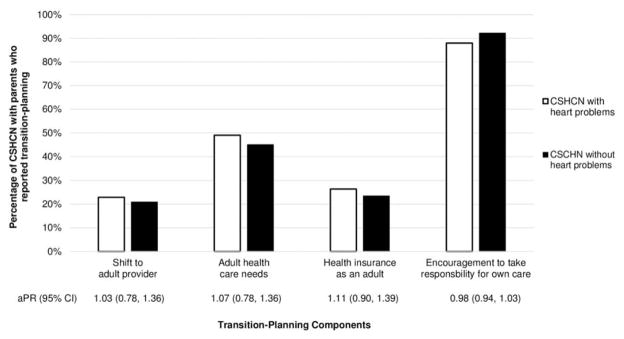
Of the 5.3% of adolescents with heart problems in our sample (n =724), 52.8% were female, 65.3% white, 62.2% privately insured, and 37.1% had medical homes. Less than 50% had parents who discussed with providers their child’s future health insurance (26.4%), shift to adult care (22.9%), and adult healthcare needs (49.0%). Transition planning did not differ between children with and without heart problems (aPR range: 1.0–1.1). Among parents of CSHCN with heart problems who did not have discussions, up to 66% desired one. Compared to 1-/13-year-olds, a larger percentage of 16-/17-year-olds had parents who discussed their shift to adult care (aPR 2.1, 95% confidence interval (CI) [1.1, 3.9]), and future insurance (aPR 1.8, 95% CI [1.1, 2.9]). Having a medical home was associated with discussing adult healthcare needs (aPR 1.5, 95% CI [1.2, 1.8]) and future insurance (aPR 1.8, 95% CI [1.3, 2.6]).
Conclusions
Nationally, less than half of adolescents with heart problems had parents who discussed their child’s transition with providers, which could be contributing to the large percentage of CHD patients who do not successfully transfer to adult care.
-
Subjects:
-
Source:Congenit Heart Dis. 12(4):497-506.
-
Pubmed ID:28523852
-
Pubmed Central ID:PMC5605904
-
Document Type:
-
Funding:
-
Volume:12
-
Issue:4
-
Collection(s):
-
Main Document Checksum:urn:sha256:858c18d63f009d75447b5d14e1ca6401f3ad9088e3c69e64e0cbcd22970eaf0d
-
Download URL:
-
File Type:
 [PDF
- 181.83 KB
]
[PDF
- 181.83 KB
]
Supporting Files


File Language:
English
ON THIS PAGE

CDC STACKS serves as an archival repository of CDC-published products including
scientific findings,
journal articles, guidelines, recommendations, or other public health information authored or
co-authored by CDC or funded partners.
As a repository, CDC STACKS retains documents in their original published format to ensure public access to scientific information.
As a repository, CDC STACKS retains documents in their original published format to ensure public access to scientific information.
You May Also Like
COLLECTION
CDC Public Access