


Screening for Cervical Cancer and Sexually Transmitted Diseases Among HIV-Infected Women
Supporting Files

-
2 2016
-
File Language:
English
Details
-
Alternative Title:J Womens Health (Larchmt)
-
Personal Author:
-
Description:Background
Women living with HIV infection are at higher risk for cervical cancer, an AIDS-defining diagnosis. We examined the prevalence of cervical cancer and sexually transmitted disease (STD) screening among human immunodeficiency virus (HIV)-infected women and factors associated with the receipt of Papanicolaou (Pap) tests.
Methods
We did a cross-sectional analysis of weighted data from a sample of HIV-infected adults receiving outpatient medical care. We used matched interview (report of Pap test) and medical record data (STD screenings) from HIV-infected women. We performed logistic regression to compute adjusted prevalence ratios and 95% confidence intervals for the association between demographic, behavioral, and clinical factors and receipt of Pap tests among HIV-infected women.
Results
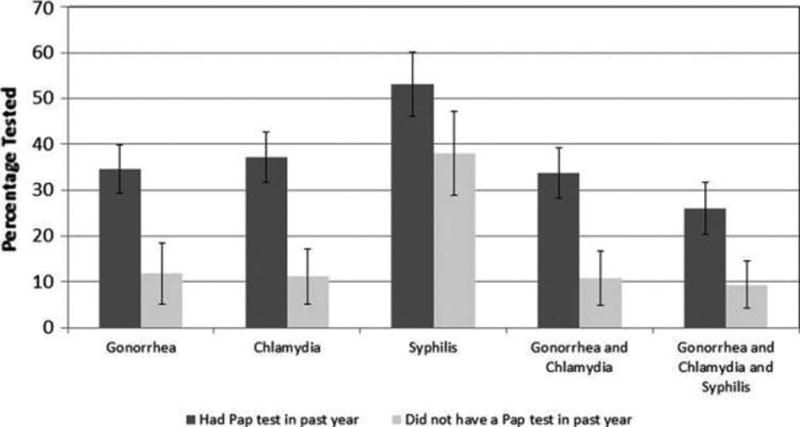
Data were available for 2,270 women, who represent 112,894 HIV-infected women; 62% were African American, 17% were Hispanic/Latina, and 18% were white. Most (78%) reported having a Pap test in the past year. Among sexually active women (n= 1234), 20% reported sex without condoms, 27% were screened for gonorrhea, and 29% were screened for chlamydia. Being screened for STDs was less likely among women who did not have a Pap test in the past year (adjusted prevalence ratios 0.82, 95% confidence interval 0.77–0.87). Women who were ≥50 years of age and reported income above federal poverty level, no sexual activity, depression, no HIV care from an obstetrician/gynecologist, and no documented STD tests, were less likely to report a Pap test (p < 0.05).
Conclusions
Screening for cervical cancer and STDs among HIV-infected women is suboptimal. Clinical visits for Pap tests are an important opportunity for HIV-infected sexually active women to also receive STD screenings and counseling regarding condoms.
-
Subjects:
-
Source:J Womens Health (Larchmt). 25(2):124-132
-
Pubmed ID:26447835
-
Pubmed Central ID:PMC5564184
-
Document Type:
-
Funding:
-
Volume:25
-
Issue:2
-
Collection(s):
-
Main Document Checksum:urn:sha256:d37961b6be6e49b88adc76922d645ca0581c9c45d5805579de6fa55c587b498d
-
Download URL:
-
File Type:
 [PDF
- 168.96 KB
]
[PDF
- 168.96 KB
]
Supporting Files


File Language:
English
ON THIS PAGE


CDC STACKS serves as an archival repository of CDC-published products including
scientific findings,
journal articles, guidelines, recommendations, or other public health information authored or
co-authored by CDC or funded partners.
As a repository, CDC STACKS retains documents in their original published format to ensure public access to scientific information.
As a repository, CDC STACKS retains documents in their original published format to ensure public access to scientific information.
You May Also Like
COLLECTION
CDC Public Access