



Effects of Marital Status and Economic Resources on Survival After Cancer: A Population-Based Study
Supporting Files

-
5 15 2016 ; 5-15-
-
Available in CDC Stacks on 2017-08-16T00:00:00Z
File Language:
English
Details
-
Alternative Title:Cancer
-
Personal Author:
-
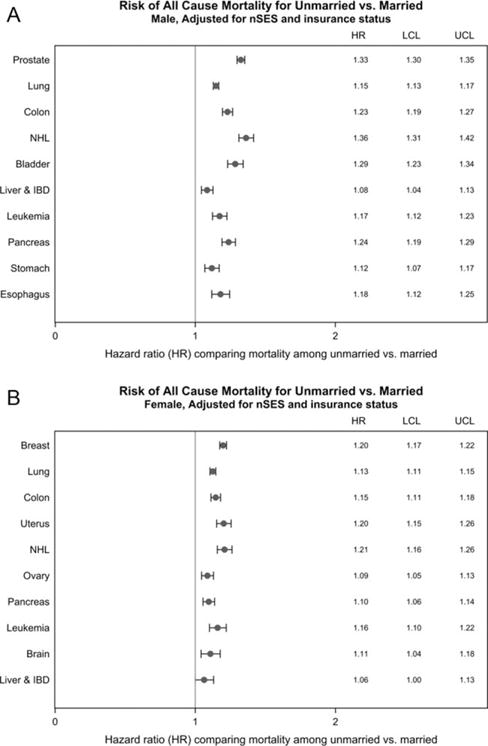
Description:BACKGROUND ; Although married cancer patients have more favorable survival than unmarried patients, reasons underlying this association are not fully understood. The authors evaluated the role of economic resources, including health insurance status and neighborhood socioeconomic status (nSES), in a large California cohort. ; METHODS ; From the California Cancer Registry, we identified 783,167 cancer patients (386,607 deaths) who were diagnosed during 2000 through 2009 with a first primary, invasive cancer of the 10 most common sites of cancer-related death for each sex and were followed through 2012. Age-stratified and stage-stratified Cox proportional hazard models were used to estimate hazard ratios (HRs) and 95% confidence intervals (95% CIs) for all-cause mortality associated with marital status, adjusted for cancer site, race/ethnicity, and treatment. ; RESULTS ; Compared with married patients, unmarried patients had an elevated risk of mortality that was higher among males (HR, 1.27; 95% CI, 1.26–1.29) than among females (HR, 1.19; 95% CI, 1.18–1.20; Pinteraction < .001). Adjustment for insurance status and nSES reduced the marital status HRs to 1.22 for males and 1.15 for females. There was some evidence of synergistic effects of marital status, insurance, and nSES, with relatively higher risks observed for unmarried status among those who were under-insured and living in high nSES areas compared with those who were under-insured and living in low nSES areas (Pinteraction = 6.8 × 10⁻⁹ among males and 8.2 × 10⁻⁸ among females). ; CONCLUSIONS ; The worse survival of unmarried than married cancer patients appears to be minimally explained by differences in economic resources.
-
Subjects:
-
Keywords:
-
Source:Cancer. 122(10):1618-1625
-
Pubmed ID:27065317
-
Pubmed Central ID:PMC5558592
-
Document Type:
-
Funding:HHSN261201000035C/CA/NCI NIH HHSUnited States/ ; HHSN261201000035I/CA/NCI NIH HHSUnited States/ ; HHSN261201000034C/CA/NCI NIH HHSUnited States/ ; U58 DP003862/DP/NCCDPHP CDC HHSUnited States/ ; HHSN261201000140C/CA/NCI NIH HHSUnited States/ ; U54 CA132384/CA/NCI NIH HHSUnited States/ ; P30 CA023100/CA/NCI NIH HHSUnited States/ ; U54 CA132379/CA/NCI NIH HHSUnited States/
-
Volume:122
-
Issue:10
-
Download URL:
-
File Type:
 [PDF - 141.85 KB]
 -
Collection(s):
-
Main Document Checksum:urn:sha256:7bfb2de975e019ddfd98e4a7c7419c3d1817f5f8b751fa2a84675abb8e23d02a
Supporting Files


File Language:
English
 Was this page helpful?
 Found an issue?

CDC STACKS serves as an archival repository of CDC-published products including
scientific findings, journal articles, guidelines, recommendations, or other public health information authored or
co-authored by CDC or funded partners.
As a repository, CDC STACKS retains documents in their original published format to ensure public access to scientific information.
As a repository, CDC STACKS retains documents in their original published format to ensure public access to scientific information.
You May Also Like
COLLECTION
CDC Public Access