



Effectiveness of community-based condom distribution interventions to prevent HIV in the United States: A systematic review and meta-analysis
Supporting Files
Public Domain

-
Aug 03 2017
File Language:
English
Details
-
Alternative Title:PLoS One
-
Personal Author:
-
Description:Background
Despite significant public health implications, the extent to which community-based condom distribution interventions (CDI) prevent HIV infection in the United States is not well understood.
Methods
We systematically reviewed research evidence applying Cochrane Collaboration methods. We used a comprehensive search strategy to search multiple bibliographic databases for relevant randomized controlled trials (RCTs) and non-RCTs published from 1986–2017. We focused on CDI that made condoms widely available or accessible in community settings. Eligible outcomes were HIV infection (primary), sexually transmitted infections, condom use, and multiple sexual partnership. Two reviewers independently screened citations to assess their eligibility, extracted study data, and assessed risk of bias. We calculated risk ratios (RR) with 95% confidence intervals (CI) and pooled them using random-effects models. We assessed evidence quality using GRADE.
Results
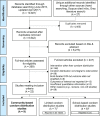
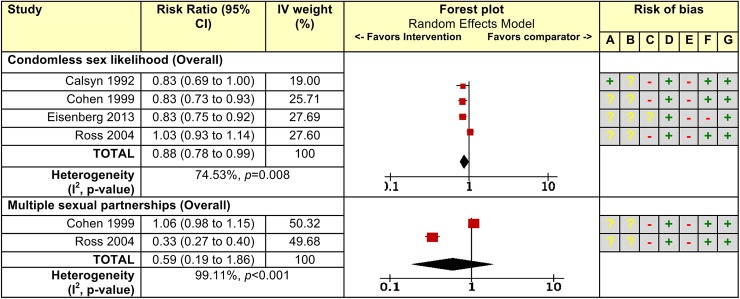
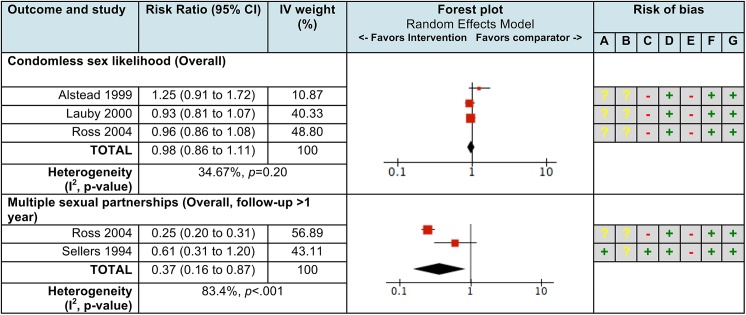
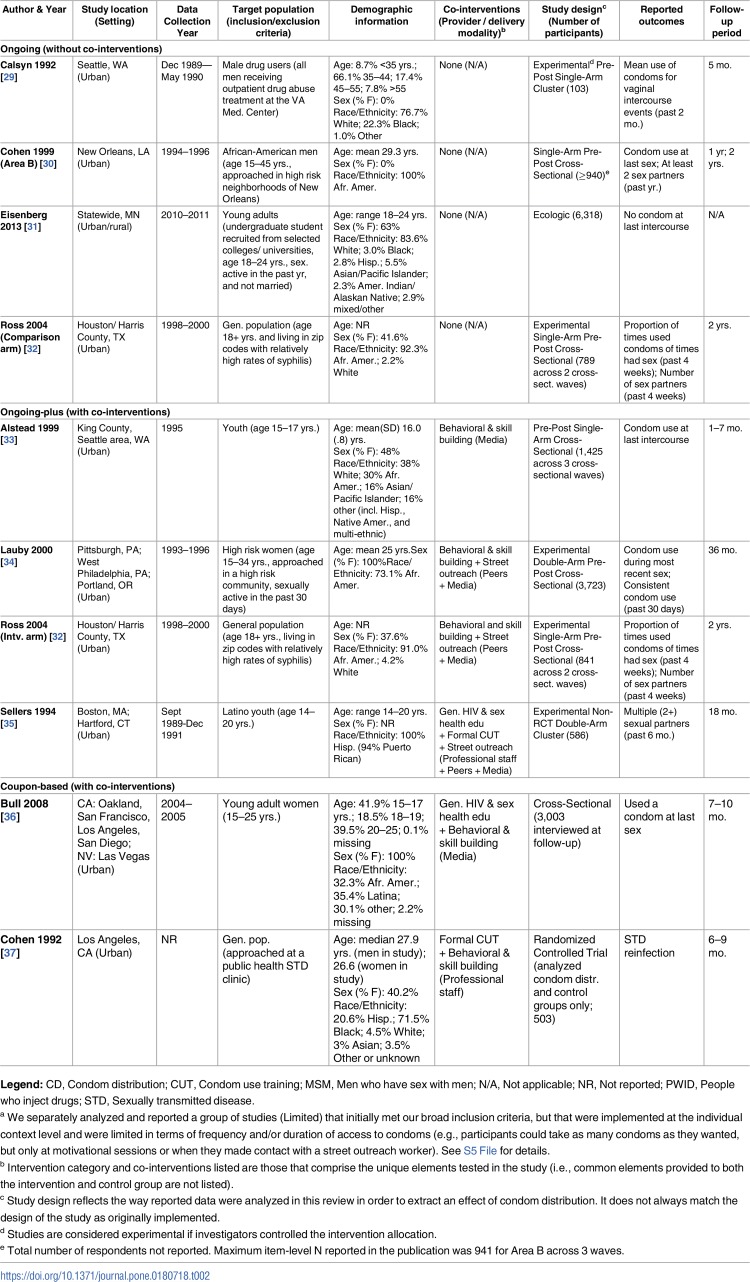
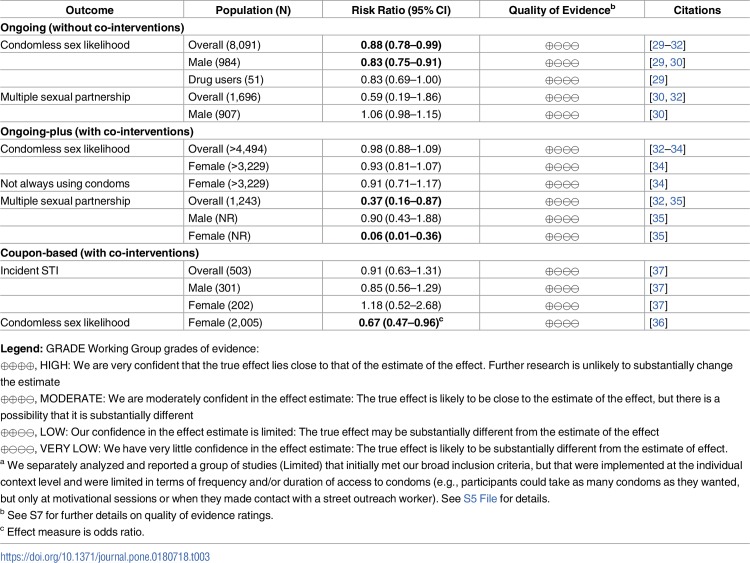
We reviewed 5,110 unique records. Nine studies (including one RCT) met eligibility criteria. Studies were conducted in 10 US states between 1989 and 2011. All studies were at high risk of bias. Interventions were categorized into three groups: “Ongoing” (unlimited access to condoms), “Ongoing-plus” (unlimited access to condoms, with co-interventions), and “Coupon-based” (coupons redeemed for condoms). No studies reported incident HIV. Ongoing CDI (four non-RCTs) modestly reduced condomless sex (RR 0.88, 95% CI 0.78 to 0.99). Ongoing-plus CDI (two non-RCTs) significantly reduced multiple sexual partnership (RR 0.37, 95% CI 0.16 to 0.87). Of two coupon-based studies, one (non-RCT) showed reduction in condomless sex in female participants (Odds Ratio 0.67, 95% CI 0.47 to 0.96), while the other one (RCT) showed no effect on STI incidence (RR 0.91, 95% CI 0.63 to 1.31). Evidence quality was “very low” for all outcomes.
Conclusions
CDI may reduce some risky sexual behaviors, but the evidence for any reduction is limited and of low-quality. Lack of biological outcomes precludes assessing the link between CDI and HIV incidence. -
Subjects:
-
Source:PLoS One. 12(8).
-
Pubmed ID:28771484
-
Pubmed Central ID:PMC5542551
-
Document Type:
-
Place as Subject:
-
Volume:12
-
Issue:8
-
Download URL:
-
File Type:
 [PDF - 2.36 MB]
 -
Collection(s):
-
Main Document Checksum:urn:sha256:d1656fdba28cf749fda93020725a4e729c8f9e8b3a0138c31781c371763e6a66
Supporting Files


File Language:
English
 Was this page helpful?
 Found an issue?




CDC STACKS serves as an archival repository of CDC-published products including
scientific findings, journal articles, guidelines, recommendations, or other public health information authored or
co-authored by CDC or funded partners.
As a repository, CDC STACKS retains documents in their original published format to ensure public access to scientific information.
As a repository, CDC STACKS retains documents in their original published format to ensure public access to scientific information.
You May Also Like
COLLECTION
CDC Public Access