


Risky sex and HIV acquisition among HIV serodiscordant couples in Zambia, 2002–2012: What does alcohol have to do with it?
Supporting Files

-
Jul 2017
-
File Language:
English
Details
-
Alternative Title:AIDS Behav
-
Personal Author:
-
Description:Objective
To evaluate the effects of heavy alcohol consumption on sexual behavior, HIV acquisition, and antiretroviral treatment (ART) initiation.
Design
Longitudinal open cohort of 1,929 serodiscordant couples in Lusaka, Zambia, 2002–2012.
Methods
We evaluated factors associated with baseline heavy alcohol consumption and its association with condomless sex with the study partner, sex outside of the partnership, and ART initiation using multivariable logistic regression. We estimated the effect of alcohol consumption on HIV acquisition using multivariable Cox models.
Results
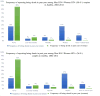
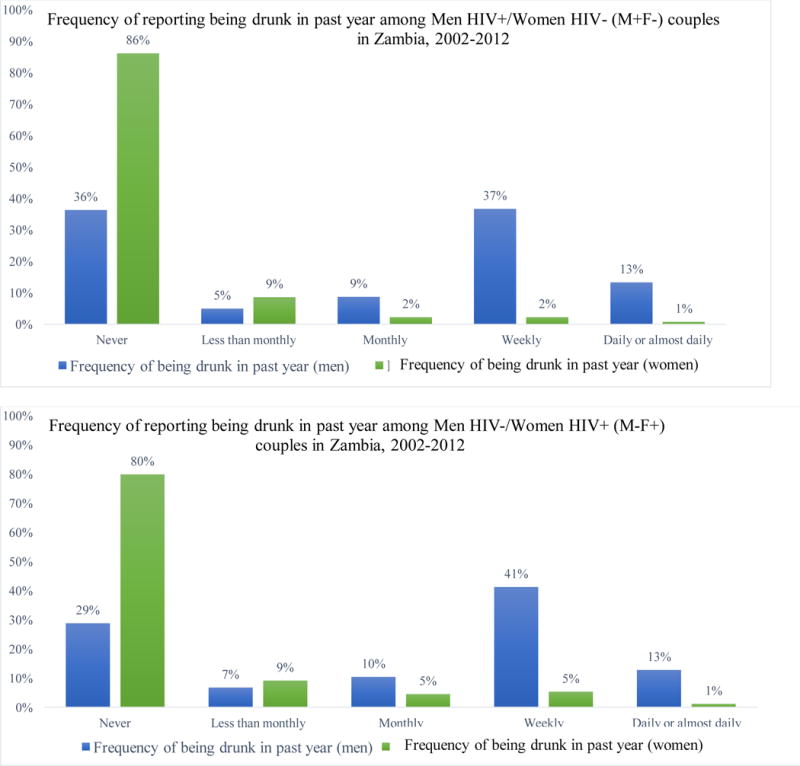
Baseline factors significantly (p<0.05) associated with women’s heavy drinking (drunk weekly or more in 12-months before enrollment) included woman’s older age (adjusted prevalence odds ratio [aPOR]=1.04), partner heavy drinking (aPOR=3.93), and being HIV-infected (aPOR=2.03). Heavy drinking among men was associated with less age disparity with partner (aPOR=0.97) and partner heavy drinking (aPOR=1.63). Men’s being drunk daily (aOR=1.18), women’s being drunk less than monthly (aOR=1.39) vs. never drunk and being in a male HIV-negative and female HIV-positive union (aOR=1.45) were associated with condomless sex. Heavy alcohol use was associated with having 1 or more outside sex partners among men (aOR drunk daily=1.91, drunk weekly=1.32, drunk monthly aOR=2.03 vs. never), and women (aOR drunk monthly=2.75 vs. never). Being drunk weekly or more increased men’s risk of HIV acquisition (adjusted hazard ratio [aHR]=1.72). Men and women being drunk weekly or more was associated (p<0.1) with women’s seroconversion (aHR=1.42 and aHR=3.71 respectively). HIV-positive women who were drunk monthly or more had lower odds of initiating ART (aOR=0.83; 95% CI=0.70–0.99) adjusting for age, months since baseline and previous pregnancies.
Conclusion
Individuals in HIV-serodiscordant couples who reported heavy drinking had more outside sex partnerships and condomless sex with their study partner and were more likely to acquire HIV. HIV-positive women were less likely to initiate ART if they were heavy drinkers.
-
Subjects:
-
Source:AIDS Behav. 21(7):1892-1903.
-
Pubmed ID:28243934
-
Pubmed Central ID:PMC5493513
-
Document Type:
-
Funding:P30 AI050409/AI/NIAID NIH HHS/United States ; R01 AI040951/AI/NIAID NIH HHS/United States ; R01 HD040125/HD/NICHD NIH HHS/United States ; R01 AI051231/AI/NIAID NIH HHS/United States ; R01 AI023980/AI/NIAID NIH HHS/United States ; R37 AI051231/AI/NIAID NIH HHS/United States ; P30 MH058107/MH/NIMH NIH HHS/United States ; R01 AI064060/AI/NIAID NIH HHS/United States ; D43 TW001042/TW/FIC NIH HHS/United States ; R01 MH066767/MH/NIMH NIH HHS/United States ; T32 MH080634/MH/NIMH NIH HHS/United States ; U2G PS000758/PS/NCHHSTP CDC HHS/United States
-
Volume:21
-
Issue:7
-
Collection(s):
-
Main Document Checksum:urn:sha256:8f71bdd9fac1eac68229dd46864c33fb31f9add772dbfc5e928d4c75f7b52785
-
Download URL:
-
File Type:
 [PDF
- 228.79 KB
]
[PDF
- 228.79 KB
]
Supporting Files


File Language:
English
ON THIS PAGE

CDC STACKS serves as an archival repository of CDC-published products including
scientific findings,
journal articles, guidelines, recommendations, or other public health information authored or
co-authored by CDC or funded partners.
As a repository, CDC STACKS retains documents in their original published format to ensure public access to scientific information.
As a repository, CDC STACKS retains documents in their original published format to ensure public access to scientific information.
You May Also Like
COLLECTION
CDC Public Access