


Restore the brake on tumor progression
Supporting Files

-
Apr 05 2017
File Language:
English
Details
-
Alternative Title:Biochem Pharmacol
-
Personal Author:
-
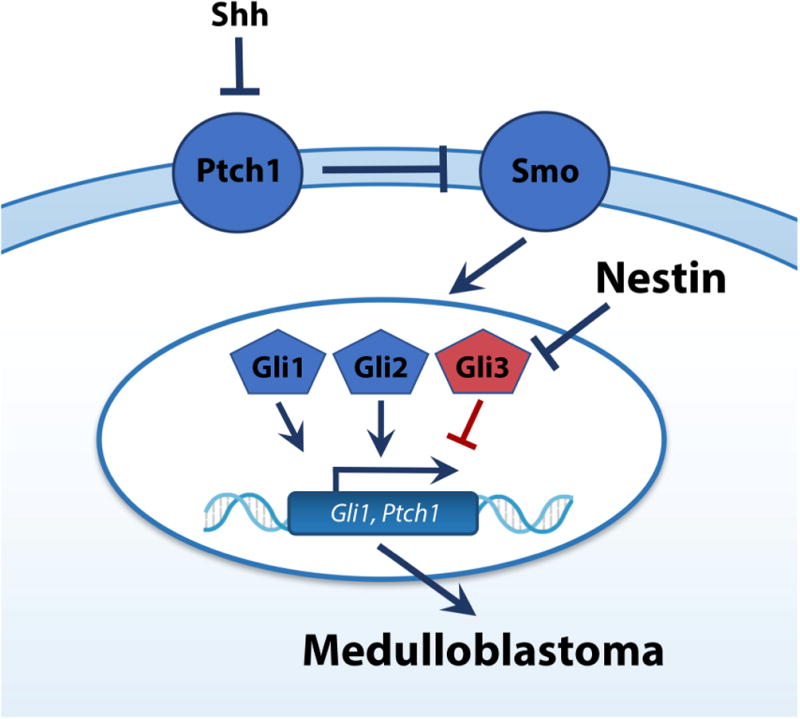
Description:Sonic hedgehog (Shh) signaling plays a key role in regulation of normal development. The negative feedback mechanism mediated by the transcriptional factor, Gli3, acts to finely tune Shh signaling, providing tight control of normal developmental processes. Hyperactivation of Shh signaling often leads to many human malignancies, including basal cell carcinoma and medulloblastoma (MB). However, how tumor cells sustain the aberrant activation of Shh signaling is still not completely understood. We recently revealed that during MB formation, tumor cells express Nestin, a type VI intermediate filament protein, which maintains uncontrolled Shh signaling by abolishing negative feedback by Gli3. Therefore, Nestin expression is a necessary step for MB formation. These findings highlight the novel function of Nestin in regulating Shh signaling, as well as the important role of a disrupted negative feedback mechanism in MB tumorigenesis. Further, restoration of the intrinsic negative feedback by repressing Nestin expression represents a promising approach to treat MB as well as other Shh signaling associated malignancies.
-
Subjects:
-
Source:Biochem Pharmacol. 138:1-6.
-
Pubmed ID:28389227
-
Pubmed Central ID:PMC5496785
-
Document Type:
-
Funding:
-
Volume:138
-
Collection(s):
-
Main Document Checksum:urn:sha256:fa444db5c892550501a0f503ab9001cc8bcc8fc591a8f993ffcbe646ec0f5696
-
Download URL:
-
File Type:
 [PDF
- 420.73 KB
]
[PDF
- 420.73 KB
]
Supporting Files


File Language:
English
ON THIS PAGE



CDC STACKS serves as an archival repository of CDC-published products including
scientific findings,
journal articles, guidelines, recommendations, or other public health information authored or
co-authored by CDC or funded partners.
As a repository, CDC STACKS retains documents in their original published format to ensure public access to scientific information.
As a repository, CDC STACKS retains documents in their original published format to ensure public access to scientific information.
You May Also Like
COLLECTION
CDC Public Access