



Botulism mortality in the USA, 1975–2009
Supporting Files

-
Aug 04 2016
-
Available in CDC Stacks on 2017-08-04T00:00:00Z
Details
-
Alternative Title:Botulinum J
-
Personal Author:
-
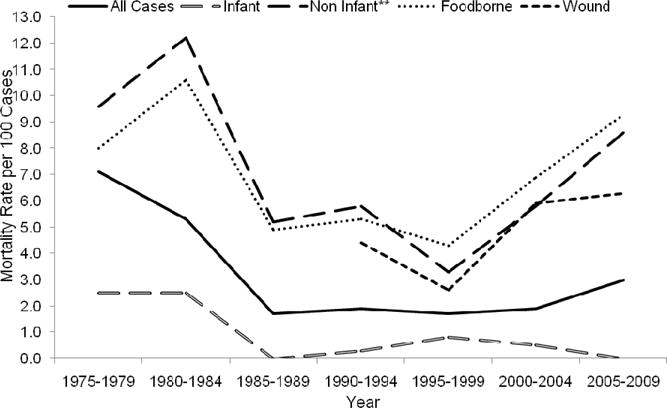
Description:Botulism had mortality rates >60% before the 1950s. We reviewed confirmed botulism cases in the USA during 1975-2009 including infant, foodborne, wound, and other/unknown acquisition categories, and calculated mortality ratios. We created a multivariate logistic regression model for non-infant cases (foodborne, wound, and other/unknown). Overall mortality was 3.0% with 109 botulism-related deaths among 3,618 botulism cases 18 (<1%) deaths among 2,352 infant botulism cases, 61 (7.1%) deaths among 854 foodborne botulism cases, 18 (5.0%) deaths among 359 wound botulism cases, and 12 (22.6%) deaths among 53 other/unknown botulism cases. Mortality among all cases increased with age; it was lowest among infants (0.8%) and highest among persons ≥80 years old (34.4%). Toxin type F had higher mortality (13.8%) than types A, B, or E (range, 1.4% to 4.1%). Efforts to reduce botulism mortality should target non-infant transmission categories and older adults.
-
Subjects:
-
Source:Botulinum J. 3(1):6-17.
-
Pubmed ID:28603554
-
Pubmed Central ID:PMC5460764
-
Document Type:
-
Funding:
-
Volume:3
-
Issue:1
-
Download URL:
-
File Type:
 [PDF - 117.23 KB]
 -
Collection(s):
-
Main Document Checksum:urn:sha256:d43101f45ebe9868bc31488c2ec2e8ad2d16b3cc166905650f133e3e0e27112e
Supporting Files


 Was this page helpful?
 Found an issue?

CDC STACKS serves as an archival repository of CDC-published products including
scientific findings, journal articles, guidelines, recommendations, or other public health information authored or
co-authored by CDC or funded partners.
As a repository, CDC STACKS retains documents in their original published format to ensure public access to scientific information.
As a repository, CDC STACKS retains documents in their original published format to ensure public access to scientific information.
You May Also Like
COLLECTION
CDC Public Access