


Microscopic Analysis and Quality Assessment of Induced Sputum From Children With Pneumonia in the PERCH Study
Supporting Files
Public Domain

-
Jun 15 2017
-
File Language:
English
Details
-
Alternative Title:Clin Infect Dis
-
Personal Author:Murdoch, David R. ; Morpeth, Susan C. ; Hammitt, Laura L. ; Driscoll, Amanda J. ; Watson, Nora L. ; Baggett, Henry C. ; Brooks, W. Abdullah ; Deloria Knoll, Maria ; Feikin, Daniel R. ; Kotloff, Karen L. ; Levine, Orin S. ; Madhi, Shabir A. ; O’Brien, Katherine L. ; Scott, J. Anthony G. ; Thea, Donald M. ; Ahmed, Dilruba ; Awori, Juliet O. ; DeLuca, Andrea N. ; Ebruke, Bernard E. ; Higdon, Melissa M. ; Jorakate, Possawat ; Karron, Ruth A. ; Kazungu, Sidi ; Kwenda, Geoffrey ; Hossain, Lokman ; Makprasert, Sirirat ; Moore, David P. ; Mudau, Azwifarwi ; Mwaba, John ; Panchalingam, Sandra ; Park, Daniel E. ; Prosperi, Christine ; Salaudeen, Rasheed ; Toure, Aliou ; Zeger, Scott L. ; Howie, Stephen R. C.
-
Corporate Authors:
-
Description:Background.
It is standard practice for laboratories to assess the cellular quality of expectorated sputum specimens to check that they originated from the lower respiratory tract. The presence of low numbers of squamous epithelial cells (SECs) and high numbers of polymorphonuclear (PMN) cells are regarded as indicative of a lower respiratory tract specimen. However, these quality ratings have never been evaluated for induced sputum specimens from children with suspected pneumonia.
Methods.
We evaluated induced sputum Gram stain smears and cultures from hospitalized children aged 1–59 months enrolled in a large study of community-acquired pneumonia. We hypothesized that a specimen representative of the lower respiratory tract will contain smaller quantities of oropharyngeal flora and be more likely to have a predominance of potential pathogens compared to a specimen containing mainly saliva. The prevalence of potential pathogens cultured from induced sputum specimens and quantity of oropharyngeal flora were compared for different quantities of SECs and PMNs.
Results.
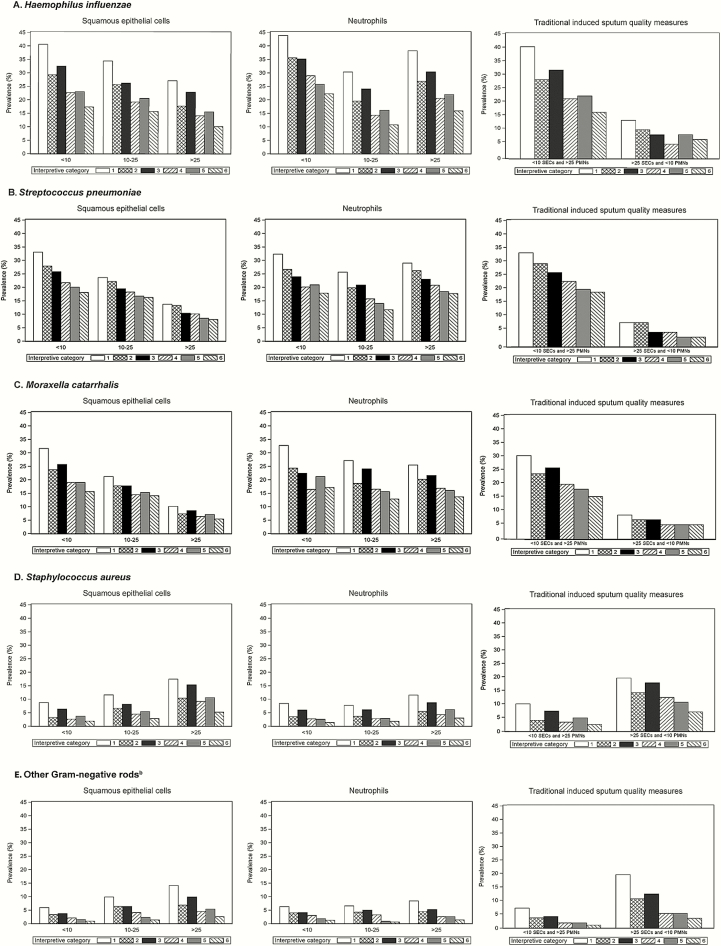
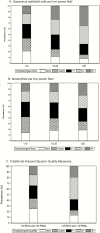
Of 3772 induced sputum specimens, 2608 (69%) had <10 SECs per low-power field (LPF) and 2350 (62%) had >25 PMNs per LPF, measures traditionally associated with specimens from the lower respiratory tract in adults. Using isolation of low quantities of oropharyngeal flora and higher prevalence of potential pathogens as markers of higher quality, <10 SECs per LPF (but not >25 PMNs per LPF) was the microscopic variable most associated with high quality of induced sputum.
Conclusions.
Quantity of SECs may be a useful quality measure of induced sputum from young children with pneumonia.
-
Subjects:
-
Source:Clin Infect Dis. 2017; 64(Suppl 3):S271-S279.
-
Pubmed ID:28575360
-
Pubmed Central ID:PMC5447851
-
Document Type:
-
Volume:64
-
Collection(s):
-
Main Document Checksum:urn:sha256:54960dfb877ffa3c16093938988ee3362bd22a7602ab7d4b3b24314b40f2debd
-
Download URL:
-
File Type:
 [PDF
- 960.97 KB
]
[PDF
- 960.97 KB
]
Supporting Files


File Language:
English
ON THIS PAGE



CDC STACKS serves as an archival repository of CDC-published products including
scientific findings,
journal articles, guidelines, recommendations, or other public health information authored or
co-authored by CDC or funded partners.
As a repository, CDC STACKS retains documents in their original published format to ensure public access to scientific information.
As a repository, CDC STACKS retains documents in their original published format to ensure public access to scientific information.
You May Also Like
COLLECTION
CDC Public Access