



Occult HIV-1 drug resistance to thymidine analogues following failure of first-line tenofovir combined with a cytosine analogue and nevirapine or efavirenz in sub Saharan Africa: a retrospective multi-centre cohort study
Supporting Files

-
3 2017 ; 3-2017
-
Available in CDC Stacks on May 08, 2017, 12:00 AM
File Language:
English
Details
-
Alternative Title:Lancet Infect Dis
-
Personal Author:Gregson, John ; Kaleebu, Pontiano ; Marconi, Vincent C ; van Vuuren, Cloete ; ChB, MB ; Ndembi, Nicaise ; Hamers, Raph L ; Kanki, Phyllis ; Hoffmann, Christopher J ; Lockman, Shahin ; Pillay, Deenan ; de Oliveira, Tulio ; Clumeck, Nathan ; Hunt, Gillian ; Kerschberger, Bernhard ; Shafer, Robert W ; Yang, Chunfu ; Raizes, Elliot ; Kantor, Rami ; Gupta, Ravindra K
-
Description:Background
HIV-1 drug resistance to older thymidine analogue nucleoside reverse transcriptase inhibitor drugs has been identified in sub-Saharan Africa in patients with virological failure of first-line combination antiretroviral therapy (ART) containing the modern nucleoside reverse transcriptase inhibitor tenofovir. We aimed to investigate the prevalence and correlates of thymidine analogue mutations (TAM) in patients with virological failure of first-line tenofovir-containing ART.
Methods
We retrospectively analysed patients from 20 studies within the TenoRes collaboration who had locally defined viral failure on first-line therapy with tenofovir plus a cytosine analogue (lamivudine or emtricitabine) plus a non-nucleoside reverse transcriptase inhibitor (NNRTI; nevirapine or efavirenz) in sub-Saharan Africa. Baseline visits in these studies occurred between 2005 and 2013. To assess between-study and within-study associations, we used meta-regression and meta-analyses to compare patients with and without TAMs for the presence of resistance to tenofovir, cytosine analogue, or NNRTIs.
Findings
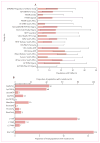
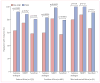
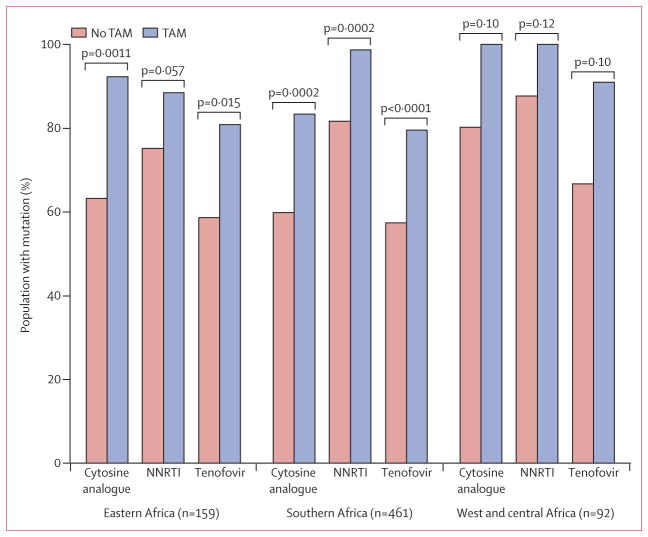
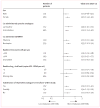
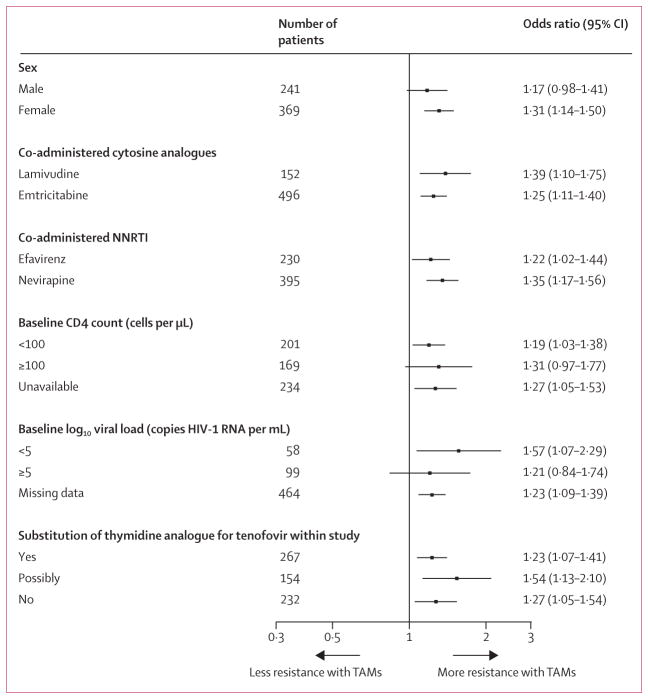
Of 712 individuals with failure of first-line tenofovir-containing regimens, 115 (16%) had at least one TAM. In crude comparisons, patients with TAMs had lower CD4 counts at treatment initiation than did patients without TAMs (60·5 cells per μL IQR 21·0–128·0 in patients with TAMS vs 95·0 cells per μL 37·0–177·0 in patients without TAMs; p=0·007) and were more likely to have tenofovir resistance (93 81% of 115 patients with TAMs vs 352 59% of 597 patients without TAMs; p<0·0001), NNRTI resistance (107 93% vs 462 77%; p<0·0001), and cytosine analogue resistance (100 87% vs 378 63%; p=0·0002). We detected associations between TAMs and drug resistance mutations both between and within studies; the correlation between the study-level proportion of patients with tenofovir resistance and TAMs was 0·64 (p<0·0001), and the odds ratio for tenofovir resistance comparing patients with and without TAMs was 1·29 (1·13–1·47; p<0·0001)
Interpretation
TAMs are common in patients who have failure of first-line tenofovir-containing regimens in sub-Saharan Africa, and are associated with multidrug resistant HIV-1. Effective viral load monitoring and point-of-care resistance tests could help to mitigate the emergence and spread of such strains. -
Keywords:
-
Source:Lancet Infect Dis. 17(3):296-304
-
Pubmed ID:27914856
-
Pubmed Central ID:PMC5421555
-
Document Type:
-
Funding:P30 AI050409/AI/NIAID NIH HHSUnited States/ ; R01 AI066922/AI/NIAID NIH HHSUnited States/ ; UM1 AI069456/AI/NIAID NIH HHSUnited States/ ; R01 AI108441/AI/NIAID NIH HHSUnited States/ ; U2G GH000925/GH/CGH CDC HHSUnited States/ ; R01 AI068581/AI/NIAID NIH HHSUnited States/ ; UL1 TR000454/TR/NCATS NIH HHSUnited States/ ; MC_U950080938/MRC_/Medical Research CouncilUnited Kingdom/ ; P30 AI042853/AI/NIAID NIH HHSUnited States/ ; UL1 RR025008/RR/NCRR NIH HHSUnited States/ ; R01 AI098558/AI/NIAID NIH HHSUnited States/ ; G0600044/MRC_/Medical Research CouncilUnited Kingdom/ ; Wellcome TrustUnited Kingdom/
-
Volume:17
-
Issue:3
-
Download URL:
-
File Type:
 [PDF - 767.14 KB]
 -
Collection(s):
-
Main Document Checksum:urn:sha256:131cd6bd6a4db8a9f572b0157cd32d78e6995910a8f4c0fbe895d98c70417a2c
Supporting Files


File Language:
English
 Was this page helpful?
 Found an issue?




CDC STACKS serves as an archival repository of CDC-published products including
scientific findings, journal articles, guidelines, recommendations, or other public health information authored or
co-authored by CDC or funded partners.
As a repository, CDC STACKS retains documents in their original published format to ensure public access to scientific information.
As a repository, CDC STACKS retains documents in their original published format to ensure public access to scientific information.
You May Also Like
COLLECTION
CDC Public Access