


Polybrominated Diphenyl Ethers and Other Persistent Organic Pollutants in Serum Pools from the National Health and Nutrition Examination Survey: 2001–2002
Supporting Files

-
Sep 24 2013
-
Details
-
Alternative Title:Environ Sci Technol Lett
-
Personal Author:
-
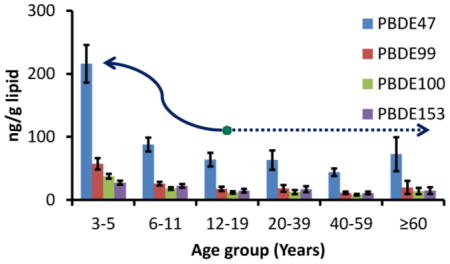
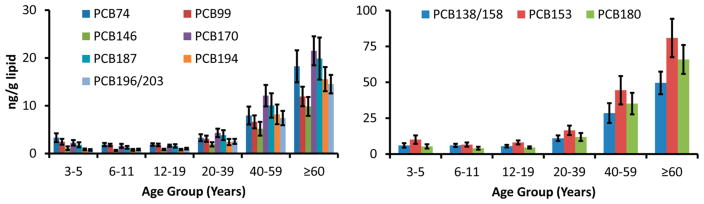
Description:Polybrominated diphenyl ethers (PBDEs), polychlorinated biphenyls (PCBs), and persistent pesticides have been measured in serum pools from participants 3-5, 6-11, 12-19, 20-39, 40-59, and ≥60 years of age from the 2001-2002 National Health and Nutrition Examination Survey. For 2,2',4,4'-tetrabromodiphenyl ether (PBDE-47), the unweighted (not adjusted for sampling weights) arithmetic mean concentration (±95% confidence interval) was 3.4 times higher in 3-5-year-olds (216 ± 30 ng/g of lipid) than in 12-19-year-olds (64 ± 11 ng/g of lipid), with no apparent change with increasing age for adults ≥20 years of age. By contrast, unweighted arithmetic mean concentrations of traditional persistent organic pollutants (POPs) such as hexachlorobenzene (HCB) and 2,2',3,3',4,4',5,5'-octachlorobiphenyl (PCB194) were 2- and 20-fold higher, respectively, in persons ≥60 years than in 12-19-year-old adolescents. Findings suggest higher exposures to PBDEs but lower exposures to traditional POPs in 3-5-year-old children than in adults.
-
Subjects:
-
Source:Environ Sci Technol Lett. 1(1):92-96.
-
Pubmed ID:27933302
-
Pubmed Central ID:PMC5139909
-
Document Type:
-
Funding:
-
Volume:1
-
Issue:1
-
Collection(s):
-
Main Document Checksum:urn:sha256:5950050eb371338e2891b91b9221d9e4b4d05a5443cf45a2688fe113d69c02a7
-
Download URL:
-
File Type:
 [PDF
- 514.41 KB
]
[PDF
- 514.41 KB
]
Supporting Files


ON THIS PAGE




CDC STACKS serves as an archival repository of CDC-published products including
scientific findings,
journal articles, guidelines, recommendations, or other public health information authored or
co-authored by CDC or funded partners.
As a repository, CDC STACKS retains documents in their original published format to ensure public access to scientific information.
As a repository, CDC STACKS retains documents in their original published format to ensure public access to scientific information.
You May Also Like
COLLECTION
CDC Public Access