



Postpartum contraceptive use among women with a recent preterm birth
Supporting Files

-
10 2015 ; 10-2015
-
Available in CDC Stacks on April 04, 2017, 12:00 AM
File Language:
English
Details
-
Alternative Title:Am J Obstet Gynecol
-
Personal Author:
-
Description:OBJECTIVE
To evaluate the associations between postpartum contraception and having a recent preterm birth.
STUDY DESIGN
Population-based data from the Pregnancy Risk Assessment Monitoring System in nine states were used to estimate postpartum use of highly or moderately effective contraception (sterilization, intrauterine device, implants, shots, pills, patch, and ring) and user-independent contraception (sterilization, implants, and intrauterine device) among women with recent live births (2009–2011). We assessed differences in contraception by gestational age (≤27, 28–33, or 34–36 weeks versus term ≥37 weeks) and modeled the associations using multivariable logistic regression with weighted data.
RESULTS
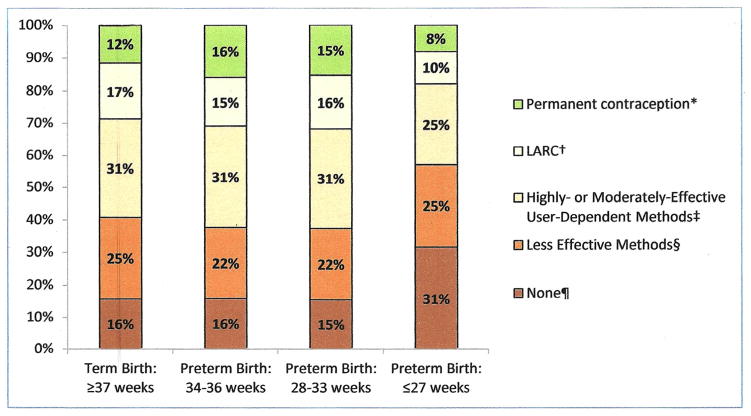
A higher percentage of women with recent extreme preterm birth (≤27 weeks) reported using no postpartum method (31%) compared with all other women (15%–16%). Women delivering extreme preterm infants had decreased odds of using highly or moderately effective methods (adjusted odds ratio aOR=0.5, 95% confidence interval CI: 0.4 – 0.6) and user-independent methods (aOR=0.5, 95% CI: 0.4 – 0.7) compared with women having term births. Wanting to get pregnant was more frequently reported as a reason for contraceptive non-use by women with an extreme preterm birth overall (45%) compared with all other women (15%–18%, p<.0001). Infant death occurred in 41% of extreme preterm births and over half (54%) of these mothers reported wanting to become pregnant as the reason for contraceptive non-use.
CONCLUSIONS
During contraceptive counseling with women who had recent preterm births, providers should address optimal pregnancy interval, and consider that women with recent extreme preterm birth, particularly those whose infants died, may not use contraception because they want to get pregnant. -
Subjects:
- Adolescent
- Adult
- Birth Intervals
- Cohort Studies
- Contraception Behavior
- Contraceptive Agents, Female
- Contraceptive Devices, Female
- Contraceptives, Oral
- Drug Implants
- Female
- Gestational Age
- Humans
- Infant
- Infant, Newborn
- Insurance, Health
- Intrauterine Devices
- Logistic Models
- Medicaid
- Multivariate Analysis
- Perinatal Death
- Postpartum Period
- Pregnancy
- Premature Birth
- Retrospective Studies
- Sterilization, Reproductive
- United States
- Young Adult
-
Keywords:
-
Source:Am J Obstet Gynecol. 213(4):508.e1-508.e9
-
Pubmed ID:26003062
-
Pubmed Central ID:PMC5379122
-
Document Type:
-
Funding:
-
Volume:213
-
Issue:4
-
Download URL:
-
File Type:
 [PDF - 260.45 KB]
 -
Collection(s):
-
Main Document Checksum:urn:sha256:557e75891f861cd7b947b29015660a51c2c57c69b7f23758d781376043f4a23d
Supporting Files


File Language:
English
 Was this page helpful?
 Found an issue?

CDC STACKS serves as an archival repository of CDC-published products including
scientific findings, journal articles, guidelines, recommendations, or other public health information authored or
co-authored by CDC or funded partners.
As a repository, CDC STACKS retains documents in their original published format to ensure public access to scientific information.
As a repository, CDC STACKS retains documents in their original published format to ensure public access to scientific information.
You May Also Like
COLLECTION
CDC Public Access