


Trends in Weight-for-Length Among Infants in WIC From 2000 to 2014
Supporting Files

-
1 2017
-
File Language:
English
Details
-
Alternative Title:Pediatrics
-
Personal Author:
-
Description:OBJECTIVES
To describe the prevalence and secular trends of high weight-for-length among infants (ages, 3–23 months) in the biennial US Department of Agriculture Women, Infants, and Children Program and Participants Characteristic (WIC-PC) Survey from 2000 through 2014 (n = 16 927 120).
METHODS
Weight-for-length was considered to be “high” if it was ≥2 SDs above the sex-and age-specific median in the World Health Organization growth standards. Poisson regression was used to calculate adjusted prevalence ratios.
RESULTS
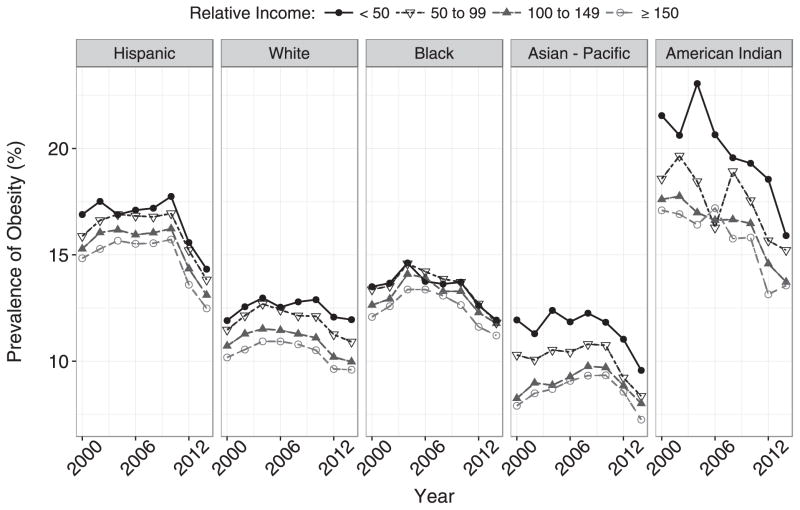
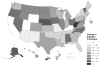
The overall prevalence of high weight-for-length increased from 13.4% in 2000 to 14.5% in 2004, remained constant until 2010, and then decreased by >2 percentage points (to 12.3%) through 2014. The prevalence of high weight-for-length was associated with sex (higher among boys), race-ethnicity (highest among American Indians/Alaskan Natives), and with both age (positive) and family income (inverse). The secular trends, however, were fairly similar within categories of these variables. From 2010 to 2014, the prevalence of high weight-for-length decreased in 40 states and 3 (of 5) US territories, with the largest decreases seen in Puerto Rico (−9 percentage points) and Kentucky (−7 percentage points), and the largest increase (+2 percentage points) seen in West Virginia.
CONCLUSIONS
Although the current results cannot be considered representative of infants in the populations, the prevalence of a high weight-for-length has decreased among infants in WIC-PC since 2010. These decreases were similar across categories of most characteristics, but there were substantial differences across jurisdictions, possibly reflecting differences in policy and local programs that target maternal and infant health.
-
Subjects:
-
Source:Pediatrics. 139(1)
-
Pubmed ID:27965380
-
Pubmed Central ID:PMC5359001
-
Document Type:
-
Funding:
-
Volume:139
-
Issue:1
-
Collection(s):
-
Main Document Checksum:urn:sha256:fd5c0ffb6ca4afafb7ce3ca503ac96b35463b3444b05d67d61280882cbf85f59
-
Download URL:
-
File Type:
 [PDF
- 650.34 KB
]
[PDF
- 650.34 KB
]
Supporting Files


File Language:
English
ON THIS PAGE



CDC STACKS serves as an archival repository of CDC-published products including
scientific findings,
journal articles, guidelines, recommendations, or other public health information authored or
co-authored by CDC or funded partners.
As a repository, CDC STACKS retains documents in their original published format to ensure public access to scientific information.
As a repository, CDC STACKS retains documents in their original published format to ensure public access to scientific information.
You May Also Like
COLLECTION
CDC Public Access