



Malondialdehyde-Acetaldehyde (MAA) Adducted Surfactant Protein Induced Lung Inflammation is Mediated Through Scavenger Receptor A (SR-A1)
Supporting Files
Peer Reviewed

-
2017/02/13
-
Available in CDC Stacks on February 13, 2017, 12:00 AM
File Language:
English
Details
-
Journal Article:Respiratory Research
-
Personal Author:
-
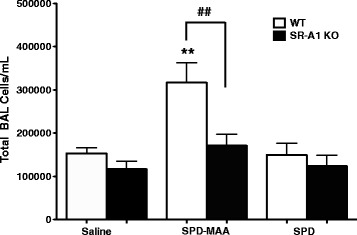
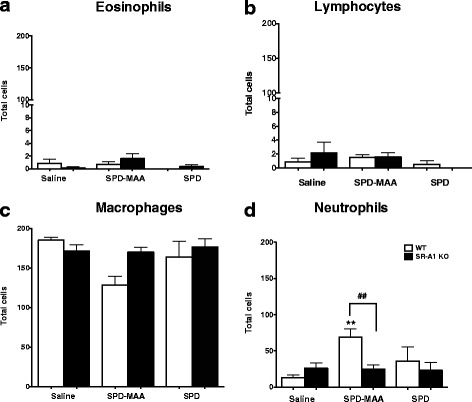
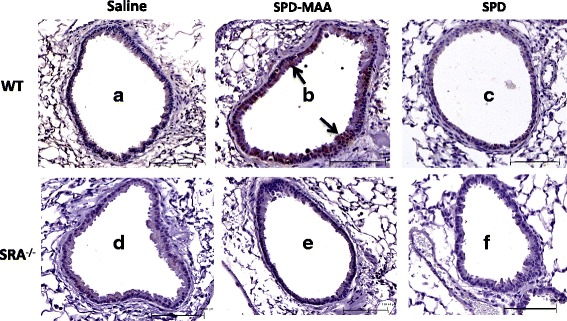
Description:BACKGROUND: Co-exposure to cigarette smoke and alcohol leads to the generation of high concentrations of acetaldehyde and malondialdehyde in the lung. These aldehydes being highly electrophilic in nature react with biologically relevant proteins such as surfactant protein D (SPD) through a Schiff base reaction to generate SPD adducted malondialdehyde-acetaldehyde adduct (SPD-MAA) in mouse lung. SPD-MAA results in an increase in lung pro-inflammatory chemokine, keratinocyte chemoattractant (KC), and the recruitment of lung lavage neutrophils. Previous in vitro studies in bronchial epithelial cells and macrophages show that scavenger receptor A (SR-A1/CD204) is a major receptor for SPD-MAA. No studies have yet examined the in vivo role of SR-A1 in MAA-mediated lung inflammation. Therefore, we hypothesize that in the absence of SR-A1, MAA-induced inflammation in the lung is reduced or diminished. METHODS: To test this hypothesis, C57BL/6 WT and SR-A1 KO mice were nasally instilled with 50 ug/mL of SPD-MAA for 3 weeks (wks). After 3 weeks, bronchoalveolar lavage (BAL) fluid was collected and assayed for a total cell count, a differential cell count and CXCL1 (KC) chemokine. Lung tissue sections were stained with hematoxylin and eosin (H&E) and antibodies to MAA adduct. RESULTS: Results showed that BAL cellularity and influx of neutrophils were decreased in SR-A1 KO mice as compared to WT following repetitive SPD-MAA exposure. MAA adduct staining in the lung epithelium was decreased in SR-A1 KO mice. In comparison to WT, no increase in CXCL1 was observed in BAL fluid from SR-A1 KO mice over time. CONCLUSIONS: Overall, the data demonstrate that SR-A1/CD204 plays an important role in SPD-MAA induced inflammation in lung. Description provided by NIOSH
-
Subjects:
-
Keywords:
-
Source:Respir Res 2017 Feb; 18:36
-
ISSN:1465-9921
-
Pubmed ID:28193223
-
Pubmed Central ID:PMC5307820
-
Document Type:
-
Funding:
-
Genre:
-
Place as Subject:
-
CIO:
-
Topic:
-
Location:
-
Pages in Document:10 pdf pages
-
Volume:18
-
NIOSHTIC Number:nn:20049378
-
Contact Point Address:Todd A. Wyatt, Department of Environmental, Agricultural and Occupational Health, College of Public Health, Nebraska Medical Center, University of Nebraska Medical Center, 985910, Omaha, NE 68198-5910
-
Email:twyatt@unmc.edu
-
CAS Registry Number:
-
Federal Fiscal Year:2017
-
NORA Priority Area:
-
Performing Organization:University of Nebraska Medical Center - Omaha
-
Peer Reviewed:True
-
Download URL:
-
File Type:
 [PDF - 1.45 MB]
 -
Collection(s):
-
Main Document Checksum:urn:sha-512:e7aaedd167d399726ea98eeaf5873e9e2e282abb504ba7e4fa44caa539c58ed02b2de54af57d4208b18abb966dc4c336c569bcce1cb5d454a272bbf7166b53e6
Supporting Files


File Language:
English
 Was this page helpful?
 Found an issue?







CDC STACKS serves as an archival repository of CDC-published products including
scientific findings, journal articles, guidelines, recommendations, or other public health information authored or
co-authored by CDC or funded partners.
As a repository, CDC STACKS retains documents in their original published format to ensure public access to scientific information.
As a repository, CDC STACKS retains documents in their original published format to ensure public access to scientific information.
You May Also Like