


Adapting Nepal’s polio eradication programme
Supporting Files
Public Domain

-
Nov 25 2016
-
Details
-
Alternative Title:Bull World Health Organ
-
Personal Author:
-
Description:Problem
Many countries have weak disease surveillance and immunization systems. The elimination of polio creates an opportunity to use staff and assets from the polio eradication programme to control other vaccine-preventable diseases and improve disease surveillance and immunization systems.
Approach
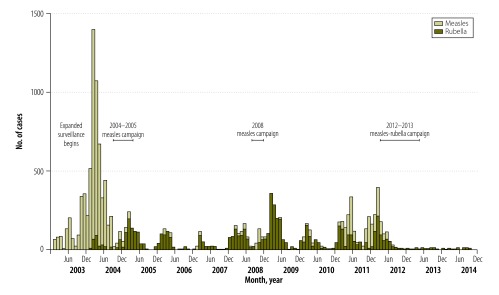
In 2003, the active surveillance system of Nepal’s polio eradication programme began to report on measles and neonatal tetanus cases. Japanese encephalitis and rubella cases were added to the surveillance system in 2004. Staff from the programme aided the development and implementation of government immunization policies, helped launch vaccination campaigns, and trained government staff in reporting practices and vaccine management.
Local setting
Nepal eliminated indigenous polio in 2000, and controlled outbreaks caused by polio importations between 2005 and 2010.
Relevant changes
In 2014, the surveillance activities had expanded to 299 sites, with active surveillance for measles, rubella and neonatal tetanus, including weekly visits from 15 surveillance medical officers. Sentinel surveillance for Japanese encephalitis consisted of 132 sites. Since 2002, staff from the eradication programme have helped to introduce six new vaccines and helped to secure funding from Gavi, the Vaccine Alliance. Staff have also assisted in responding to other health events in the country.
Lesson learnt
By expanding the activities of its polio eradication programme, Nepal has improved its surveillance and immunization systems and increased vaccination coverage of other vaccine-preventable diseases. Continued donor support, a close collaboration with the Expanded Programme on Immunization, and the retention of the polio eradication programme’s skilled workforce were important for this expansion.
-
Subjects:
-
Source:Bull World Health Organ. 2017; 95(3):227-232.
-
Pubmed ID:28250536
-
Pubmed Central ID:PMC5328109
-
Document Type:
-
Volume:95
-
Issue:3
-
Collection(s):
-
Main Document Checksum:urn:sha256:db26659e85176ab8f612f736acb32461e527dd99ae0bfffbdc885893704667a6
-
Download URL:
-
File Type:
 [PDF
- 386.09 KB
]
[PDF
- 386.09 KB
]
Supporting Files


ON THIS PAGE


CDC STACKS serves as an archival repository of CDC-published products including
scientific findings,
journal articles, guidelines, recommendations, or other public health information authored or
co-authored by CDC or funded partners.
As a repository, CDC STACKS retains documents in their original published format to ensure public access to scientific information.
As a repository, CDC STACKS retains documents in their original published format to ensure public access to scientific information.
You May Also Like
COLLECTION
CDC Public Access