



Health-care access among adults with epilepsy: The U.S. National Health Interview Survey, 2010 and 2013✩
Supporting Files

-
2 2016 ; 2-2016
-
Available in CDC Stacks on February 20, 2017, 12:00 AM
File Language:
English
Details
-
Alternative Title:Epilepsy Behav
-
Personal Author:
-
Description:Introduction
Community-based and other epidemiologic studies within the United States have identified substantial disparities in health care among adults with epilepsy. However, few data analyses addressing their health-care access are representative of the entire United States. This study aimed to examine national survey data about adults with epilepsy and to identify barriers to their health care.
Materials and methods
We analyzed data from U.S. adults in the 2010 and the 2013 National Health Interview Surveys, multistage probability samples with supplemental questions on epilepsy. We defined active epilepsy as a history of physician-diagnosed epilepsy either currently under treatment or accompanied by seizures during the preceding year. We employed SAS-callable SUDAAN software to obtain weighted estimates of population proportions and rate ratios (RRs) adjusted for sex, age, and race/ethnicity.
Results
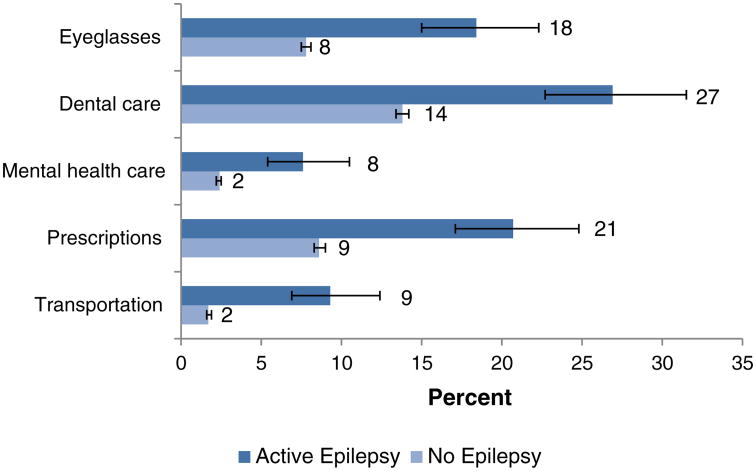
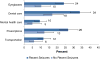
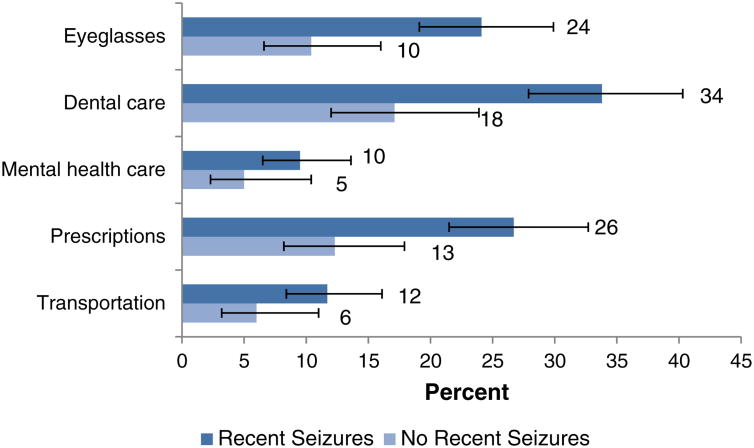
Compared to adults reporting no history of epilepsy, adults reporting active epilepsy were significantly more likely to be insured under Medicaid (RR = 3.58) and less likely to have private health insurance (RR = 0.58). Adults with active epilepsy were also less likely to be employed (RR = 0.53) and much more likely to report being disabled (RR = 6.14). They experience greater barriers to health-care access including an inability to afford medication (RR = 2.40), mental health care (RR = 3.23), eyeglasses (RR = 2.36), or dental care (RR = 1.98) and are more likely to report transportation as a barrier to health care (RR = 5.28).
Conclusions
These reported substantial disparities in, and barriers to, access to health care for adults with active epilepsy are amenable to intervention. -
Subjects:
-
Keywords:
-
Source:Epilepsy Behav. 55:184-188
-
Pubmed ID:26627980
-
Pubmed Central ID:PMC5317396
-
Document Type:
-
Funding:
-
Volume:55
-
Download URL:
-
File Type:
 [PDF - 610.53 KB]
 -
Collection(s):
-
Main Document Checksum:urn:sha256:32d581348bc9853f496b5df54c2edd95aac3e069c444d4ba2ee15329f523f567
Supporting Files


File Language:
English
 Was this page helpful?
 Found an issue?

CDC STACKS serves as an archival repository of CDC-published products including
scientific findings, journal articles, guidelines, recommendations, or other public health information authored or
co-authored by CDC or funded partners.
As a repository, CDC STACKS retains documents in their original published format to ensure public access to scientific information.
As a repository, CDC STACKS retains documents in their original published format to ensure public access to scientific information.
You May Also Like
COLLECTION
CDC Public Access