



to Health Care Resource Utilization: an Analytic Approach
Supporting Files

-
Mar 2017
-
Available in CDC Stacks on March 01, 2018, 12:00 AM
File Language:
English
Details
-
Alternative Title:Med Care
-
Personal Author:
-
Description:Background
Multimorbidity affects the majority of elderly adults and is associated with higher health costs and utilization, but how specific patterns of morbidity influence resource use is less understood.
Objective
To identify specific combinations of chronic conditions, functional limitations, and geriatric syndromes associated with direct medical costs and inpatient utilization.
Design
Retrospective cohort study using the Health and Retirement Study (2008–2010) linked to Medicare claims. Analysis used machine learning techniques: classification and regression trees (CART) and random forest.
Subjects
A population-based sample of 5,771 Medicare-enrolled adults age 65 and older in the United States.
Measures
Main covariates: self-reported chronic conditions (measured as none, mild, or severe), geriatric syndromes, and functional limitations. Secondary covariates: demographic, social, economic, behavioral, and health status measures. Outcomes: Medicare expenditures in the top quartile and inpatient utilization.
Results
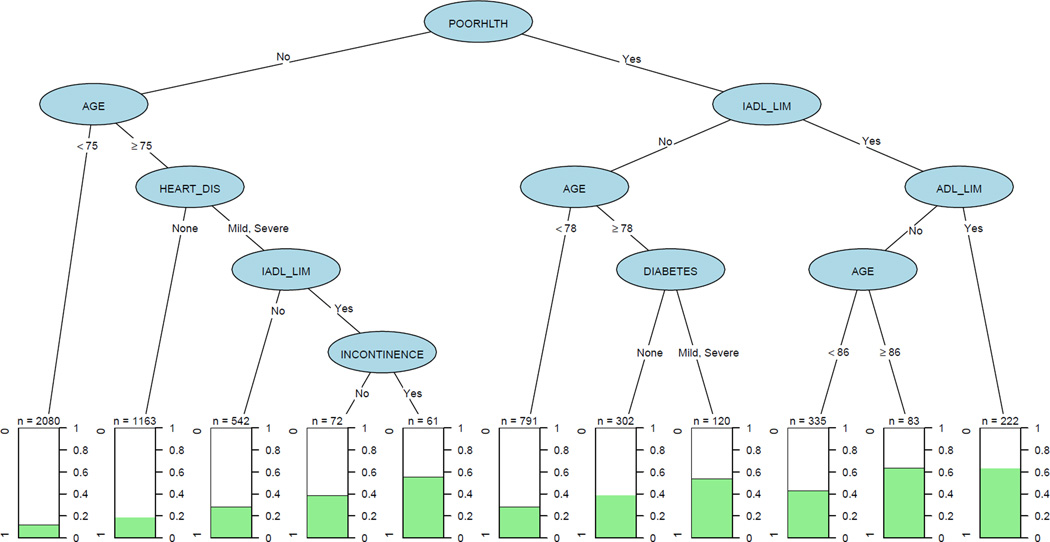
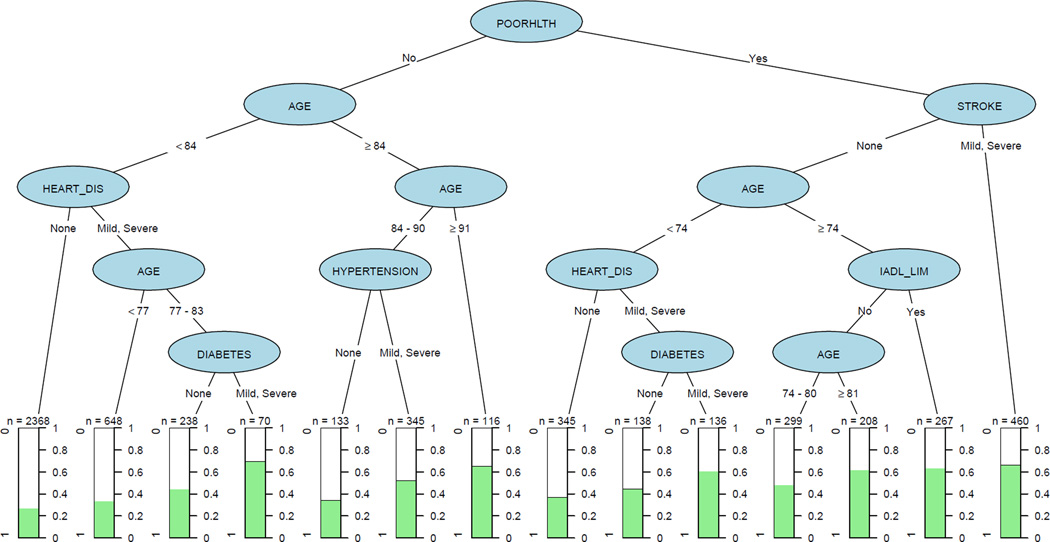
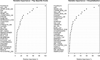
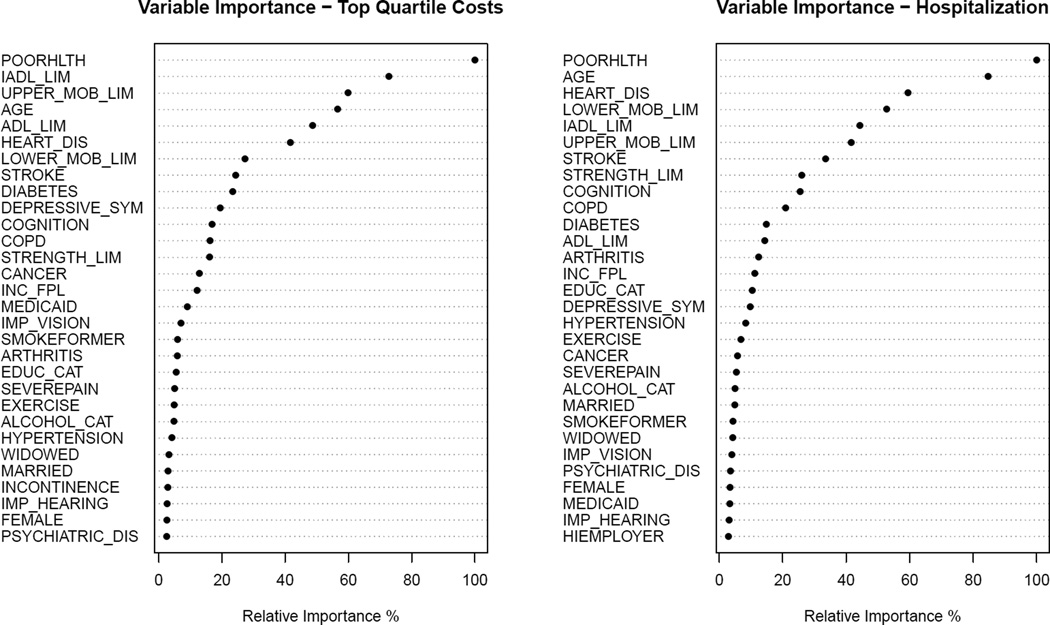
Median annual expenditures were $4,354, and 41% were hospitalized within two-years. The tree model shows some notable combinations: 64% of those with self-rated poor health plus ADL and IADL disabilities had expenditures in the top quartile. Inpatient utilization was highest (70%) in those age 77 – 83 with mild to severe heart disease plus mild to severe diabetes. Functional limitations were more important than many chronic diseases in explaining resource use.
Conclusions
The multimorbid population is heterogeneous and there is considerable variation in how specific combinations of morbidity influence resource use. Modeling the conjoint effects of chronic conditions, functional limitations, and geriatric syndromes can advance understanding of groups at greatest risk and inform targeted tailored interventions aimed at cost-containment. -
Subjects:
-
Source:Med Care. 55(3):276-284.
-
Pubmed ID:27753745
-
Pubmed Central ID:PMC5309172
-
Document Type:
-
Funding:
-
Place as Subject:
-
Volume:55
-
Issue:3
-
Download URL:
-
File Type:
 [PDF - 1.11 MB]
 -
Collection(s):
-
Main Document Checksum:urn:sha256:a346471b6e39d5cf856c3e09b662d6e5bb5b631e500345bfcc8befae2ca25419
Supporting Files


File Language:
English
 Was this page helpful?
 Found an issue?


CDC STACKS serves as an archival repository of CDC-published products including
scientific findings, journal articles, guidelines, recommendations, or other public health information authored or
co-authored by CDC or funded partners.
As a repository, CDC STACKS retains documents in their original published format to ensure public access to scientific information.
As a repository, CDC STACKS retains documents in their original published format to ensure public access to scientific information.
You May Also Like
COLLECTION
CDC Public Access