



Conceptualizing the Dynamics of Workplace Stress: A Systems-Based Study of Nursing Aides
Supporting Files
Peer Reviewed

-
2017/01/05
-
Available in CDC Stacks on January 05, 2017, 12:00 AM
File Language:
English
Details
-
Journal Article:BMC Health Services Research
-
Personal Author:
-
Corporate Authors:
-
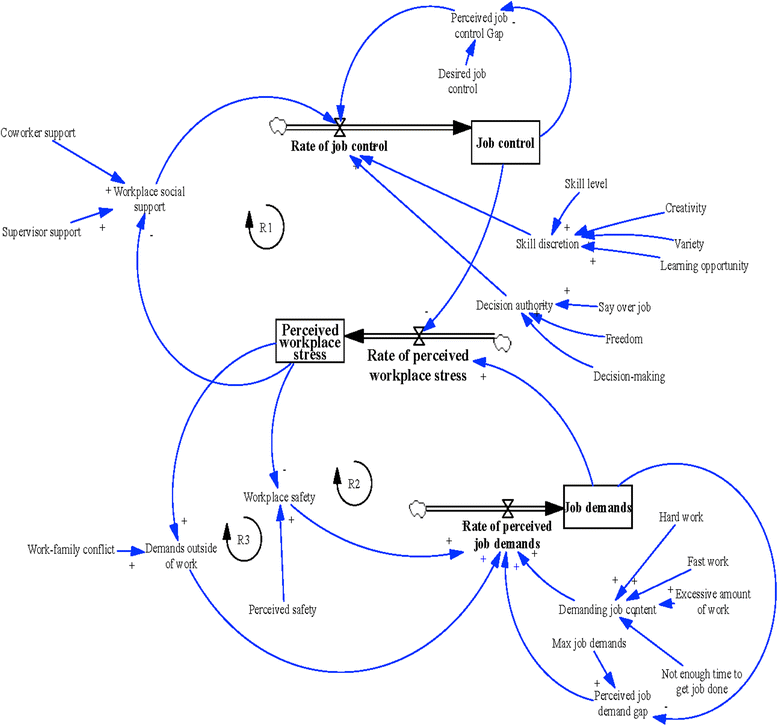
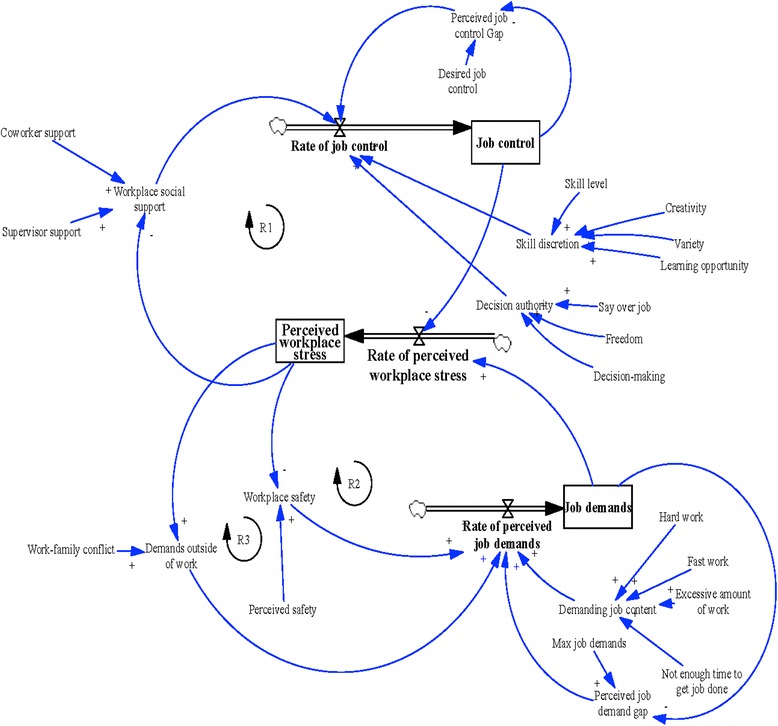
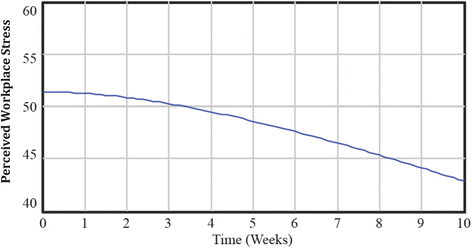
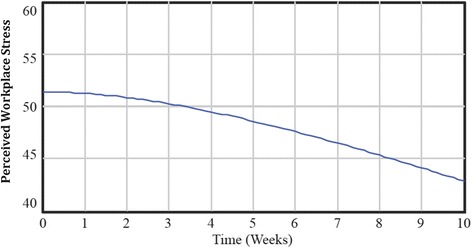
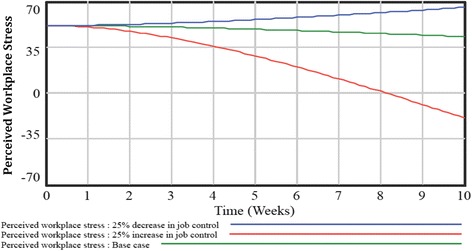
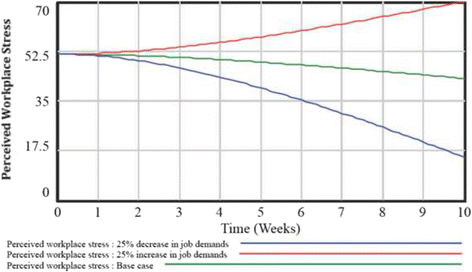
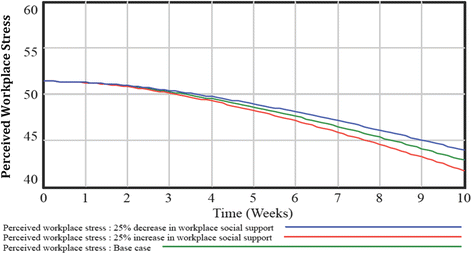
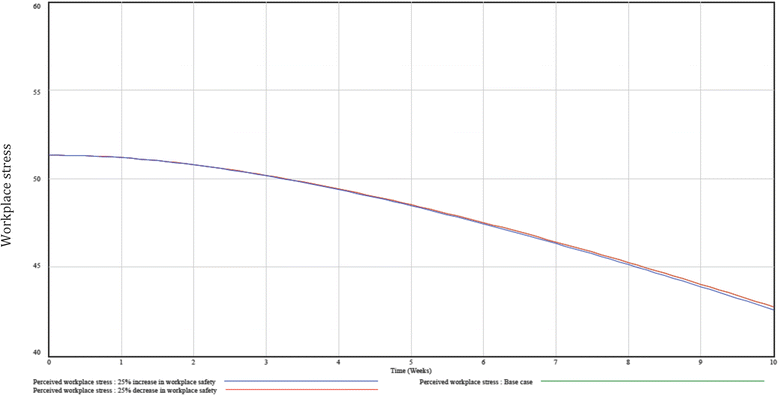
Description:Background: Workplace stress is a complex phenomenon that may often be dynamic and evolving over time. Traditional linear modeling does not allow representation of recursive feedback loops among the implicated factors. The objective of this study was to develop a multidimensional system dynamics model (SDM) of workplace stress among nursing aides and conduct simulations to illustrate how changes in psychosocial perceptions and workplace factors might influence workplace stress over time. Methods: Eight key informants with prior experience in a large study of US nursing home workers participated in model building. Participants brainstormed the range of components related to workplace stress. Components were grouped together based on common themes and translated into feedback loops. The SDM was parameterized through key informant insight on the shape and magnitude of the relationship between model components. Model construction was also supported utilizing survey data collected as part of the larger study. All data was entered into the software program, Vensim. Simulations were conducted to examine how adaptations to model components would influence workplace stress. Results: The SDM included perceptions of organizational conditions (e.g., job demands and job control), workplace social support (i.e., managerial and coworker social support), workplace safety, and demands outside of work (i.e. work-family conflict). Each component was part of a reinforcing feedback loop. Simulations exhibited that scenarios with increasing job control and decreasing job demands led to a decline in workplace stress. Within the context of the system, the effects of workplace social support, workplace safety, and work-family conflict were relatively minor. Conclusion: SDM methodology offers a unique perspective for researchers and practitioners to view workplace stress as a dynamic process. The portrayal of multiple recursive feedback loops can guide the development of policies and programs within complex organizational contexts with attention both to interactions among causes and avoidance of adverse unintended consequences. While additional research is needed to further test the modeling approach, findings might underscore the need to direct workplace interventions towards changing organizational conditions for nursing aides. Description provided by NIOSH
-
Subjects:
-
Keywords:
-
Source:BMC Health Serv Res 2017 Jan; 17(1):12
-
ISSN:1472-6963
-
Pubmed ID:28056973
-
Pubmed Central ID:PMC5216606
-
Document Type:
-
Funding:
-
Genre:
-
Place as Subject:
-
CIO:
-
Topic:
-
Location:
-
Pages in Document:11 pdf pages
-
Volume:17
-
Issue:1
-
NIOSHTIC Number:nn:20049251
-
Contact Point Address:Arif Jetha, Department of Work Environment, University of Massachusetts Lowell, Lowell, MA, USA
-
Email:AJetha@iwh.on.ca
-
Federal Fiscal Year:2017
-
NORA Priority Area:
-
Performing Organization:University of Massachusetts, Lowell
-
Peer Reviewed:True
-
Download URL:
-
File Type:
 [PDF - 1.23 MB]
 -
Collection(s):
-
Main Document Checksum:urn:sha-512:9cf6e5d002f42e1efe8423f3afc79035c752dd78fe8dfd0b4bb788d12f7d845472f91dae85d0ef583c8c9caa47a7c2e159585f97882790b8e65082fc2cb1eda4
Supporting Files


File Language:
English
 Was this page helpful?
 Found an issue?






CDC STACKS serves as an archival repository of CDC-published products including
scientific findings, journal articles, guidelines, recommendations, or other public health information authored or
co-authored by CDC or funded partners.
As a repository, CDC STACKS retains documents in their original published format to ensure public access to scientific information.
As a repository, CDC STACKS retains documents in their original published format to ensure public access to scientific information.
You May Also Like