



The Prevalence of Low Serum Vitamin B-12 Status in the Absence of Anemia or Macrocytosis Did Not Increase among Older U.S. Adults after Mandatory Folic Acid Fortification123
Supporting Files

-
2 2014 ; 2-2014
-
Available in CDC Stacks on February 03, 2017, 12:00 AM
File Language:
English
Details
-
Alternative Title:J Nutr
-
Personal Author:
-
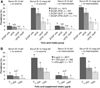
Description:Whether folic acid fortification and supplementation at the population level have led to a higher prevalence of vitamin B-12 deficiency in the absence of anemia remains to be examined among a nationally representative sample of older U.S. adults. We assessed the prevalence of low vitamin B-12 status in the absence of anemia or macrocytosis before and after fortification among adults aged >50 y using cross-sectional data from the NHANES 1991-1994 (prefortification) and 2001-2006 (postfortification). We compared the prefortification and postfortification prevalence of multiple outcomes, including serum vitamin B-12 deficiency (<148 pmol/L) and marginal deficiency (148-258 pmol/L) with and without anemia (hemoglobin <130 g/L for men, <120 g/L for women) and with and without macrocytosis (mean cell volume >100 fL) using multinomial logistic regression, adjusting for age, sex, ethnicity, body mass index, C-reactive protein, and vitamin B-12 supplement use. Prefortification and postfortification serum vitamin B-12 deficiency without anemia 4.0 vs. 3.9%; adjusted prevalence ratio (aPR) (95% CI): 0.98 (0.67, 1.44) or without macrocytosis 4.2 vs. 4.1%; aPR (95% CI): 0.96 (0.65, 1.43) remained unchanged. Marginal deficiency without anemia 25.1 vs. 20.7%; aPR (95% CI): 0.82 (0.72, 0.95) or without macrocytosis 25.9 vs. 21.3%; aPR (95% CI): 0.82 (0.72, 0.94) were both significantly lower after fortification. After fortification, higher folic acid intake was associated with a lower prevalence of low serum B-12 status in the absence of anemia or macrocytosis. Results suggest that the prevalence of low serum B-12 status in the absence of anemia or macrocytosis among older U.S. adults did not increase after fortification. Thus, at the population level, we found no evidence to support concerns that folic acid adversely affected the clinical presentation of vitamin B-12 deficiency among older adults.
-
Keywords:
-
Source:J Nutr. 144(2):170-176
-
Pubmed ID:24306216
-
Pubmed Central ID:PMC5291239
-
Document Type:
-
Funding:
-
Volume:144
-
Issue:2
-
Download URL:
-
File Type:
 [PDF - 780.10 KB]
 -
Collection(s):
-
Main Document Checksum:urn:sha256:7539e8d6d070d3adfc4b3aaf08f7b6ad63c8c4fdbbcf7725c8842a0cfb96479a
Supporting Files


File Language:
English
 Was this page helpful?
 Found an issue?



CDC STACKS serves as an archival repository of CDC-published products including
scientific findings, journal articles, guidelines, recommendations, or other public health information authored or
co-authored by CDC or funded partners.
As a repository, CDC STACKS retains documents in their original published format to ensure public access to scientific information.
As a repository, CDC STACKS retains documents in their original published format to ensure public access to scientific information.
You May Also Like
COLLECTION
CDC Public Access