


Development of a Job-Task-Exposure Matrix to assess occupational exposure to disinfectants among U.S. nurses
Supporting Files

-
Aug 26 2016
-
File Language:
English
Details
-
Alternative Title:Occup Environ Med
-
Personal Author:Quinot, C ; Dumas, O ; Henneberger, PK ; Varraso, R ; Wiley, AS ; Speizer, FE ; Goldberg, M ; Zock, JP ; Camargo, CA ; Le Moual, N
-
Description:Objectives
Occupational exposure to disinfectants is associated with work-related asthma, especially in healthcare workers. However, little is known about the specific products involved. To evaluate disinfectant exposures, we designed job-exposure (JEM) and job-task-exposure (JTEM) matrices, which are thought to be less prone to differential misclassification bias than self-reported exposure. We then compared the three assessment methods: self-reported exposure, JEM, and JTEM.
Methods
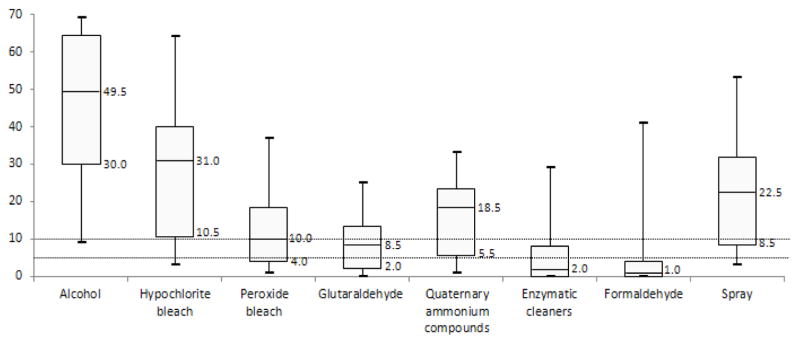
Disinfectant use was assessed by an occupational questionnaire in 9,073 U.S. female registered nurses without asthma, aged 49–68 years, drawn from the Nurses’ Health Study II. A JEM was created based on self-reported frequency of use (1–3, 4–7 days/week) of 7 disinfectants and sprays in 8 nursing jobs. We then created a JTEM combining jobs and disinfection tasks to further reduce misclassification. Exposure was evaluated in 3 classes (low, medium, high) using product-specific cut-offs (e.g., <30%, 30–49.9%, ≥50%, respectively, for alcohol); the cut-offs were defined from the distribution of self-reported exposure per job/task.
Results
The most frequently reported disinfectants were alcohol (weekly use: 39%), bleach (22%) and sprays (20%). More nurses were classified as highly exposed by JTEM (alcohol 41%, sprays 41%, bleach 34%) than by JEM (21%, 30%, 26%, respectively). Agreement between JEM and JTEM was fair-to-moderate (kappa: 0.3–0.5) for most disinfectants. JEM and JTEM exposure estimates were heterogeneous in most nursing jobs, except in emergency room and education/administration.
Conclusion
The JTEM may provide more accurate estimates than the JEM, especially for nursing jobs with heterogeneous tasks. Use of the JTEM is likely to reduce exposure misclassification.
-
Subjects:
-
Source:Occup Environ Med. 74(2):130-137.
-
Pubmed ID:27566782
-
Pubmed Central ID:PMC5237395
-
Document Type:
-
Funding:
-
Place as Subject:
-
Volume:74
-
Issue:2
-
Collection(s):
-
Main Document Checksum:urn:sha256:b454a79605e3aa933924781ee3eb56558e94b7d399b2bef1b3eaeee94f3027dc
-
Download URL:
-
File Type:
 [PDF
- 609.70 KB
]
[PDF
- 609.70 KB
]
Supporting Files


File Language:
English
ON THIS PAGE


CDC STACKS serves as an archival repository of CDC-published products including
scientific findings,
journal articles, guidelines, recommendations, or other public health information authored or
co-authored by CDC or funded partners.
As a repository, CDC STACKS retains documents in their original published format to ensure public access to scientific information.
As a repository, CDC STACKS retains documents in their original published format to ensure public access to scientific information.
You May Also Like
COLLECTION
CDC Public Access