


Spatial Stability of Adult Aedes aegypti Populations
Supporting Files
Public Domain

-
Dec 2011
File Language:
English
Details
-
Alternative Title:Am J Trop Med Hyg
-
Personal Author:
-
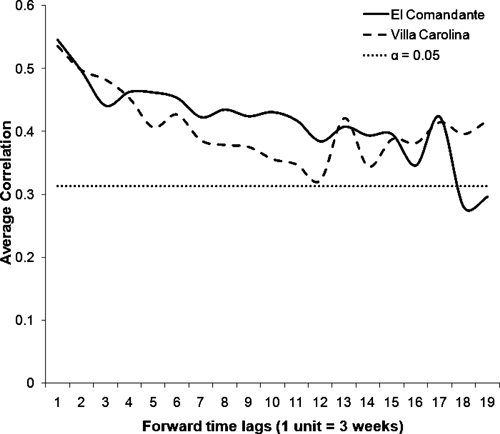
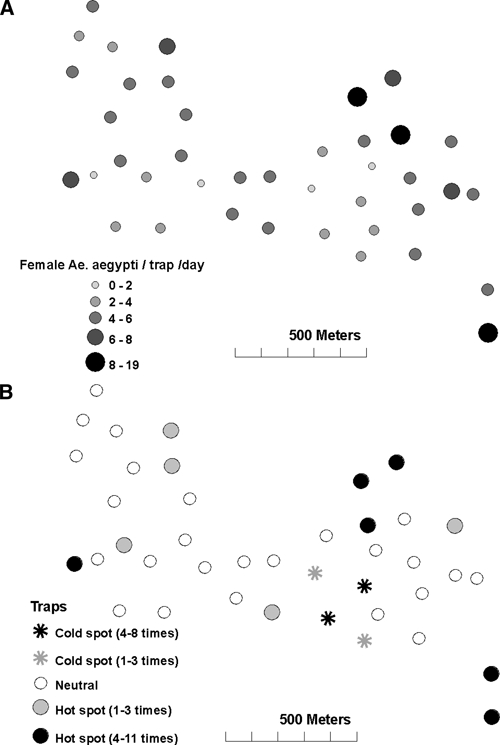
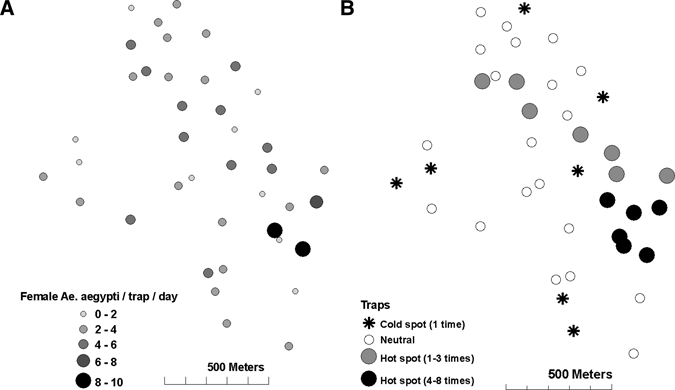
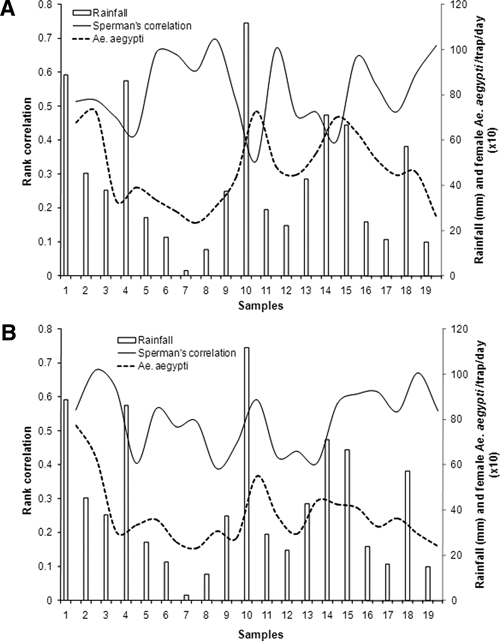
Description:Vector control programs could be more efficient by identifying the location of highly productive sites of Aedes aegypti. This study explored if the number of female adults of Ae. aegypti in BG-Sentinel traps was clustered and if their spatial distribution changed in time in two neighborhoods in San Juan, Puerto Rico. Traps were uniformly distributed across each neighborhood (130 m from each other), and samples were taken every 3 weeks. Global and local spatial autocorrelations were explored. Spatial stability existed if the rank order of trap captures was kept in time. There was lack of global autocorrelation in both neighborhoods, precluding their stratification for control purposes. Hot and cold spots were identified, revealing the highly focal nature of Ae. aegypti. There was significant spatial stability throughout the study in both locations. The consistency in trap productivity in time could be used to increase the effectiveness of vector and dengue control programs.
-
Subjects:
-
Source:Am J Trop Med Hyg. 2011; 85(6):1087-1092.
-
Document Type:
-
Place as Subject:
-
Volume:85
-
Issue:6
-
Collection(s):
-
Main Document Checksum:urn:sha256:f697af7ca125d80f1a76d119f828b625f4344c4133a9bdd25335e02a580108c9
-
Download URL:
-
File Type:
 [PDF
- 676.45 KB
]
[PDF
- 676.45 KB
]
Supporting Files


File Language:
English
ON THIS PAGE

CDC STACKS serves as an archival repository of CDC-published products including
scientific findings,
journal articles, guidelines, recommendations, or other public health information authored or
co-authored by CDC or funded partners.
As a repository, CDC STACKS retains documents in their original published format to ensure public access to scientific information.
As a repository, CDC STACKS retains documents in their original published format to ensure public access to scientific information.
You May Also Like
COLLECTION
CDC Public Access